 Μake us preferred on Google
Women strangled. Women shot. Women beaten to death. Women dismembered and stuffed into suitcases. Women murdered by husbands or partners whose warped sense of masculinity cannot accept that a woman can live her own life, make her own decisions or leave whenever she wants or needs to. Men who have learned to see women as just another possession.
Femicides are happening around us, constantly sounding the alarm about what is going on in our society. They occur almost every day, not only on November 25, the International Day for the Elimination of Violence Against Women.
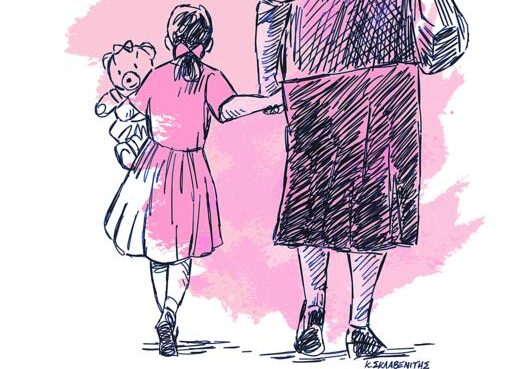
But women are not the only victims of these perpetrators. Their children are also left behind, facing one of the most complex forms of traumatic grief. Their circumstances may make their cases even more complicated and difficult to manage than those of the hundreds or thousands of abandoned or abused children many of whom remain in hospitals or even police stations because appropriate facilities and care are unavailable.
What happens next to the “children of femicide”? Who takes responsibility for their care? Does the state have a protection network that guarantees psychological care, social support and financial assistance, allowing them to grow up in the safest and most protected environment possible?
The lasting impact of trauma
“The child does not simply lose their mother. When the perpetrator is the father, they effectively lose their second parent as well, while often having to change homes, schools and family environments. In a very short period, the entire world they have known can collapse,” psychologist Stefanos Alevizos says.
“International research describes intense grief, fear, insecurity, anger, guilt and shame. The conflicting emotions toward the father are particularly difficult. A child may love him while simultaneously fearing him or feeling angry with him. They may even wonder whether they could have prevented what happened,” he adds.
Alevizos also points out that “the social stigma and silence surrounding what happened within the family can reinforce isolation and make it harder for children to express their feelings.”
He explains that “difficulties with trust, forming secure emotional bonds and intimacy have been documented. As they grow older, some children may fear abandonment, struggle to trust a partner or feel that close relationships conceal dangers.” There is also “an increased risk of post-traumatic stress, depression and other mental health difficulties.”
Nevertheless, he concludes, “the care a child receives afterward can be a powerful antidote. What matters most, therefore, is not only what the child has experienced, but also what they encounter next: whether they find people who can listen to them, protect them and support them, not just during the first few weeks but in the years that follow. Trauma can resurface at different stages of life, and the need for support changes as the child grows.”
The nonexistent support network
“AEGIS: Recording and documenting lethal gender-based and domestic violence against children and adults. A qualitative investigation of lived experiences and their impact.” This is the title of a research project examining the effects of femicide on the children of victims. It covers all children who are “victims” of lethal violence within a couple, although women make up the overwhelming majority of those killed.
As Konstantina Sklavou, the research project’s lead and an associate professor in the Department of Social Work at the University of West Attica, explains, “the lived experiences of survivors, their support needs, and their paths to recovery and social reintegration remain largely unexplored in Greece.”
Does such a protection network actually exist and function?
“There is no tool, no management protocol and no specialized service capable of supporting these children over the long term. Naturally, their legal rights are not safeguarded either,” Sklavou stresses. “The assistance people receive is fragmented. Sometimes it comes from public services, sometimes from NGOs. But it is not provided through a specific, targeted model of support.”
Stefanos Alevizos, a key member of the research team, also highlights the absence of an organized protection network, particularly when it comes to psychological support.
“There does not appear to be a unified, specialized system to support children from the moment immediately following a femicide and throughout the years that follow. This means that not every child is guaranteed immediate intervention by a child psychologist, appropriate preparation and protection during legal proceedings, or systematic psychological follow-up over the long term.”
What if relatives are not “available”?
What happens when there is no caregiver available within a child’s immediate family, or when a relative is deemed unsuitable to assume custody and raise the child?
Lawyer Kleio Papapantoleon explains that, in such cases, “the children will initially be taken to a children’s hospital and then transferred to some kind of care facility. You can therefore understand the multiple shocks such a child experiences: they do not simply lose both parents in an instant, but also lose the life they knew until then and all their points of reference.”
The children’s financial interests are also not protected. Current legislation does not provide for financial compensation, despite the existence of Law 3811/2009.
“The provisions of this law refer to victims. The minor children of homicide victims are not considered victims in the technical legal sense of the term, even if they were parties to the trial. In any case, the law’s eligibility requirements are particularly restrictive, which is why it is rarely applied,” she says.
“What is needed is planning and strategy, people to implement them — particularly specialists when dealing with such complex trauma — and, of course, funding. If each municipality has one or two social workers expected to respond to a wide range of cases, from child neglect and hygiene and living conditions in a home to the children we are discussing, you can understand that talking about adequate protection is almost laughable,” the lawyer stresses.
What is certain is that this is yet another problem happening “right beside us.” Closing our eyes to it is not a solution.
The grandmother who was forced to become a mother
“I woke up one morning and I was simply the mother of Erato, who had been murdered. That is who I am. I no longer have a name,” Eleni Kremastioti says, describing the tragic loss of her 24-year-old daughter, who was murdered by her estranged husband in 2019.
“Now I have to take on the role of a mother, because, sadly, her mother is no longer here. It is incredibly difficult because you are trying to cope with the loss of your own child, while also dealing with the loss of a mother for that child.”
How did she tell her granddaughter, who is now 10, the painful truth?
“Every time she asked me, ‘Where is Mommy?’ I would cry. At first, I would tell her, ‘She isn’t here; she can’t come.’ Then, one day, when we were leaving the island shortly before Christmas, I had her in her stroller. She was a little girl, two and a half, almost three years old. We were going to the supermarket when she said, ‘I want to go to Mommy.’ I told her, ‘You can’t, sweetheart. It’s not possible.’ She asked, ‘Why?’ And I told her, ‘Because she died.’ My tears were streaming like rivers. She turned around in her stroller and said to me, ‘Don’t cry, don’t cry. Please don’t cry.’”
With the help of a child psychologist, Kremastioti is raising her granddaughter while trying to nurture love rather than hatred, even toward the man who murdered the girl’s mother.
“We told her that Mommy died because someone hurt her. And when she asked about her father, we told her that he was locked up somewhere because he had done something very bad.”
She adds: “I consult both the child psychologist she sees and my own psychologist, giving her the answer they have advised me to give. ‘No, sweetheart, Daddy is not bad. He did something very bad.’”
“I desperately want to fulfill the wish and promise I made to my daughter: that if anything happened to her, I would raise her child myself. And I am trying to do what is best for her (…) I want the little girl to be healthy, lucky, blessed, and never to lose her optimism or her trust in people. I want her to have love within her, as she already does, and to share it generously.”
And what is the state doing? Where is it?
“My child was just a number to the state. That number ceased to exist the moment the Supreme Court of Greece issued its final ruling and closed her case file. The authorities do not even know that this child exists, and all the efforts we make are carried out privately.”