 Μake us preferred on Google
Forty years after the Iran-Contra scandal exposed blatant abuses of power by the White House, the story of those secret operations still echoes in Washington. At its core, the affair was not simply a diplomatic misadventure. It was a systematic effort by the Reagan administration to get around the constitutionally guaranteed powers of Congress. Today, as American democracy is once again tested by the concentration of power, the lessons of that dark period seem more relevant than ever.
The ‘Bombshell’ of November 25, 1986
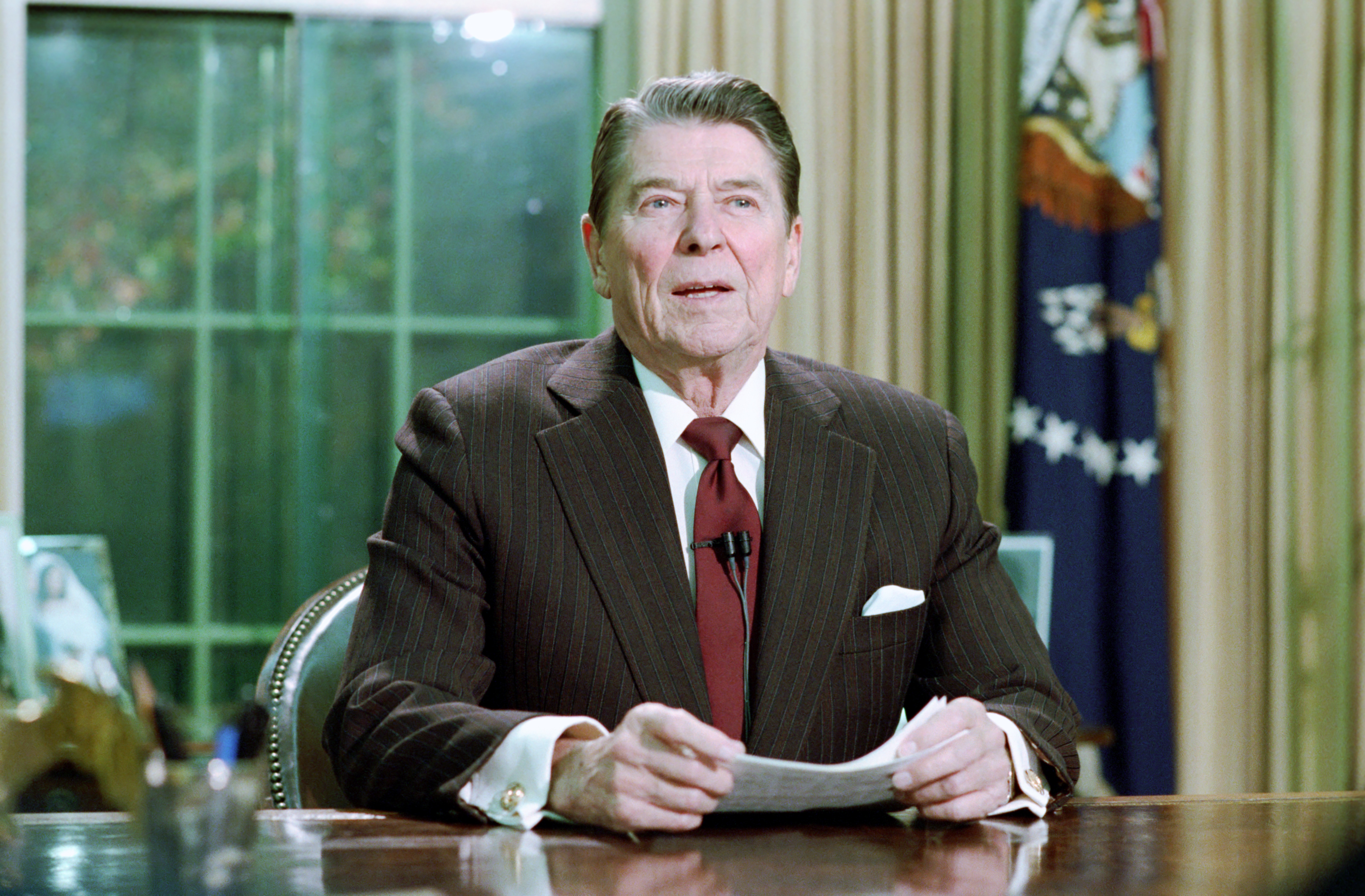
The scandal officially broke in Washington on November 25, 1986. President Ronald Reagan and Attorney General Edwin Meese appeared in the White House West Wing briefing room to address the nation about two seemingly unrelated affairs that had dominated the news for weeks.
In early October of that year, a small aircraft had been shot down over the Nicaraguan jungle. It turned out to be part of a secret supply network set up by the Reagan administration to support anti-communist rebels known as the “Contras.”
Just a month later, a Lebanese magazine revealed a secret trip by a US delegation to Tehran. Its mission was to negotiate the release of American hostages held in Lebanon by the pro-Iranian group Hezbollah. The currency of the exchange was advanced American weapons, whose export to Iran was explicitly banned. The United States itself had designated Iran a state sponsor of terrorism.
For almost two months, the White House flatly denied any involvement. But when press reports undermined its claims, Reagan was forced to admit the connection. Then Edwin Meese dropped an even bigger bombshell: the two operations were linked. Profits from the arms sales to Iran had been secretly funneled to the Contras. That got around the Boland Amendment, the explicit ban Congress had imposed on US military aid to the rebels.
The ‘Diversion’ and the Shadow of Watergate
Reagan had been nicknamed the “Teflon President” for his ability to emerge unscathed from scandals. His admission of such wrongdoing inevitably drew comparisons with Watergate, even within his own administration.
The link between the two operations, which went down in history as the “diversion,” was seen by Congress and prosecutors as the heart of the scandal. However, Lieutenant Colonel Oliver North, the White House’s main operative in both affairs, and other analysts later argued something equally troubling. By voluntarily revealing the diversion, the attorney general turned the media spotlight onto the one point on which Reagan could plausibly claim ignorance. In other words, the admission itself may have been a diversion.
The offenses of the Iran-Contra affair make up a long list of institutional abuses:
- Selling high-tech weapons to a hostile state.
- Training and arming a foreign rebel army through the CIA, despite the ban imposed by the Boland Amendment.
- Bypassing Congress through secret quid pro quo deals with foreign governments.
- Systematically destroying documents, concealing evidence and lying under oath to investigating committees.
Impunity, Pardons and a Legacy of Distrust
Despite the scale of the wrongdoing, senior officials in the administration, the CIA and the National Security Council largely escaped criminal penalties. Reagan and his aides had good reason to fear impeachment, but the Democratic majority in the House of Representatives hesitated, wary of the political cost of confronting an elderly and still popular president.
Reagan and his vice president, George H.W. Bush, suffered only temporary damage. Two years later, Bush was elected president, despite strong evidence that he knew about and took part in the secret operations.
Most of those charged never faced lasting consequences. Oliver North and National Security Adviser John Poindexter were convicted, but their convictions were overturned on appeal. The courts ruled that their trials may have been tainted by the immunized testimony they had given to Congress. On Christmas Eve 1992, shortly before leaving the White House, Bush pardoned six others. They included former Defense Secretary Caspar Weinberger, who was pardoned before his trial began, and former National Security Adviser Robert McFarlane.
“The Iran-Contra cover-up, which has continued for more than six years, has now been completed,” independent counsel Lawrence Walsh said bitterly at the time.
A Lesson for Modern Democracy
The fact that so few were held accountable, combined with the public’s willingness to move on quickly, set a dangerous precedent. It encouraged practices by later presidents that deepened political divisions and fed citizens’ deep distrust of institutions.
The legacy of that era lives on through tens of thousands of pages of televised hearings, criminal case files and declassified documents. Many of them came to light under the Freedom of Information Act (FOIA) through organizations such as the National Security Archive. Members of the legal team that investigated the affair are meeting again at Georgetown University to assess that historic moment.
“The Iran-Contra affair reminds us of a time when abuses of power, the bypassing of congressional checks and unchecked deception were seen as major threats to the Constitution,” said Tom Blanton, director of the National Security Archive. “Forty years later, this dark and complex story continues to offer valuable lessons for protecting today’s constitutional order.”
The 12 Key Documents
- At a crucial National Security Planning Group meeting at the White House on June 25, 1984, the Reagan administration’s leadership considers funding the Contras through third countries to get around opposition in Congress. Secretary of State George Shultz sternly warns, based on an assessment by Chief of Staff James Baker, that such a move would be an impeachable offense. Even so, Vice President George Bush backs the plan, with the sole condition that nothing be offered in return. Bush himself would break that condition the following year in a deal with Honduras. The meeting ends with Ronald Reagan demanding absolute secrecy and warning of harsh consequences if anything leaks.
- A March 1985 memo reveals Oliver North’s plan, addressed to National Security Adviser Robert C. McFarlane, to bypass Congress and keep funding the Contras through foreign donors such as Saudi Arabia, with support from Honduras. When the scandal broke a year and a half later, North tried to make the incriminating evidence disappear. Strict National Security Council security protocols did not allow classified documents to simply be destroyed, so North forged them, replacing the originals with altered copies. The deception was uncovered by an observant investigator, who noticed that the letterhead of the forged document, written in November 1986, did not exist in early 1985, the date of the original memo.
- The secret US deals with Iran, led by National Security Adviser Robert McFarlane, were mainly aimed at freeing American hostages in Lebanon. At the same time, however, a circle of officials pushed for limited arms sales to Tehran, fearing that isolating the Khomeini regime would leave Moscow free to expand its influence in the Middle East. Despite strong objections from the secretaries of state and defense, the plan went ahead because of President Reagan’s determination to free the hostages and avoid a political cost like the one that had cost Jimmy Carter reelection in 1980.
- In the 1980s, Vice Admiral John Poindexter introduced IBM’s pioneering PROFS email system to the White House. It radically changed how the US government communicated, bypassing the traditional paper bureaucracy. When Poindexter took charge of the secret Iran-Contra operations, he used a private messaging channel within the system, called “Private Blank Check,” to communicate with his subordinate, Oliver North. Through it, the two men avoided oversight by the central secretariat, securing the direct and hidden communication that made the scandal possible. The digital records eventually came to light after the National Security Archive won a court ruling that recognized them as official government records.
- In 1985, the United States and Israel carried out secret arms shipments to Iran in exchange for the release of hostages, even though Tehran was on the list of state sponsors of terrorism. After a failed missile delivery in November, the US secretaries of state and defense, Shultz and Weinberger, opposed continuing the plan. However, at an emergency meeting in December, President Reagan insisted that the deal go ahead, ignoring the legal risks. His priority was not to appear weak by losing a chance to rescue the hostages.
- The scandal’s exposure revealed the secret link between the arms sales to Iran and the illegal funding of the Contra rebels in Nicaragua. The key piece of evidence is a memo by Oliver North laying out the plan to channel arms proceeds to the rebels. It was found in November 1986 in the National Security Council’s files, having inexplicably survived the mass destruction of documents that North himself carried out to cover up the affair.
- Oliver North, a central figure in the Iran-Contra scandal, recorded his illegal activities in detail in dozens of notebooks, which were released in 1989 after a legal battle by the National Security Archive. The notes showed that when North realized, before the scandal broke, that the Archive was tracking his activities, he considered approaching its main funder, the Ford Foundation, to cut off its resources. It was a sign of how far he was willing to go to cover up the secret operations.
- Former Vice President, and later President, George Bush could not avoid being implicated in the Iran-Contra scandal, despite repeatedly claiming he was “out of the loop.” The most damaging evidence was an audio diary he kept from November 1986 to January 1987. He withheld it from investigators until the end of his presidency in December 1992, deliberately delaying its handover until after the election. In those recordings, two days after the arms-for-hostages deals with Iran were revealed, he admitted he was “one of the few people that know fully the details.”
- After the secret arms-for-hostages deals with Iran were revealed in November 1986, top White House officials raced to contain the political damage, pressing Secretary of State George Shultz to protect President Reagan. As the meticulous notes of his aide Charles Hill show, Shultz had opposed the deals from the start and was struggling to keep his name clean. He warned privately that the administration had wrecked its Middle East policy and broken the law, and he described the atmosphere in the White House as a “Watergate climate.”
- Despite congressional bans, the White House struck secret quid pro quo deals with foreign governments, including Israel, Panama and Saudi Arabia, to fund and arm the Contras. At his 1989 trial, Oliver North threatened to expose classified documents about these dealings, a tactic known as “graymail.” This forced prosecutors to draw up an official summary of the evidence to avoid leaking diplomatic secrets. The document confirms the behind-the-scenes actions of the CIA and President Reagan, who personally persuaded Saudi King Fahd to fund the Contras with $32 million.
- A lengthy legal memo from Christian Mixter, an associate of Independent Counsel Lawrence Walsh, assesses President Ronald Reagan’s criminal liability in the Iran-Contra scandal. The document establishes Reagan’s central role both in approving arms sales to Iran to free American hostages and in tacitly covering for the illegal resupply of the Contras and securing funding from third countries after the congressional embargo. Despite the evidence and a review of his testimony for possible perjury, Mixter concludes there is no basis for prosecuting the president. He stresses, however, that on the arms sales to Tehran in particular, the legal judgment was “a close call.”
- In a legal memo from the Independent Counsel’s office, Christian Mixter assesses then-Vice President George Bush’s involvement in the Iran-Contra scandal. The document establishes Bush’s participation in key meetings on the arms sales to Iran and the illegal aid to the Contras, as well as his role in arranging behind-the-scenes quid pro quo deals with Honduras. Although Mixter believes Bush knew most of the facts, he concludes that Bush’s subordinate role under Reagan limited his criminal liability. However, the memo was written before Bush’s concealment of his personal diaries came to light in 1992, which led prosecutors to consider charging him with illegally withholding evidence.