 Μake us preferred on Google
Shortly after 8 a.m. on Tuesday, a tour bus pulled up on Agiou Dimitriou Street in Thessaloniki and opened its doors. Dozens of Turkish tourists stepped out, crossed the road and made their way to Apostolou Pavlou Street, where the house believed to be the birthplace of Mustafa Kemal Ataturk stands.
They were among hundreds of Turkish visitors who arrived in the northern Greek city on Nov. 10 to mark the 88th anniversary of the death of Ataturk, the founder of modern Turkey, who is believed to have been born in Thessaloniki in 1881.
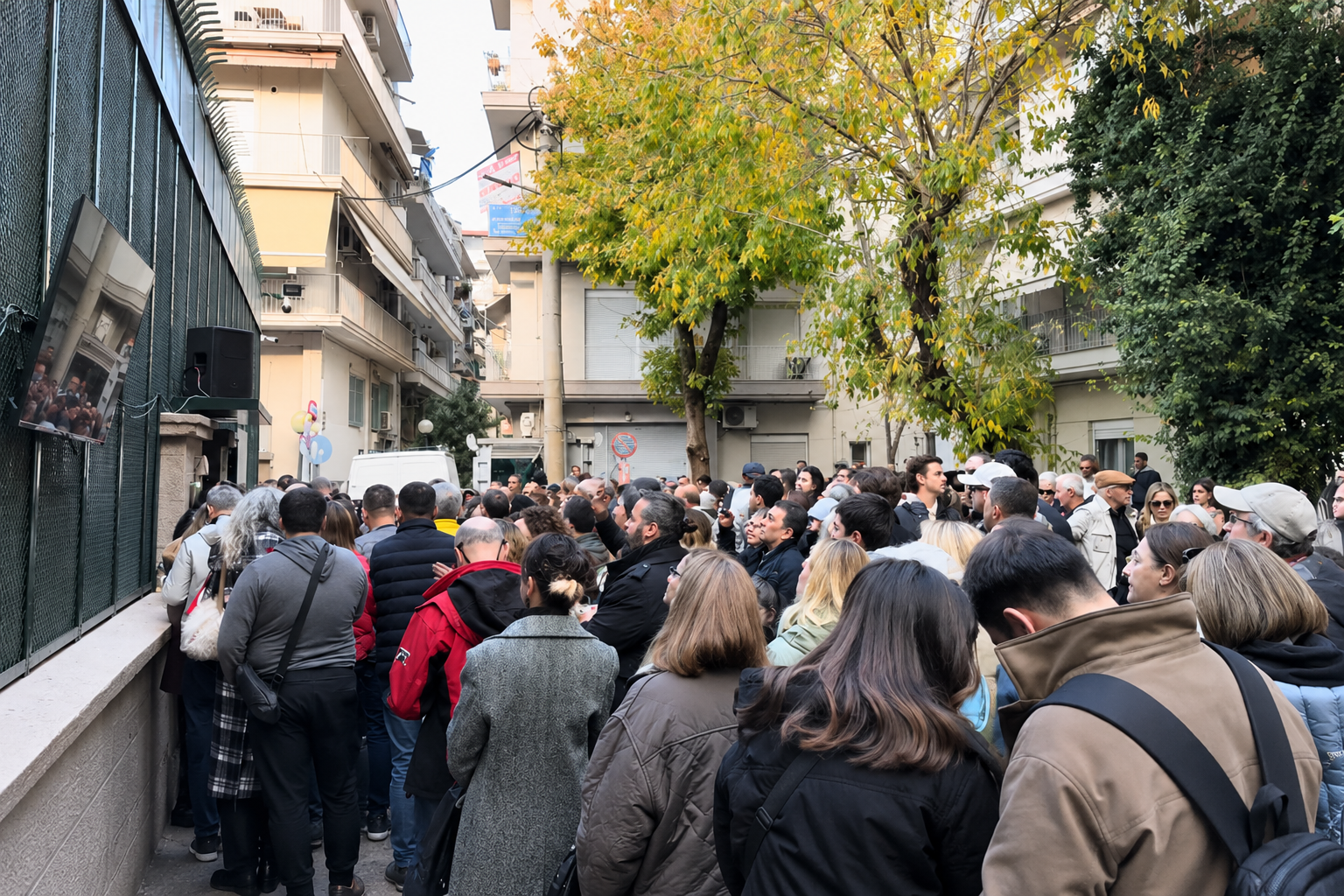
Outside the house, now the Ataturk Museum and part of the Turkish Consulate complex, visitors were already lining up to enter. Others posed for photographs or settled into nearby cafes for tea and Turkish delicacies. As the morning wore on, the crowds grew.
Many wore T-shirts or pins bearing Ataturk’s portrait, while others carried Turkish flags. They had traveled from Istanbul, eastern Thrace, Izmir, Bursa and other parts of Turkey, arriving by bus or car. An estimated 1,500 Turkish visitors came to Thessaloniki on Tuesday alone. Among them were several school groups, including one from Tekirdag, a city in European Turkey. “We come every year with the children,” two accompanying teachers, Ayca and Bahar, told Greek newspaper TA NEA.
A Moment of Silence at 9:05 a.m.
In the museum courtyard, large Turkish flags had been draped across the building, including one bearing Ataturk’s portrait. At precisely 9:05 a.m., the estimated time of his death, those gathered observed a minute of silence. Speeches and performances by school choirs followed.
Screens had been installed outside the building so that visitors waiting in line could watch the ceremony. Once the official proceedings ended, the museum opened its doors to the public.
One of those waiting was Mustak, a university professor from Istanbul who had flown to Thessaloniki for an academic conference. He decided to take the opportunity to visit the museum on the anniversary, something he had never done before. He was already familiar with the city, having visited twice with his family during summer vacations. On those occasions, he had driven from Turkey, a journey he said was more convenient.
The museum is estimated to have received 300,000 visitors so far this year, with the total expected to reach 400,000 by the end of 2026.
How Thessaloniki Became a Favorite Among Turkish Tourists
The anniversary has become an important date on Thessaloniki’s tourism calendar, thanks in part to an initiative launched in 2012 by the city’s then-mayor, Yiannis Boutaris.
Boutaris sought to attract more Turkish visitors by promoting Thessaloniki’s historical connections with its neighbor. Stefanos Hadjimanolis, who helped lead that effort and is now general secretary of the Association of Tourist Agencies of Macedonia and Thrace, says travel patterns have changed considerably since then.
Today, the overwhelming majority of Turkish visitors arrive in their own cars. “About 85% come by car. Then we have another 20 to 25 tour buses,” Hadjimanolis told TA NEA.
He explains that some visitors spend the night before the anniversary in Thessaloniki or in nearby northern Greek cities such as Xanthi, Komotini and Kavala. Others drive through the night to attend the commemorations and book accommodation for Nov. 10. For some, Thessaloniki is just the first stop on a longer trip through the Balkans.
But the city’s appeal to Turkish travelers extends well beyond the annual commemoration of the death of Ataturk.
According to the Thessaloniki Hoteliers Association, Turkish visitors accounted for 112,000 overnight stays between January and August 2026, up from 87,000 during the same period last year. That represents an increase of nearly 29%. A further 11,400 overnight stays were recorded in September, making Turkey the city’s largest foreign tourism market.
History Draws Visitors, but Food and Shopping Keep Them Coming
“History provides the reason for the visit,” Dimitris Simiakos, general secretary of the Thessaloniki Hoteliers Association, told TA NEA. “National and religious holidays give them a chance to visit Greece. They enjoy Thessaloniki and consider it an affordable destination,” he said. Turkish tourists also make a significant contribution to the local economy, with many willing to spend generously on fine dining, upscale hotels and shopping, according to tourism industry representatives.
There is, however, one challenge for the local tourism industry: getting them to stay longer. Despite their reputation as enthusiastic diners and generous spenders, Turkish tourists tend to spend relatively few days in Thessaloniki.
One possible way to encourage longer visits, industry observers suggest, is to make more of the city’s Ottoman heritage. Thessaloniki has a number of surviving Ottoman-era monuments, including the Hamza Bey Mosque, also known as Alkazar, which has recently undergone restoration.
Making such sites more accessible and incorporating them into the city’s tourism offerings could give visitors another reason to extend their stay.
Source: TA NEA