Μake us preferred on Google
When I first met her, she was not called Katerina. In fact, she had no name at all. She was simply a bear cub, about six months old, found wandering alone one morning in Heroes’ Square in Florina, northern Greece. According to a local story, she had even been playing with children like a puppy.
There were rumors that hunters had killed her mother, leaving the cub on her own, although it was also possible that she had become separated from her for another reason. Whatever had happened, at that age she was far too vulnerable to survive without her mother’s protection.
The discovery of a bear in the middle of the town caused a stir. The magazine I worked for at the time sent me to Florina to report on the story. I spoke with residents, children, students, teachers and local authorities.
Thirty-eight years later, I remember very little of that assignment. But I have never forgotten meeting the cub. I found her inside a small cage, before she was transferred with other bears to the Florina zoo. ARCTUROS, the Greek wildlife protection organization, had not yet been established.
Her eyes were desperate, as if she were trying to understand what had suddenly happened to her. That look stayed with me.
A few days ago, I read ARCTUROS’ farewell to Katerina, a bear that had lived under the organization’s care, and realized that she was the same cub I had met all those years earlier. The dates, location and circumstances matched.
“Some animals pass through our history, and some become part of it,” the organization wrote. “Katerina was one of them.”
She died at the age of 39, having spent nearly three decades at ARCTUROS. She was among the organization’s first bears, one of its most familiar residents and one of the oldest bears it had cared for.
Those who knew her remembered her as strong-willed, untamed and independent, always determined to do things her own way. Even when it came to eating, she had her own routine: She would take a piece of dry bread to the water and dip it in before eating it to soften it.
“Nearly 30 years together is almost an entire lifetime,” ARCTUROS said in its tribute. “Good journey, Katerina. You will always be part of ARCTUROS’ history.”
The announcement prompted an outpouring of affection from people who had followed her life. One message thanked the organization for giving her the chance to “make this world more beautiful and live a full life.” Another expressed confidence that she had enjoyed a happy life in its care.
I wanted to connect the two moments — the frightened cub in the cage and the elderly bear whose death was being mourned — so I sought out people who had known her throughout her life.
From a frightened cub to a sanctuary resident
Giorgos Mostakis, a guide at ARCTUROS, had followed Katerina’s story from the beginning. As a schoolboy, he remembered visiting her at the Florina zoo.
“She was very unruly, banging against the wire fencing. She could not accept what had happened to her,” he recalled.
At the zoo, Katerina became close to another bear, Mitsos, a young animal that had been confiscated after being used as a dancing bear and brought to Florina from Tripoli. The two got along exceptionally well. They were transferred together to ARCTUROS in the mid-1990s and remained companions until Mitsos died in November 2017.
At the organization’s 70-acre Bear Protection Center, Katerina retained her independent nature. She did not make friends easily, apart from Mitsos and a small number of other female bears. She was a particularly strong-willed animal.
The sanctuary gave her room to explore the ground, dig for bulbs and roots, and search for ants — activities that allowed her to live as naturally as possible under the circumstances. She even tried to build a den in the soil, despite never having had the chance to learn how from her mother.
Near her artificial den, she had a feeding area where she enjoyed her meals, which consisted mainly of seasonal fruit, especially apples, along with bread, honey, carrots and acorns. Many people symbolically adopted her, among them Katerina Sakellaropoulou, when she was serving as Greece’s president.
The quiet life of an elderly bear
In the last two or three years of her life, Katerina had become what Mostakis affectionately called a “grandmother bear” or a “matriarch.”
She was very old by the standards of her species. Brown bears typically live 20 to 25 years in the wild, and by then everyone at the sanctuary treated her with particular respect.
She would make herself a hollow in the ground, lie down in the shade and sleep for hours. Until a few years ago, the only occasional disturbance came from younger male bears that approached her in an attempt to play. Katerina would get up, chase them for a few yards to make her displeasure clear, and then return to her resting place.
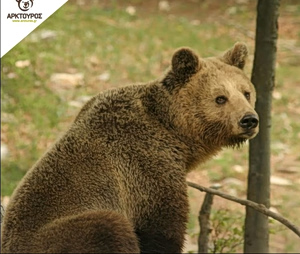
Looking at the photographs released by ARCTUROS after her death, I find myself returning to her eyes. The frightened, desperate gaze I remembered from 38 years ago had given way to a calm, confident expression.
It was the look of a happy bear.