 Μake us preferred on Google
 No foreign figure in the history of Modern Greece has been celebrated, admired, and offered such immense gratitude as Lord Byron, and justly so.
Byron, in the mere five months of his last journey to Greece, by offering his name, fortune and celebrity turned the attention of all of Europe to the courageous liberation struggle of an impoverished and downtrodden Christian nation against the powerful Ottoman Empire.
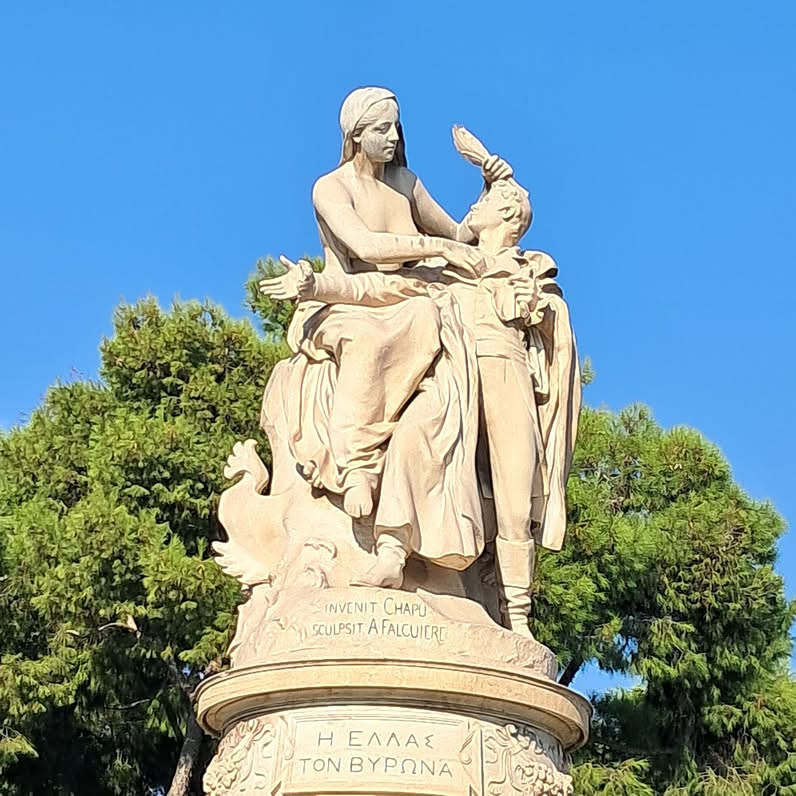
A fine full-figure statue of the poet at the knees of a bare-breasted female personification of Greece crowning him stands near the magnificent neoclassical Ζappeion in central Athens; a bust is situated at the historic main building of the University of Athens, and there are others in Messolonghi, where he died, not in battle but of a fever, on April 19, 1824.
After his death, some Greeks began to name their sons Byron (even though the Orthodox Church requires that children be baptized with Christian names). This fashion gained impetus at the time of the 100th anniversary of his death in 1824. At that time, the government decided to name an entire neighborhood populated by Asia Minor refugees “Vyronas” in his honor.
Byron, one of a handful of the most important English romantic poets of the 19th century, would have been more than delighted. Though he already enjoyed great fame, he managed, by becoming the European “poster boy” for the Greeks’ struggle for independence, to transform his life into legend.
The creator of the poetical Byronic Hero chose an adventurous and risky path by which he made himself a Byronic Hero in the flesh. His decision to make his life mirror his art was a conscious choice, and that becomes clear in the historical evidence, not least in the only detailed, eyewitness account of his mission in Greece.
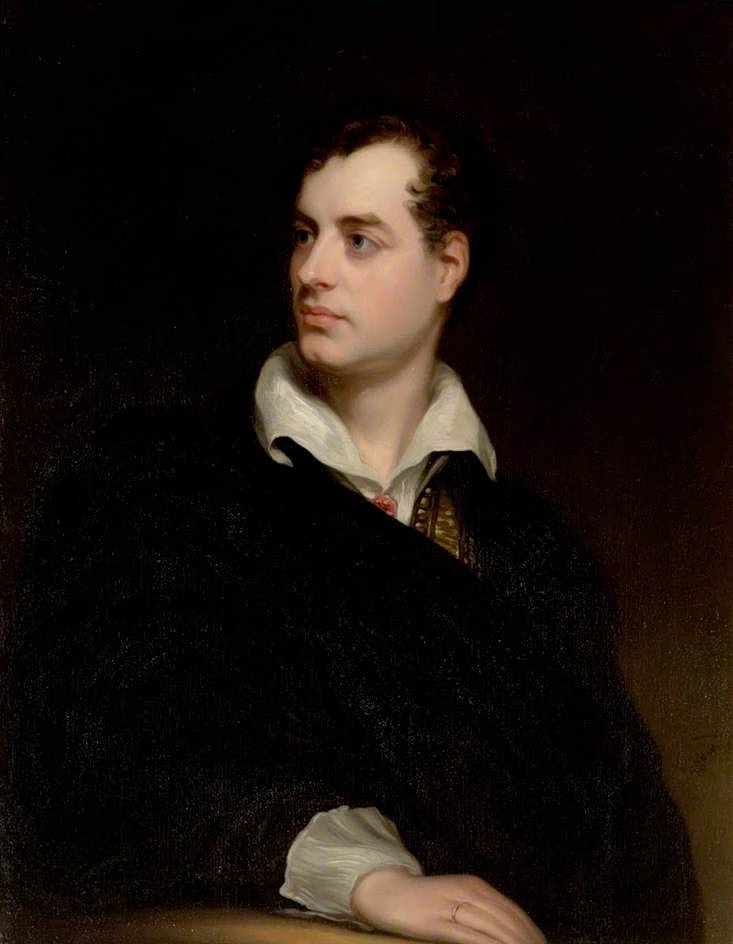
Portrait of Lord Byron painted by Thomas Philips in 1813. (c) Newstead Abbey; Supplied by The Public Catalogue Foundation
Eyewitness account, a poet’s fatigue
Count Pietro Gamba, who acted as Lord Byron’s companion and secretary throughout the tumultuous journey, in a diary published in 1825, the year after Byron’s death, and entitled Lord Byron’s Last Journey to Greece, writes that Byron’s thoughts turned to Greece at the end of February, 1823. “I have become tired of writing, and the public must have too,” Byron said.
Gamba was himself imbued with a revolutionary spirit. He was a member of Italy’s Carbonari, which aimed to overthrow absolute monarchies and establish constitutional governments. But that was not the basis of his acquaintance with Byron.
He was the brother of Teresa, Contessa Guiccioli, Byron’s married mistress, with whom he had his most passionate, long-term affair (1819-1823), that began during his stay in Ravenna while writing Don Juan, his last major poem.
Foreign powers
Though Gamba’s narrative clearly reflects his enormous admiration, it by and large offers a straightforward, fairly objective account of events with many direct quotes, on which he bases interpretations of the poet’s sentiments, interspersed with observations about Byron’s disposition and reactions to people and circumstances.
Maintaining balances
Byron ─ while trying with his stance to maintain some balance in the ongoing civil war between the Greek politicians and the military chieftains who actually fought the Turks ─ formed a very close, natural association with Prince Alexandros Mavrokordatos, Greece’s most prominent political figure, he supported a Western-style centralized, liberal government with complete control of the military by politicians.
Mavrokordatos was the par excellence exponent of British interests in Greece, as he was convinced, and rightly so, that the empire’s support was crucial for the success of the revolution.
In 1825, a year after Byron’s death, he headed (along with Georgios Kountouriotis) the so-called British Party, established through a petition asking for British protection during the War of Independence.
On the other end was Theodoros Kolokotronis, the greatest military leader of the revolution, who led the liberation struggle in the Peloponnese with great successes.
Kolokotronis, like Mavrokordatos, favored a centralized government, but wanted the military, which had fought and shed blood in the revolution, to maintain strong, localized power and not be sidelined by the politicians.
Given the fact that Byron’s overarching aim was to mediate between factions, the challenge was to reconcile the political and military powers-that-be in Greece. The military chieftains had the upper hand when Byron arrived.
Byron’s motivations
Gamba lays out Byron’s motivations, and his conviction that no one was more devoted to the cause of Greece’s liberation, at the outset.
“The challenge of his venture made him intent upon undertaking it. If those vowing devotion to Greece’s liberation had planned a crusade with few obstacles, then Lord Byron would never have joined in the undertaking. He was not one to follow the crowd or to engage in enterprises free of danger.”
Gamba relates how a clergyman named Ignatios, Archbishop of Arta, gave Byron letters of introduction to two of the most important figures in the Greek Revolution: Prince Alexandros Mavrokordatos and Markos Botsaris. The brave Souliote Botsaris was killed in a foray against the Turks in Karpenisi, and Byron would later hire many of his Souliote warriors as his personal guard.
Mavrokordatos, however, became a close ally and collaborator of Byron both on the political and military level.
Strategizing on Cephalonia
Byron spent his first five months in Greece on the Ionian island of Cephalonia, then under British control. There, as Gamba recounts in detail, he assessed the situation on the ground, corresponding with all the parties, conferred with local British officials, and set out the strategy for his next steps.
Only then did he decide to spend a substantial part of his fortune for the struggle. At the request of the provisional legislative body, he signed his historic cheque for £4,000 – roughly £332,000 today – to finance an emergency fleet of 14 ships (nine from Hydra and five from Spetses) to successfully defend Messolonghi from the fierce siege by Ottoman Albanians.
He would later progressively offer another £3,000 in cash expenses, making his total cash expenditure about £800,00 in today’s value.
The choice of Messolonghi
Byron was persuaded by Mavrokordatos, who had taken charge of Western Greece, to abandon his original plan to go to Tripolitsa (the former strategic-administrative centre of the Ottomans in the Peloponnese, conquered by revolutionary war hero Theodoros Kolokotronis in 1821) and to join him at his headquarters in Messolonghi.
As Gamba’s account makes clear, the two men shared the objective of organizing a standing army under the strong control of a central government, along European lines.
This pitted them against the military chieftains of the Peloponnese, and not just Kolokotronis, who had incidentally served in the British Army on Zakynthos during the Napoleonic wars, achieving the rank of brigadier 1810.
Kolokotronis, as would be expected, fought for localized power centers that would give substantial authority for decision-making to those who had actually fought and shed their blood in the revolution.
Mavrokordatos, European diplomatic recognition
Kolokotronis tried unsuccessfully to court Byron, to persuade him to come to the Peloponnese and to peel him away from the politicians, both because of the huge international prestige he would lend and the money he could disburse from his personal fortune and the forthcoming British loan.
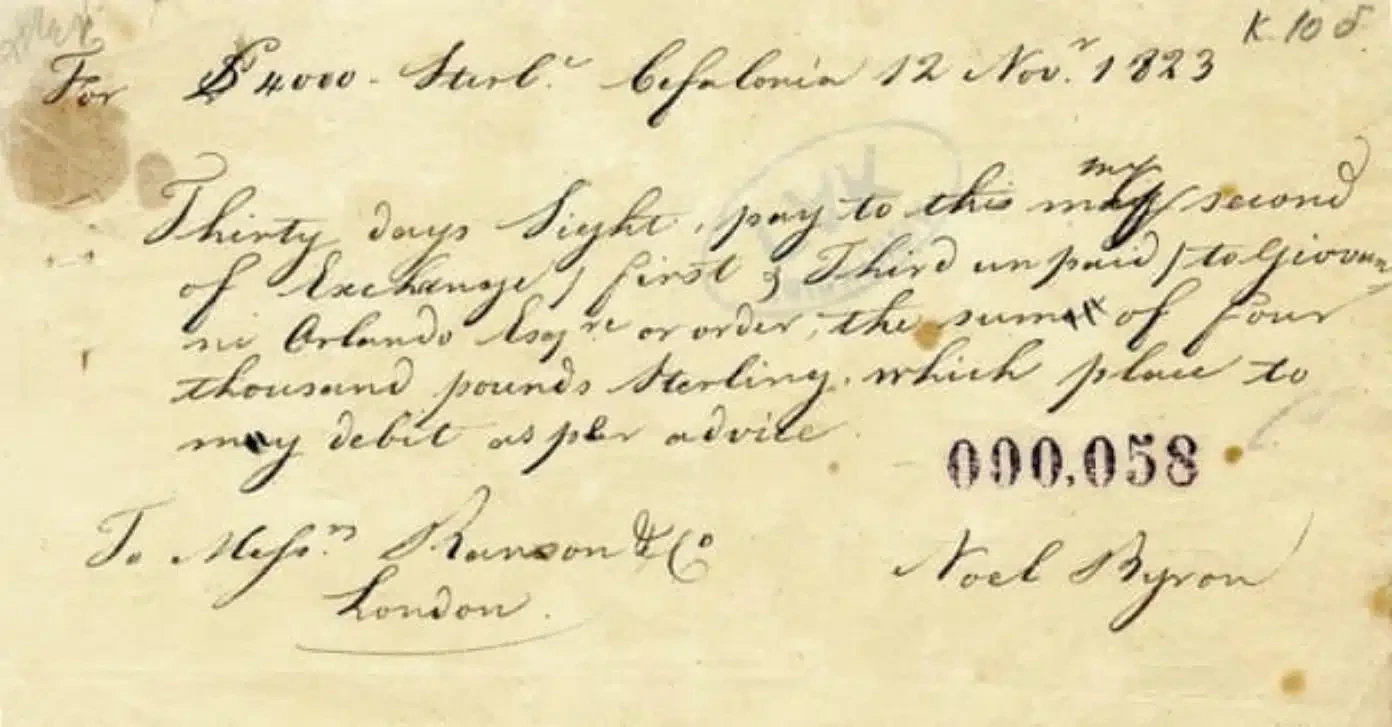
In the cheque pictured above, Byron stipulates that £4,000 (£332,000 today) be paid to Ioannis Orlandos to receive funds and travel to London. GEORGE GORON BYRON/GENERAL STATE ARCHIVES OF GREECE/THE OBSERVER)
Byron sided with Mavrokordatos because he was convinced that a central British-style constitutional government was the only way Greece would achieve diplomatic recognition from European powers, and of course from Britain first and foremost.
The problem for Byron, however, was that Kolokotronis was stronger than the government, and his protracted efforts to reconcile the warring chieftains would not come to fruition.
The age-old Greek scourge of factionalism
He is repeatedly quoted as saying that the Greek factions were more preoccupied with battling each other than fighting the Turks.
“They are more intent on persecuting and calumniating each other than on securing the independence of their country. More is to be feared from their own dissensions than from the Turks.”
Having noted Byron’s famous quote that ─ “I come not here to join a faction but a nation, to act with honest men, not speculators or peculators, as the Greeks daily call each other.” ─ Gamba offers a glimpse of his character and tactic.
Byron’s name as powerful weapon
“Those who have studied the character of Lord Byron in his writings will easily believe that prudence was not in the catalogue of his virtues. He carefully avoided every appearance of ostentation and had great dread of being taken as a searcher after adventures.”
Byron was well aware of the overriding importance of his image as a symbol. “By perseverance and discernment, he hoped to assist in the liberation of Greece – To Know and To Be Known,” Gamba notes.
This was undoubtedly one of his greatest contributions to the struggle, and it helped him exploit his wide nexus of connections in Britain and on the continent.
A natural lust for adventure, from Italy to Greece
Again and again, Gamba’s journal indicates that the adventure and risk of Byron’s undertaking was a central psychological underpinning of his overarching passion for the liberation of Greece’s enslaved, as Byron oft repeated, people.
Prior to the momentous decision to turn his sights to the Greek liberation struggle, Byron made his residence in Italy (1816-1823), but according to Gamba the political state of the country disgusted him: “He had thoughts of going to the United States of America, and I once saw him nearly on the point of departure.”
Representing the London Philhellenic Committee
Gamba makes clear that Byron’s mission was not only the action of a solitary romantic crusader for freedom, though it was that as well. It began with his induction in the powerful London Greek (Philhellenic) Committee months before his departure for Greece.
The committee portrayed itself as a private philhellenic organization which, however, included many MPs, politically influential people, and even the major British philosopher Jeremy Bentham, the founder of classic utilitarianism.
The committee recruited Byron, but the poet already was imbued with the romantic passion to help Greece gain its freedom, to be resurrected as it were, not as a continuation of ancient glory ─ he had no such illusions ─ but as a free state among the nations.
To dream the impossible dream
Byron’s romantic dream of releasing Greece from its centuries old bondage was eloquently expressed over a decade before the start of the Greek Revolution, in his great poem Childe Harold’s Pilgrimage, in which he himself is essentially the hero, based on his 1809-1811 Grand Tour of Europe and the Mediterranean:
“Fair Greece! sad relic of departed worth!
Immortal, though no more; though fallen, great!
Who now shall lead thy scattered children forth,
And long accustomed bondage uncreate?”
Yet, Byron was in no way imbued by a hatred for the Turks. He confided in Gamba that, in his early youth, reading Ottoman history brought him great delight, and that one might discern oriental tinges that derived from that in his poetry.
‘Unite now or forget dream of liberty’
Byron strongly pressured the Greeks to unite, warning that a failure of warring factions to reach reconciliation would mean that “all hopes of a [British] loan will be in vain”.
Gamba quotes a long letter to the Greek executive and legislative bodies, penned in Cephalonia on November 30, 1823:
“All this assistance which the Greeks could expect from abroad – assistance neither trifling nor worthless – will be suspended or destroyed. What is worse, the Great Powers of Europe, of whom none was an enemy of Greece, but seemed to favor the establishment of an independent power, will be persuaded that the Greeks are unable to govern themselves, and will perhaps themselves undertake to settle your disorders in such a way as to blast the brightest hopes of yourselves and your friends.”
History would prove him right.
In the starkest terms, as Gamba relates it, Byron warned in yet another letter, to Mavrokordatos, that there were three possible eventualities:
Greece would either reconquer her liberty, or become a dependency of sovereign Europe, or return to being a Turkish province.
“She has the choice only of these three alternatives. If she wishes to be truly Greece, free and independent, she must resolve today, or she will never again have the opportunity.”
Utility of the Greek Committee, military role
The London Greek Committee was not an organ of the officially neutral British government, but it had documented contacts, and its role went far beyond humanitarian relief. In effect, there was a pragmatic use of the philhellenic movement as an instrument for advancing British influence over the Eastern Mediterranean, while officially maintaining neutrality so as not to fuel any direct Anglo-Ottoman confrontation.
A British Army officer in active duty, Colonel Leicester Stanhope, was sent by the committee to Greece and worked closely with Byron, not least in securing a crucial British loan of £800,000 (of which only £470,000 or 59% of the nominal loan amount was received by the Greek provisional government) – £67.3 million in today’s purchasing power. The rest went to exorbitant fees and commissions. By all accounts it could not have been issued without the tacit support of the British government.
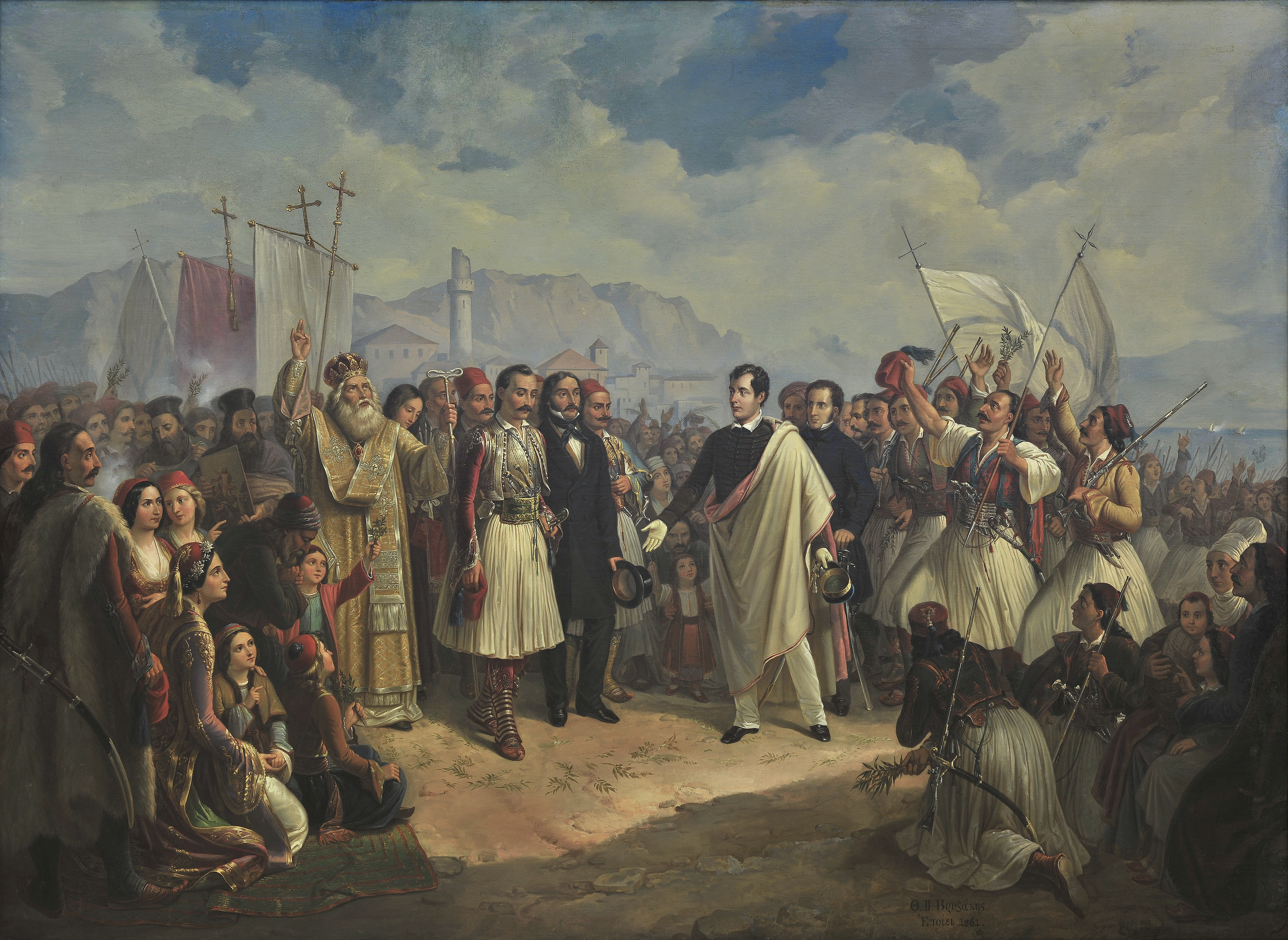
The Reception of Lord Byron at Messolonghi, painted by Theodore Vryzakis. Photograph courtesy of the National Gallery of Athens
British newspapers, including The Times of London spoke of “scandalous” terms.
Stanhope, who was by Byron’s side in Messolonghi, said in his correspondence that the committee sent engineers, artillery officers, infantry and cavalry officers. This meticulous organization of military-political planning with a large arms stockpile for targeted operations clearly could not possibly have been accomplished without government acquiescence or involvement, direct or indirect.
George Canning: The sea change in British policy
British foreign secretary George Canning (a public square in Athens bears his name), with whom Byron was acquainted prior to his journey to Greece, played a pivotal role in supporting the Greek Revolution diplomatically, and then more tacitly financially.
In spring 1823, Great Britain abandoned its neutrality and recognized the Greeks as a warring nation. Though Gamba stresses the role of Byron and mainly the Greek Committee in pushing for the crucial 1824 and 1825 (the latter after Byron’s death) British loans to Greece, it should be noted that the British government did nothing to impede the process, suggesting at the very least tacit approval.
British political, financial and strategic interests in the Eastern Mediterranean were linked to the outcome of the struggle.
Byron’s pure, romantic intentions
This, however, can in no way be interpreted to mean that Byron intended to serve as a tool for the advancement of British government interests. His pure intentions focused solely on the cause of the liberation of the Greeks, as Gamba’s narrative makes clear at every turn.
This is evidenced by all his actions, both on the island of Cephalonia and subsequently in Messolonghi, where he died while working toward Greek independence.
The crusading nature of his endeavour, the charm of risk and danger were a core part of Byron’s disposition and constitution, as Gamba’s, account stresses:
“Opposition and the prospect of the greatest dangers were to him the most alluring excitement.”
In another remark to Gamba Byron noted, “I have always looked upon storms as one of the sublimest spectacles in nature.”
In that sense, it is perhaps no surprise that he knowingly placed himself at the center of one.