 Μake us preferred on Google
 September 14 has been declared by the Greek Parliament as the “day of national remembrance for the genocide of the Greeks of Asia Minor by the Turkish state.” It marks the memory of the Asia Minor Catastrophe, the tragic and horrific events of August and September 1922, which brought death and displacement to hundreds of thousands of Greeks from Asia Minor.
During those same tragic days, “ELEFTHERON VIMA,” founded only a few months earlier (February 6, 1922), recorded this unimaginably bloody catastrophe minute by minute through telegrams and dispatches.
Many decades later, “TA NEA,” in collaboration with the Center for Asia Minor Studies, is publishing testimonies from survivors who lived through the events of the Asia Minor Catastrophe in the harshest way. Through their accounts, they reveal their own deep personal tragedies, which together make up the larger collective drama of the Asia Minor refugees.
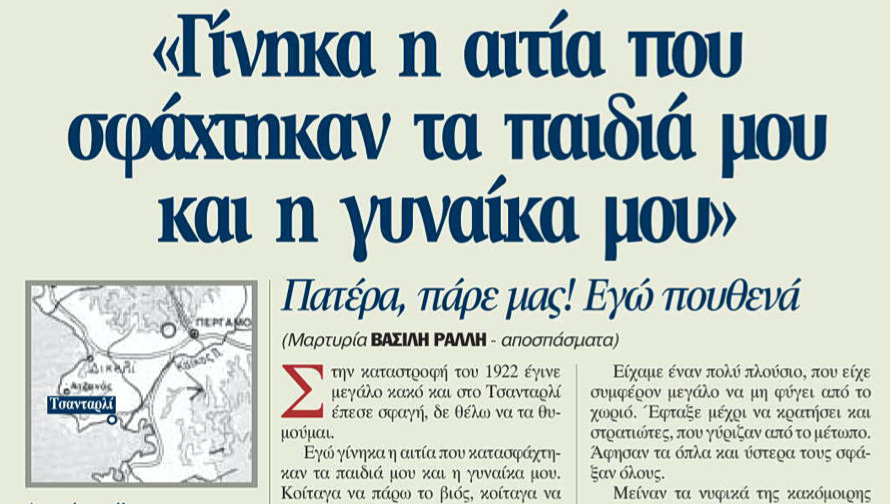
Title reads: “I became the cause that my wife and children were slaughtered”. Source: TA NEA 4.9.2023, Historical Archive “ΤΟ ΒΗΜΑ” Ι “ΤΑ ΝΕΑ”
Testimony of Vasilis Rallis (excerpts)
Western coast. Magnesia region. Chandarli
(Chandarli, a coastal town with 2,000 Greek and Turkish residents, sits on the north shore of the gulf of the same name, 61 km northwest of Smyrna, 58 km northwest of Magnesia, 29 km southwest of Pergamon, and 47 km southeast of Ayvalik. The town is built on the ruins of the ancient Aeolian city of Pitane.)
“During the catastrophe of 1922, great harm came to Chandarli too. There was a massacre there. I don’t want to remember it.
I was the reason my children and my wife were slaughtered. I was busy trying to save my belongings, trying to save the lifeless things.
I don’t want to remember, it weighs on my soul. My child cried out to me, ‘Father, take us with you.’ And like a fool I said, ‘I’ll come back,’ as if it were up to me. I never imagined what would happen. I loaded everything valuable I had onto a small motorboat, set off for Mytilene, and said I would return. But I didn’t make it in time. The massacre happened. They herded everyone into the fortress and the axe fell. Four children and my wife, gone, taken from me.
There was a very wealthy man among us who had strong reasons not to leave the village. He even managed to hold back soldiers who were retreating from the front. They laid down their weapons, and afterward they were all slaughtered too.
My poor wife’s wedding garments survived, and when I remarried, the woman I married found them, unstitched them, and made dresses for herself out of them. That’s how it goes. ‘Father, take us with you.’ And I was nowhere to be found.
That dark fortress became the grave of everyone there. The dead lay unburied everywhere, filling the whole land, all of Asia Minor.”
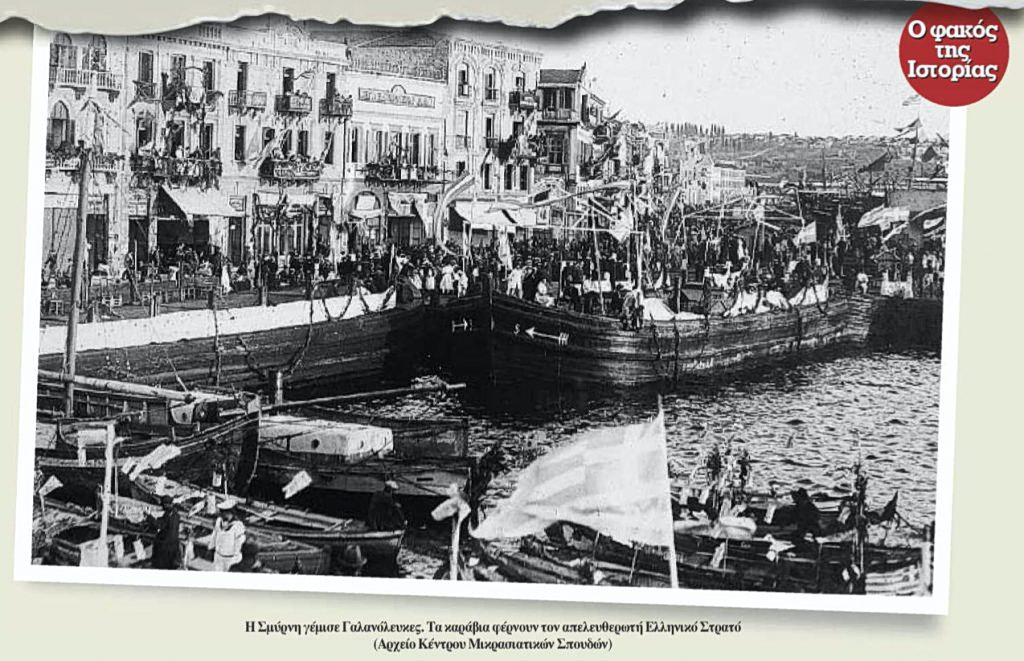
Caption reads. “Smyrna filled with Blue-White colours. Boats Bring the Liberating Greek Army”. (Archive of the Center of Asia Minor Studies). Source: TA NEA 4.9.2023, Historical Archive “ΤΟ ΒΗΜΑ” Ι “ΤΑ ΝΕΑ”
Testimony of Filio Seitanidou (excerpts)
Western coast. Magnesia region. Hadjileri
(Hadjileri, a mixed village of about 2,000 residents total. The Greeks, who made up half its population, came from mainland Greece, the islands, and Cyprus. It lies 45 km northeast of Smyrna, 15 km west-northwest of Magnesia, and 6.5 km southwest of Kordelio.)
“When the retreat happened I was about fifteen years old, but I still can’t forget what I went through. Our whole village emptied out. Some went ahead, some behind, they left on foot, by cart, and headed to Smyrna. I had my mother’s sister there, in the village of Bournova.
People poured into the streets like water, they had lost their minds. No one knew which way to go. It was Saturday morning and we heard cannon fire. And everyone said, ‘The Greek army is holding the line, holding the defense!’ How could they hold any defense, when they were coming back barefoot and in rags?
Only a few had taken to the roads and the mountains. As soon as we heard ‘defense,’ everyone rushed outside, the women in their nightgowns, the men in their underwear. We were planning to hide in a shop belonging to a man named Reizis. We understood the situation, and we meant to take refuge there until we could board a ship for Crete. But then, as everyone else was fleeing, the urge to escape overtook me so strongly that I never even went back to find my own family.
I just took to the road with the neighbor women, and on foot we made it from Bournova to Basmahane!
In Smyrna
(…)
Someone told us there was an Italian man moving people by cart, and that we should go to the Evangelical School. There were a lot of people there. They had some measure of safety. So that’s what we did, we went to the Evangelical School. The night we arrived there, the fire broke out. We went back out into the street. Crowds of people were running, all heading for the waterfront.
You won’t believe it, but in all that chaos I found my sister and my aunt, my mother’s sister. We reached the waterfront and went into a beer hall. That’s where the Turks descended on us and tried to take the men away. A huge crowd had gathered there. They raised their knives, cursed in Turkish, and we cowered like worms.
The stranger’s baby
The fire kept spreading. It reached us there too. We fled again, toward Punta. The ground there was covered with the dead. Coal dust had turned everyone pitch black. A mother was holding her baby and begged me to carry it for her while she went to look for a little flour to feed it. I held the stranger’s baby all night long.
The mother never came back. Some people shouted at me, ‘Why don’t you just throw it away? Why are you carrying it? Even its own mother abandoned it, and you feel sorry for it?’ But I did feel sorry for it. My heart ached, it was hungry and drooping like a withered leaf.
When God brought the morning, the mother found me. I’ll never forget how she went half mad with joy. She never expected to find me again. The baby survived with its mother. He’s a strong young man now. How could I have thrown him away? Would my soul ever have found rest anywhere after that? Others, in their desperation, drowned their babies, threw them away, buried them in threshing floors. But thank God, I didn’t do that, whoever the child belonged to.
On top of the dead
Afterward we slowly made our way to Mersinli, a two-day march. Before we got there, the Turks were throwing bombs at every building still standing. You’d see people, with no fire and no smoke, just fall where they stood. The dead lying there were something else entirely. For three nights and two days we woke up on top of women, children, old people, and animals, all dead.
I slept on top of a huge dead old man in his underwear. What could we do? Where could we go? On one side was the open sea, on the other people were being killed, and on another they had set up a cordon and were taking men, girls, clothes, money, bundles. So we slept on top of the dead.
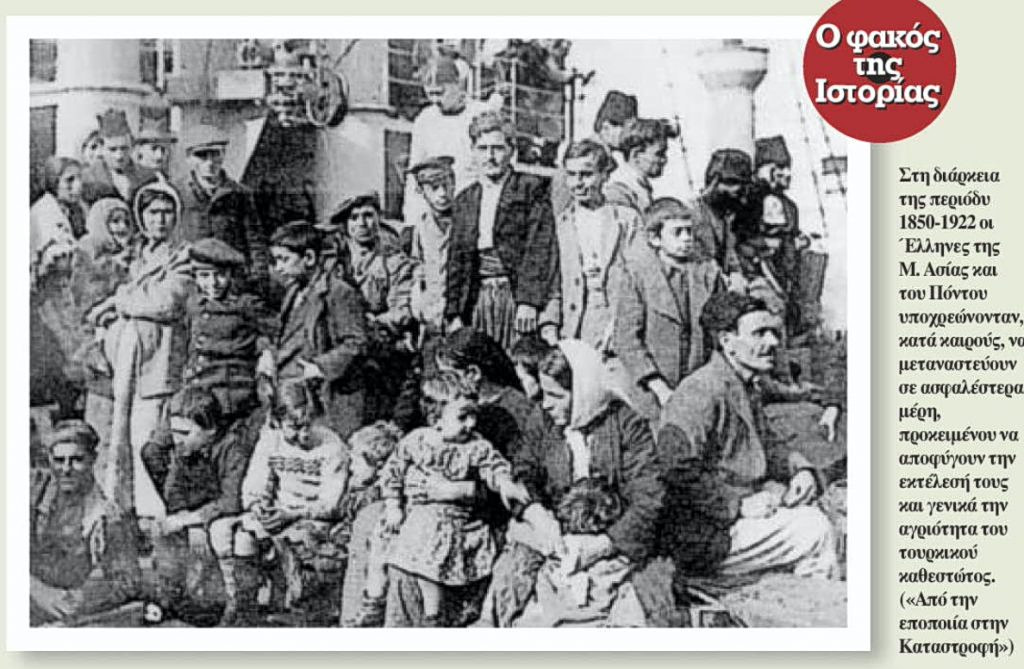
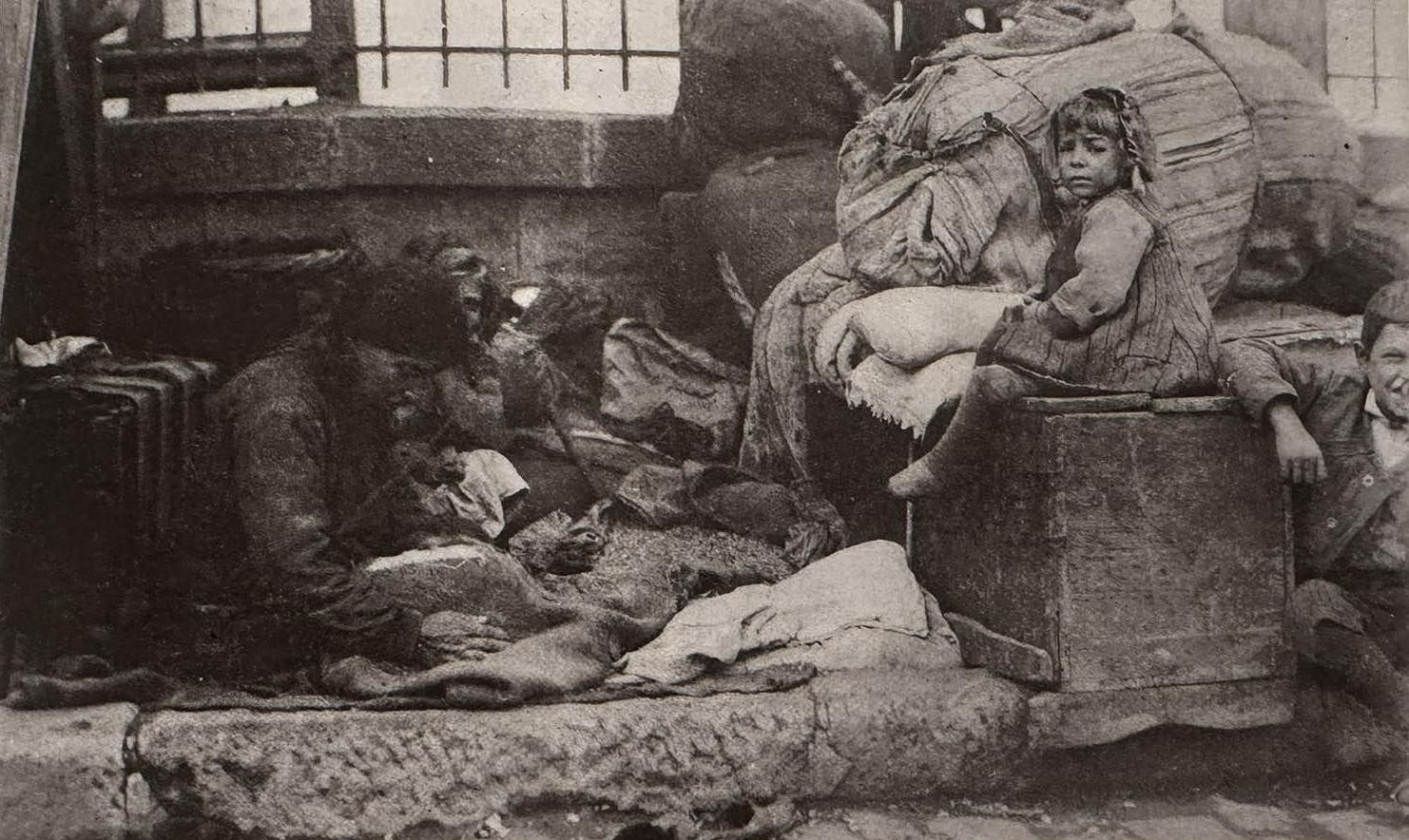
Text reads: “During the period 1850-1922, Greeks of Asia Minor and the Pontus were on occasion forced to migrate to safer places so as to avoid their execution and generally the brutality of the Turkish regime” (“From Epic to Catastrophe: Asia Minor 1919-1922”, a volume historical work by Titos I. Athanasiadis.) Source: TA NEA 4.9.2023, Historical Archive “ΤΟ ΒΗΜΑ” Ι “ΤΑ ΝΕΑ”
Inside a grave
I lost track of my family again and we ended up in a cemetery, I couldn’t even tell you where exactly. We had already lost everything. They were taking women and men there too.
We pulled up a gravestone and three of us girls climbed into a grave. Some old women helped us, then pulled the stone back and covered the grave again.
After Mersinli we took shelter in a beer hall. But the Turks didn’t leave us alone there either. They opened fire, knocked it down, and we were forced back out into the street.
We went into a yard with small trees. Each of us was given a blanket, and Turks on horseback stood guard over us. Then word spread that the fire had stopped. The woman whose baby I had carried knew of a coach house, something like a stable where carriages were kept, near Ayios Ioannis in Smyrna.
We had gone back. We said that if we found the coach house still standing, that would be good, since it also had a water barrel. If we couldn’t find it, we’d go into the church of Ayios Ioannis instead.
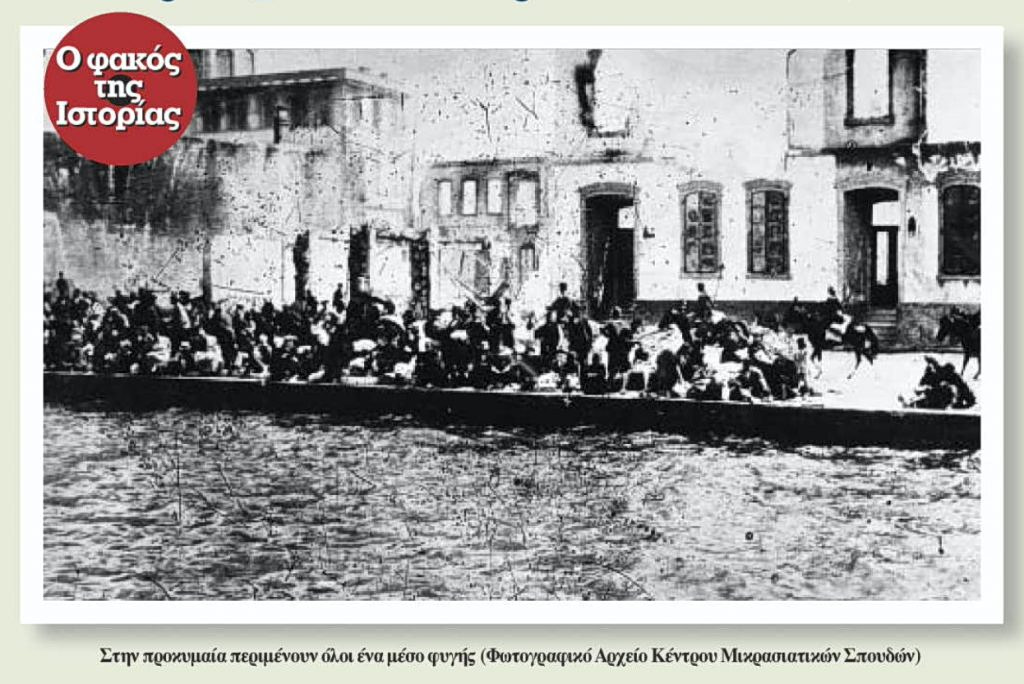
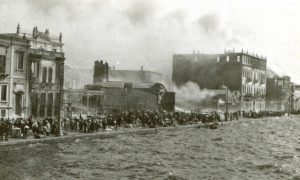
Caption reads: “On the waterfront, everyone is waiting for a way to escape”. Source: TA NEA 4.9.2023, Historical Archive “ΤΟ ΒΗΜΑ” Ι “ΤΑ ΝΕΑ”
Inside we prayed, outside we heard weeping
The coach house was sturdy. It had a big iron door. It also had a loft where they kept feed for the animals. There were eleven men, thirteen women, old men, old women, and small children. One old woman held an icon and kept a small lamp lit for it.
There we all prayed, night and day. Every so often we heard crying and screaming, they were taking the girls, the men, and we waited our turn, hour by hour. We prayed. We knelt. We made prostrations. And that was our fate, whatever you want to call it.
Saint Demetrios’s feast day had already passed when we all went together to the French consulate. We paid for two or three horse carts. The carts belonged to the Italians. They put an Italian flag on top and took us to the French ship to board it.
We waited, we begged to be allowed to leave. Then, at one point, the ship started moving and left us behind. The Italians then took charge of us with their whips and threw us into the burned houses.
There we saw nuns, the ones with the white caps. They were handing out pieces of bread. They gave us some too. There were about a hundred and fifty other people there as well. We weren’t alone anymore. We had also gotten to know the twenty four people we’d lived with in the coach house.
We got into the carts again and went back to Punta, where a great many people were waiting for ships. At some point two ships arrived. Everyone rushed to get on board.
In Greece
They put us ashore on Chios. We were half naked and barefoot. I had torn off my underskirt and used it like a headscarf, to cover my head and face so I wouldn’t be seen.
When I reached Piraeus, I sold some blankets and bought shoes and bread. Seven months later I found my sister. My poor aunt was killed by the Chetes. She didn’t escape. They emptied the house, stole everything, wrecked it, and killed her too.
At first I did sewing. The landlady I rented from was a seamstress. She sewed, I sewed too, and I kept learning the trade. I worked in cutting. Later my sister found out where I was and came and got me. We stayed in Athens. We rented a room. I didn’t end up in a factory like some other girls did.”