
 Μake us preferred on Google
On November 23, 1976, Olympic Airways Flight 830, operating the Athens–Larissa–Kozani route, became one of the deadliest aviation disasters in Greek history. The twin-engine YS-11A aircraft, named Nisos Milos, crashed in a mountainous area near the village of Metaxas, in the Kozani region of northern Greece, killing all 50 people on board.
The aircraft had departed Athens that morning, with a scheduled stop in Larissa. However, adverse weather conditions prevented it from landing, and the captain decided to continue toward Kozani. Shortly afterward, communication with the aircraft was lost.
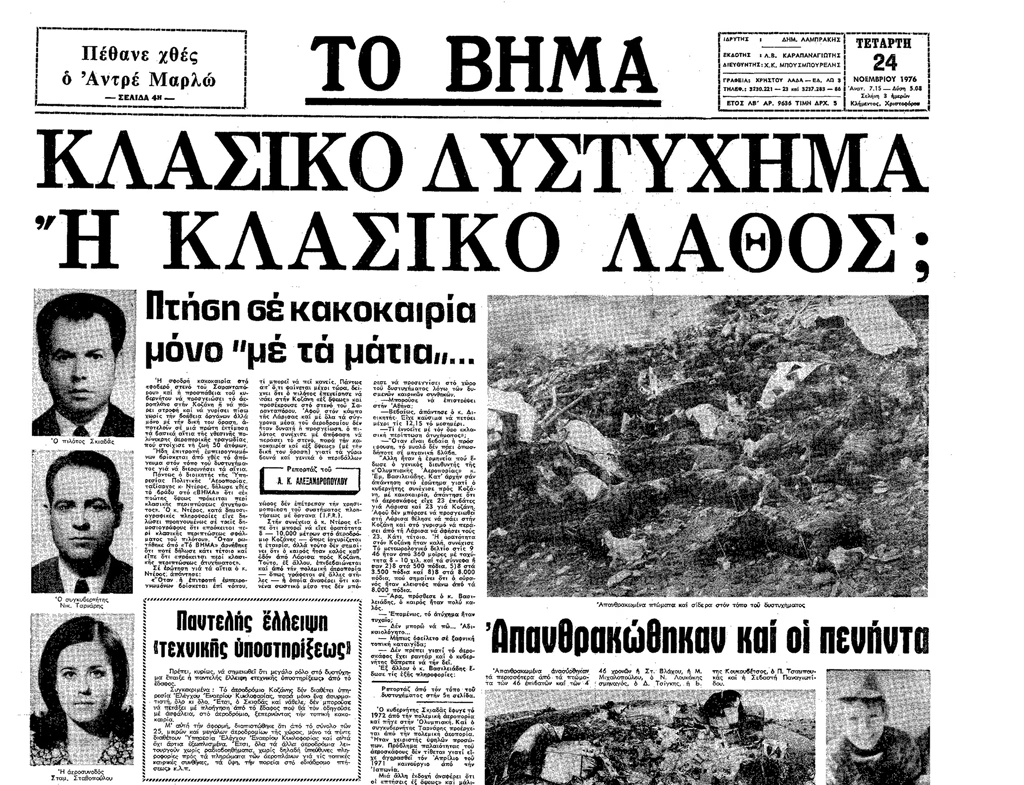
The day after the tragedy, on November 24, 1976, TO BHMA described the flight’s final moments:
“Fifteen minutes before its scheduled arrival in Kozani, it requested a weather report and then fell silent.”
According to information reported by the newspaper at the time, the captain had said he was unable to land because of the fog, adding that he “could see an opening through which he would attempt to land.”
The flight never reached its destination
The wreckage was found in the mountainous Servia area, on the western foothills of the Pierian Mountains, in the Macheras Lakkos ravine. The aircraft had struck a hillside and burst into flames.
The first accounts from the crash site conveyed the scale of the disaster. Evangelos Papagiannis, a shepherd who was in the area, was among the first to notice the smoke and rush to the scene.
“Since early morning, there had been heavy fog in the area of the crash,” the newspaper reported, quoting his account that “you couldn’t see more than two meters ahead.”
The conditions also hampered rescue operations at the crash site, as helicopters arriving in the area were unable to land because of the low cloud cover.
TO BHMA, November 24, 1976. Historical Archive of TO BHMA and TA NEA.
The first questions
From the first hours after the crash, attention focused on the captain’s decision to continue toward Kozani despite the severe weather.
As TO BHMA noted on November 24, the severe weather in the Sarantaporo Pass – a narrow mountain pass in northern Greece situated between the Vigla and Amorves mountains – and the captain’s attempt to fly relying on visibility, without the assistance of navigational instruments, were considered the main causes of the tragedy in initial assessments.
The then head of the Civil Aviation Authority, Ilias Deros, said that “at first glance, this appears to be a classic case of an accident,” while refraining from assigning definitive responsibility before the investigation was completed.
Olympic Airways management, meanwhile, maintained that weather conditions at Kozani Airport were good. However, this did not necessarily mean that conditions were the same along the route from Larissa.
A second issue also came to the fore: the lack of adequate radio navigation aids and technical support.
On November 25, TA NEA published a statement by the Civil Aviation Authority, according to which flights along the specific route were conducted exclusively “under visual flight conditions,” meaning that visibility had to be sufficient to allow safe navigation.
The authority nevertheless rejected broader claims that aviation infrastructure was inadequate, arguing that any conclusions about the causes of the crash before the official investigation report was issued would be arbitrary.
TO BHMA, November 24, 1976. Historical Archive of TO BHMA and TA NEA.
The prosecutor’s report and the search for accountability
On March 5, 1978, TO BHMA published the findings of prosecutor Nikolaos Trypolitis, who recommended that seven individuals be referred for trial. They were employees of Olympic Airways, the Meteorological Service and the Civil Aviation Authority, and faced charges of multiple counts of negligent manslaughter and negligently endangering aircraft safety.
The same report recommended that no charges be brought against other individuals involved, including the head of the Civil Aviation Authority and Olympic Airways’ general director.
What the investigation revealed about the fatal flight
Beyond the search for individual responsibility, the prosecutorial investigation also brought to light serious deficiencies in aviation infrastructure.
As TO BHMA reported on March 5, 1978:
“According to the prosecutor’s report, the aircraft was operating normally, and the person considered primarily responsible for the fatal aviation disaster was the aircraft’s captain, who, of course, was killed.”
According to the findings, Captain Skiadas, despite his experience and knowledge of the area, had violated visual flight rules by attempting to continue under adverse weather conditions.
“The report also highlights the lack of radio navigation aids along the Larissa–Kozani route,” the newspaper noted, pointing out that their presence would have enabled the captain to deal more effectively with the adverse weather conditions.
Of particular significance was the fact that a radio beacon intended for Kozani Airport had already been sitting in the Civil Aviation Authority’s warehouses since July 18, 1975, without ever having been installed.
Delays in preparing the relevant technical study, the cancellation of the tender for the construction of the required housing structure and lengthy administrative procedures had prevented its installation before the crash.
“Olympic Airways pilots unanimously described flights without radio navigation aids as unsafe,” the newspaper reported.
The November 23, 1976, tragedy exposed not only issues surrounding the crew’s handling of the flight, but also shortcomings in aviation infrastructure and safety concerns related to flying in difficult weather conditions.
Fifty people lost their lives in a disaster that brought to light failures and critical questions about transportation safety. Questions that, 50 years later, still resonate painfully today.