 Μake us preferred on Google
 Dreams stop being fantasies when stubbornness, ability, and hard work come together. The Wright Brothers, at a time when only birds crossed the sky, decided they would be the first to conquer the air. On this day, May 22, 1906, they were granted the patent for their airplane.
To find the landmark achievements of remarkable people, one must look to the past, especially when those achievements were truly original. At a time when nothing like them had existed before, there were inventors who changed the world from scratch: Alexander Graham Bell, who invented the telephone, Thomas Edison, inventor of the microphone and the electric light bulb, and many others.
Today, however, our focus lies elsewhere. On May 22, 1906, somewhere in Ohio, two brothers, Orville and Wilbur Wright, accomplished something extraordinary. Three years after performing the first crewed powered flight, they were officially granted the patent for their aircraft, known as the Flyer.
The Wright Family
The Wright family was defined by an intense energy and drive. Their father, Milton Wright, was a bishop who frequently traveled for church matters, while their mother, Susan, the daughter of a well-known German carriage maker of the era, was said to be exceptionally bright and naturally gifted at building things, particularly toys for her children.
Their sister, Katharine, strong-willed and sharp, was the only college graduate in the family. It is not difficult to understand how these gifted inventors were raised, shaped, and developed, nurturing their mechanical aptitude until they ultimately conquered the skies.
The stimuli they received were plentiful and varied. Letters their father sent from his travels broadened their geographical knowledge and fed their general curiosity. Their home was full of books, as both parents firmly believed in education and never placed limits on their children. If Orville or Wilbur missed school for some worthwhile activity or experiment, it was always welcomed. And in a sense, it all started with a gift from Milton.
The Toy Helicopter That Launched Aviators
The story began when their well-traveled father bought his sons a small toy helicopter. It was of French origin, based on the designs of an earlier aviation pioneer named Alphonse Penaud.
Penaud, at just 20 years old in 1870, solved the problem that had stumped all inventors before him: he created an engine capable of propelling a rotor while the craft was airborne. A year later, he built and tested his first helicopter, which he called a “Planophore.” The result was a complete success: it flew 40 meters in approximately 11 seconds.
That achievement only deepened his ambition. He began designing gliders heavier than air. But despite his brilliant ideas, he never found a financial backer, and to make matters worse, his designs were used by toy manufacturers without paying him royalties. Unable to bear the situation any longer, Alphonse Penaud took his own life in 1880, at just 30 years old.
That small helicopter of his eventually found its way into the hands of an 11-year-old Wilbur and a 7-year-old Orville Wright. The boys were captivated by the way it hovered, became obsessed with it, and ultimately took it apart. In trying to fix it, they built a model that flew better than the original.
The rest is history. Wherever they went, it was the only thing they worked on. As they grew older, they began building their first glider, drawing on the flight designs of earlier inventors like Penaud. That little toy helicopter was the spark that ignited everything.
The First Crewed Powered Flight
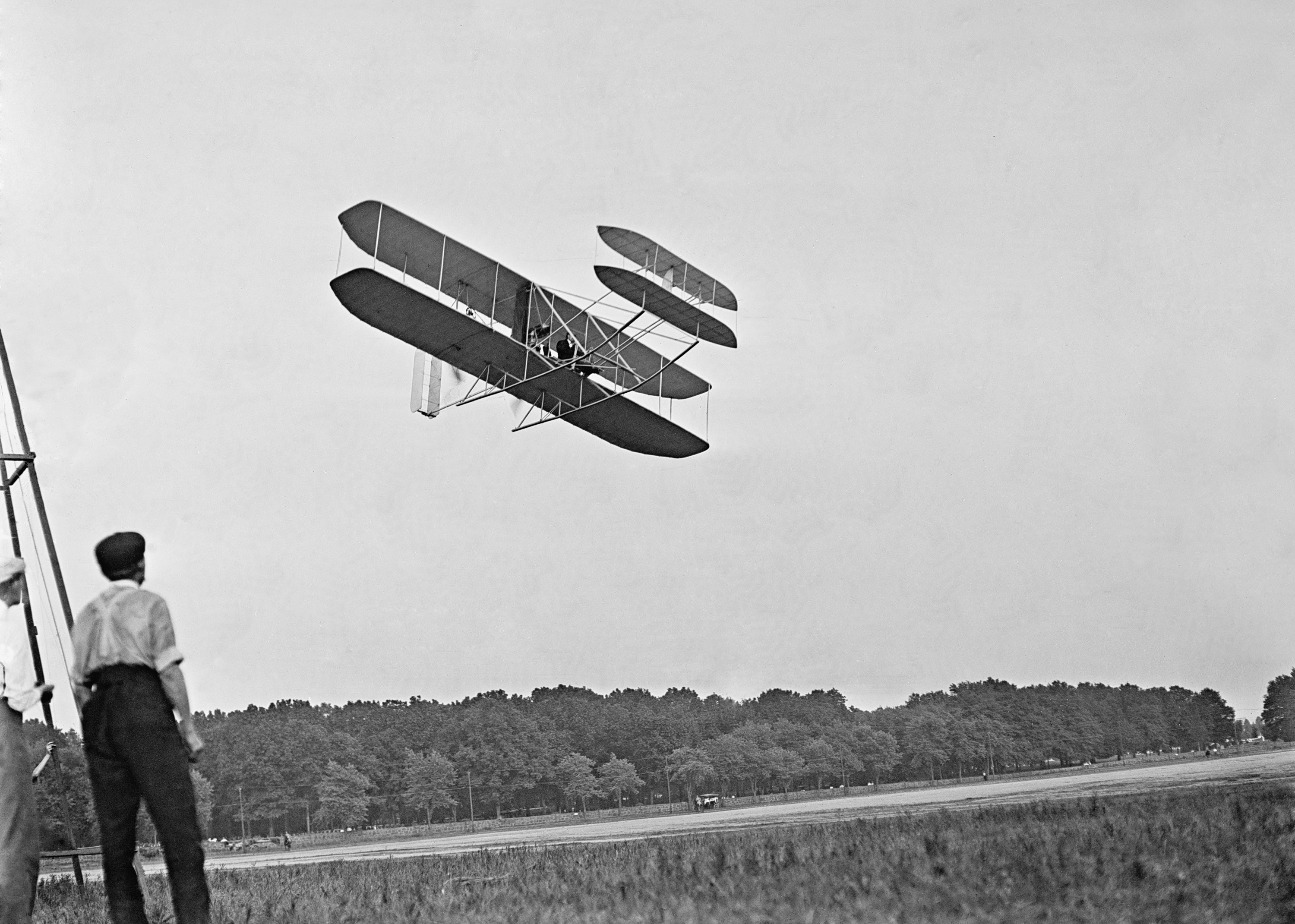
December 17, 1903, is a milestone date in the history of aviation. That day, the Wright Brothers achieved the first crewed powered flight. Flying their aircraft, the Flyer, which laid the foundations of modern aviation, they took to the skies four times that day.
The Flyer was constructed from spruce wood and weighed 341 kilograms. It was 6.5 meters long with a wingspan of 12.5 meters, and one wing was slightly larger than the other by a few centimeters to improve stability. The pilot lay face-down at the controls.
With Orville at the helm, the first flight lasted just 12 seconds before landing, but it made history. The brothers then took turns in the cockpit, completing three more straight-line flights, with the final one lasting 59 seconds and covering a distance of 260 meters.
The Patent
Nine months before their historic first powered flight, on March 23, 1903, the Wright Brothers had filed a patent application, which they drafted entirely on their own. The Patent Office rejected it, however, deeming it too vague.
Determined to protect their invention, Wilbur and Orville hired a patent attorney specializing in intellectual property, Henry Toulmin. Working together with him, they prepared a new application.
After a lengthy review, the Patent Office granted U.S. Patent No. 821,393 on May 22, 1906, three years after their original submission.
That date stands as the crowning achievement of their labor, creativity, and ingenuity. The Wright Brothers, Wilbur and Orville, in an era of limited technological development, chose to break from established norms and become true innovators. Their radical ideas in the fields of engineering and aviation did not remain on paper but became reality. In every sense, theirs was a revolution, carried out by bold and daring trailblazers.