 Μake us preferred on Google
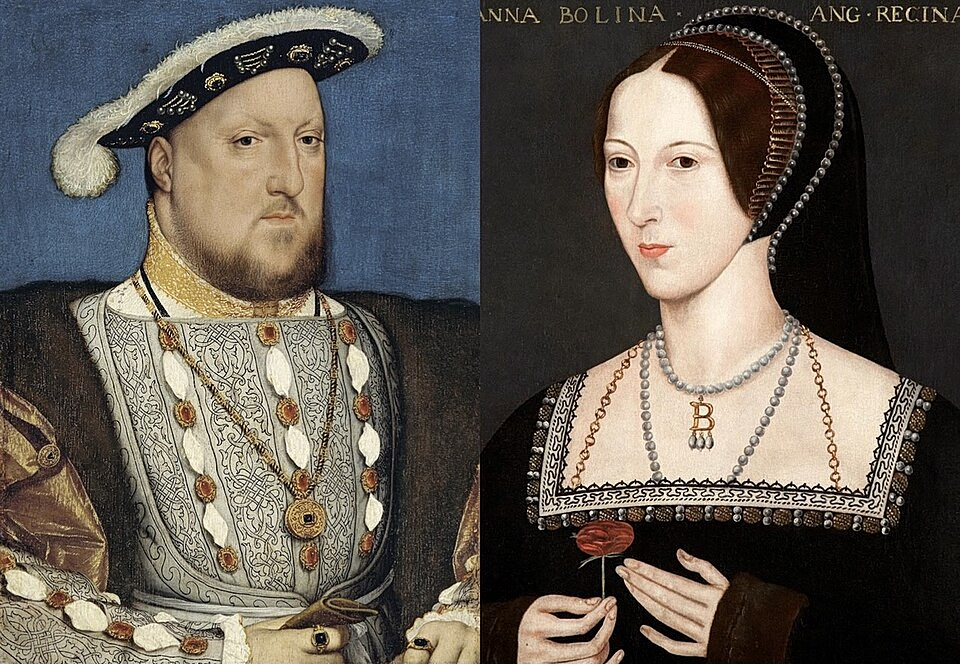
 On this day on May 19, 1536, Anne Boleyn, otherwise known as Nan Bullen or Anne of the Thousand Days, second wife to King Henry VIII of England was executed on charges of treason. The events surrounding her death as well as her role/position as one of the 6 wives of the mercurial King have become the subject of historical speculation, mythmaking and narrative reinvention.
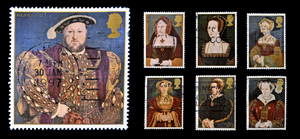
Henry VIII and his Six Wives shown in postage stamps, circa 1997. Source: Shutterstock
Anne Boleyn was executed after a mere 3 years of marriage, with her headless body being hastily buried in an unmarked grave inside the Tower of London, a notable place of high-profile executions since the days of the Norman Conquest of 1066. Her remains were later identified during chapel renovations in 1876 and are now marked on the marble floor of the Chapel of St Peter ad Vincula.
Yet a puzzling question must be asked: What makes a King execute his own wife and queen?
A King’s Determination
Every King needs an heir, specifically a male one, and Henry VIII was lacking in that department. While he did have one daughter, Princess Mary in 1516, with his first wife the Spanish princess Catherine of Aragon (whom he had married in 1509), the social norms of the time pressured the King to have more children so that a boy might be born, who might inherit the kingdom.
The King began considering the annulment of his marriage with Catherine — that is aiming to prove that the marriage was never valid — in 1525, on the grounds that the papal dispensation granted by Pope Julius II, permitting him to marry her, had been obtained under false pretences, since she was his brother’s widow.
More broadly, Henry had come to believe his marriage was “cursed”, and interpreted the Book of Leviticus to say that a man who marries his brother’s wife shall be childless, a sign, in his view, that God condemned the union. This theological argument, combined with his desperation for a male heir, formed the basis of what was known as “the King’s Great Matter.”
Enter Anne Boleyn
Anne Boleyn was born between 1501 and 1507 (historians dispute the exact date, lacking exact records), as the daughter of Sir Thomas Boleyn, an ambitious diplomat and courtier, and Lady Elizabeth Howard, daughter of Thomas Howard, 2nd Duke of Norfolk.
She was, contrary to many English noblewomen of the time, educated at the courts of first Margaret of Austria in the Netherlands and then Queen Claude of France, making her unusually cosmopolitan and well-traveled. This had a strong imprint on her character, moulding her into a polished woman of sophistication, intellectual wit and cultural refinement.
By the standards of the time, she was not considered a conventional beauty. Contemporary accounts describe a woman of magnetic presence rather than classical prettiness, possessing striking dark eyes, a long elegant neck, and a sharp, vivacious intelligence that drew people to her.
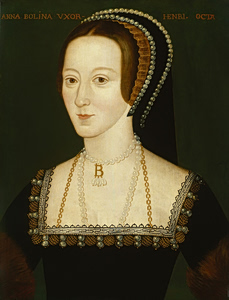
Portrait of Anne Boleyn, based on a contemporary portrait which no longer survives. Source: Wikimedia Commons
Anne also carried genuine religious convictions that would have consequences far beyond her own life. During her time in France she became an adherent of the ideas of the Reformation, returning to England with radical ideas such as challenging the power of the Catholic Church.
Anne Boleyn had an early experience in court politics when in 1523 she entered into a secret betrothal with Henry Percy, the son of the Earl of Northumberland. While the young nobleman was said to be genuinely in love with her, hopes of a happy marriage were crushed when Henry VIII ordered his principal advisor at the time, Cardinal Wolsey, to dissolve the betrothal on the grounds of the match lacking royal approval.
At around the same time as the annulment discussions, the King began courting Anne Boleyn in 1526.
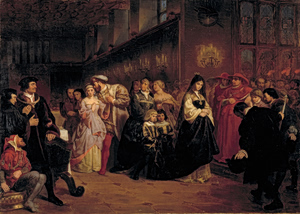
The Courtship of Anne Boleyn (1846) by Emanuel Gottlieb Leutze. Source: Shutterstock
Years went by and Henry VIII could not find a solution to the question of his marriage to Catherine. After the Catholic Church repeatedly refused the annulment, he took drastic action, deciding to overturn nearly a thousand years of religion (England had been Catholic since around 597 AD), to establish an independent, from the Pope, Church of England, with himself as head.
With this newly established power, he proclaimed the annulment of his marriage to Catherine in May 1533. Even before the annulment had been officially declared, Henry had already secretly married Anne Boleyn four months prior.
A Queen Cast Aside
Catherine refused to accept the annulment, continuing to refer to herself as Queen, and sought support from both the Pope and the Holy Roman Emperor, Charles V, who was also her nephew. In retaliation, Henry banished her from court, sent her to the remote Kimbolton Castle, drastically reduced her household staff and living allowance, and forbade her from seeing or even contacting her daughter Mary. She died at Kimbolton on January 7, 1536, just months before Anne’s own execution, of cancer. She was deeply mourned by the English people.
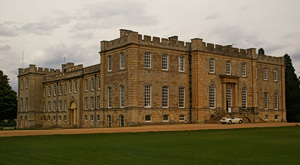
Kimbolton Castle, the place of Catherine of Aragon’s death, converted since 1950 into a school. Source: Wikimedia Commons
From Queen to Condemned
The King was hoping for a male heir, yet his new union produced a daughter, Elizabeth, who would go on to become the future Elizabeth I. Anne subsequently suffered from multiple miscarriages, leading the King to become “disillusioned” with his choice, facilitating the beginning of his courtship of Jane Seymour.
By May 1536, the King instructed his principal advisor Thomas Cromwell to fabricate treason charges against her, leading to her immediate arrest and imprisonment at the Tower of London.
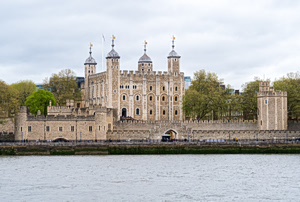
A modern day view of the Tower of London. Source: Shutterstock
The charges specifically referred to adultery with her five “lovers”, incest with her brother, and high treason. Some accounts also state that she was accused of witchcraft due to Henry telling people he was “bewitched”, but this was not listed in the official charges.
The Jury and Trial
The jury was heavily biased against her, with the entire affair of the trial having been prejudiced by the guilty verdicts of the four men tried before her (her brother George was not amongst them, instead being tried alongside her on May 15). The jury was also made up largely of her enemies, including:
- the Duke of Suffolk, Henry’s brother-in-law and a man who despised Anne,
- the Marquis of Exeter and Lord Montague, both supporters of Princess Mary,
- the Earl of Northumberland, Henry Percy, her former lover, described by historian Alison Weir as “an ailing, embittered man whose former love for Anne had long since withered into contempt”, and
- the Earl of Worcester, whose own sister was said to have been a key witness against the Queen.
The jury was presided over by her uncle Thomas Howard, Duke of Norfolk, who pronounced the death sentence with tears running down his cheeks, though whether those tears reflected genuine grief or theatrics remains debated.
Anne was convicted on May 15th and beheaded four days later, on May 19, 1536, at the Tower of London, with Henry VIII becoming betrothed to Jane Seymour the immediate day afterwards.
In the four days between her conviction and her execution, Anne remained in the Tower, reportedly hearing Mass daily and maintaining, by most accounts, a dignity that impressed even her captors.
The Execution
Accounts as to her last moments are rife with factionalism. It must be considered that she had long stirred intense and divided opinions. To supporters of Henry VIII’s first wife, the virtuous and recently deceased Spanish princess and former Queen Catherine of Aragon, she was viewed as a manipulative and immoral woman who had lured Henry away from both his rightful queen and the Catholic faith. To her admirers, however, Anne was seen as intelligent, refined, and ambitious.
On the day of her execution, Spanish sources claimed she was “frail and dazed” while climbing the scaffold. Most observers, however, shared the view of the Frenchman Lancelot de Carles, the secretary to the French Ambassador and eyewitness to the trial and execution, who remarked that “when she was brought to the place of her execution her expression was cheerful.”
Upon Anne’s death, the King wished to eliminate all memory of her, ordering the destruction of as many of her portraits as he could locate, leaving historians with only those created after her passing.
An Enduring Legacy
Perhaps the greatest irony is that the daughter that the King had with Anne Boleyn, whom he dismissed with such base disappointment, would go on to become arguably one of the greatest monarchs in English history: Elizabeth I.