 Μake us preferred on Google
 On Jan. 21, 2017, one day into Donald Trump’s tenure as president of the U.S., and roughly five decades into Gloria Steinem’s tenure as its most famous feminist, Steinem arrived on the National Mall to address the Women’s March on Washington—a mass gathering in rebuke of both a president who had bragged about groping women, and the society that had elected him anyway.
At age 82, Steinem looked as she had always looked, only older: tinted aviator glasses, leather jacket, long hair parted down the middle with two lightened streaks at the front. And she sounded like she had always sounded: resolute but coolheaded and—even amid great trepidation—adamantly joyful, too.
“You look great! I wish you could see yourselves—it’s like an ocean!” she hollered at the roughly half a million bodies in front of her. “This is the upside of the downside. This is an outpouring of energy and true democracy like I have never seen in my very long life.”
Steinem—who died Wednesday at home at the age of 92, according to a post on her Instagram account—was, by then, a living symbol of the women’s movement, having spent her life working, as a journalist, editor, activist and organizer, to brazenly propel women forward and cannily scrutinize the forces holding them back. She was arguably the most effective avatar of a movement that was meant to represent half the population of Earth—and, aware of the peculiarity and pressures of that position, held fast to a conviction that all people were equal and interdependent, and that change comes only from collective action. “We are linked. We aren’t ranked,” she told the Women’s March, deploying a favorite line.
When people asked her who she was passing the torch to, she bristled: “There is no one torch—there are many torches,” she told the New Yorker in 2015, “and I’m using my torch to light other torches.”
Named after a doll
Steinem was born March 25, 1934, in Toledo, Ohio, and named after her older sister’s favorite doll. Her father was a traveling antiques dealer, but also operated a lakeside summer resort in Michigan, where, at a young age, Steinem was enamored of the musicians who passed through to play. She settled on her own plan to escape a conventional, 9-to-5 life: She would be a Rockette.
Her parents separated when she was 10. Steinem lived in Toledo with her mother, Ruth, a former newspaper reporter who had quit to raise her kids, suffered a mental breakdown and became addicted to the sodium pentathol she took to tamp down her malaise. Steinem described her mother as disappearing down the street in her nightgown, or marooned in bed “with eyes closed and lips moving in occasional response to voices only she could hear.” Steinem would bring her coffee and bologna sandwiches—a desperate child’s conception of a nourishing meal. She often said, of her own generation of women: “Most of us are living out the unlived lives of our mothers.”
Upon graduating from Smith College in 1956, Steinem received a fellowship to travel and write in India, where, over two years, she discovered the critical role women had played in the Indian independence movement. Before leaving the U.S., Steinem had written a note to her college boyfriend, breaking off their engagement. “I felt as if I got married, it was the last choice I would have. Life would be over,” she told the podcast “Design Matters” in 2022.
In 1960, she arrived in New York wanting to be a journalist but initially only landed odd-jobs from the classifieds—dancing at grocery-store openings, standing against a cork board while a magician threw knives—and the sort of freelance pieces editors entrusted to women. (Steinem would later describe “the low point in my life” as “writing about textured stockings” for the New York Times.) She broke through in 1963, with a piece for Show magazine about working undercover as a scantily uniformed “bunny” at the Playboy Club. It was a biting expose about the club’s working conditions and culture of sexual degradation, but Steinem was irritated that many couldn’t get past the salaciousness of its premise.
In 1968, editor Clay Felker hired her as part of New York magazine’s inaugural stable of writers, which also included Jimmy Breslin and Tom Wolfe. There Steinem wrote one of the first mainstream media dispatches from the women’s movement, covering a 1969 abortion speak-out in Greenwich Village, where woman after woman shared stories of terminating pregnancies.
Steinem had an abortion at age 22, in London en route to India, but had never talked about it. At the speak-out, she was suddenly rattled by her own silence and the invisibility of these stories in the culture at large. “I began to read every piece of feminist writing I could lay my hands on, and talk to every active feminist I could find,” she recalled in one of her books, “Outrageous Acts and Everyday Rebellions.”
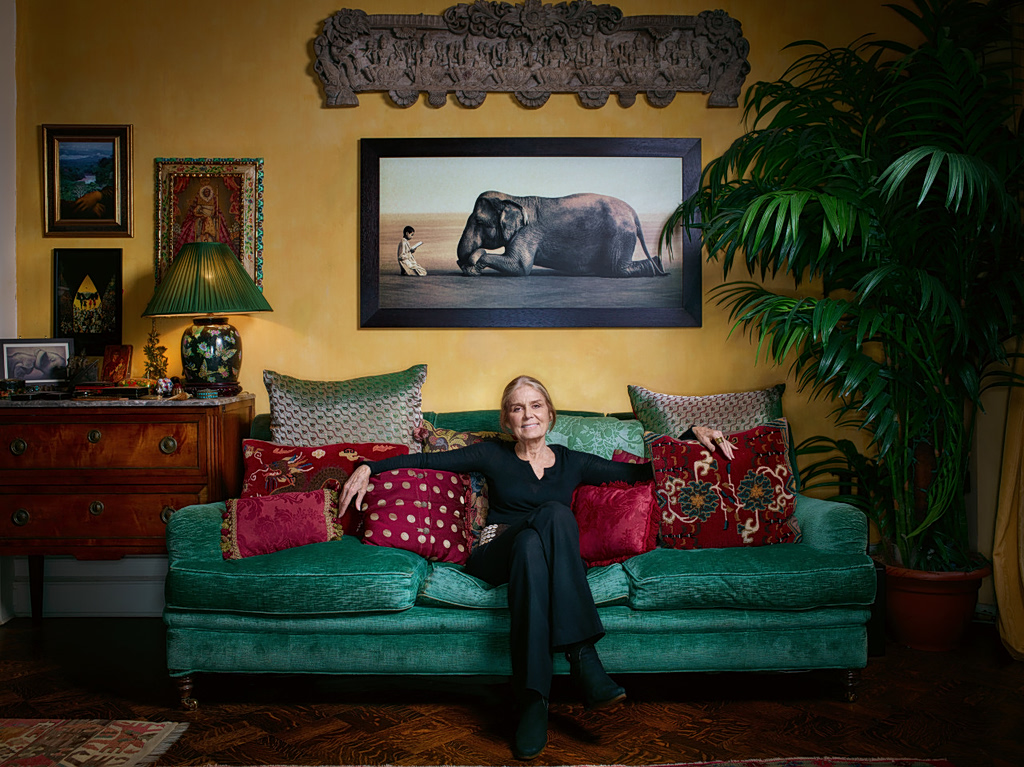
Steinem in 2015. Brad Trent for WSJ
As Steinem dove headlong into covering the movement, women’s groups invited her to speak. Petrified, she recruited two charismatic friends as alternating sidekicks: daycare owner and activist Dorothy Pitman Hughes, and civil rights attorney Florynce Kennedy. Both were also Black, expanding the audience for their talks.
For Steinem, the most rewarding part of these events were the open-ended conversations she facilitated afterward, as those in the room formed connections, hatched plans. She referred to these sessions as “talking circles.” For the rest of her life, she would urge her audiences to turn and introduce themselves to each other once the house lights came back on—sharing what was on their minds, discovering what might be done about it together.
The founding of Ms.
In 1971, Steinem co-founded Ms. magazine, run exclusively by women, for women, and born from conversations with other women writers who’d grown exhausted with the belittling conventions and blind spots of male-dominated media. The idea was radical. So was the name. When answering the phone, the staff found they had to refer to the magazine as “M-S magazine” because the appellation was still so unfamiliar in the culture that few recognized the sound of the word.
Ms. would become known for spirited, frank coverage of subjects that were typically only spoken about quietly: workplace and domestic inequalities, domestic violence, homosexuality, racism, date rape. That fearlessness was apparent in the inaugural issue, which included, the year before Roe v. Wade, a statement titled “We Have Had Abortions” signed by 53 famous women, including Steinem, Judy Collins, Anaïs Nin and Billie Jean King.
It was an era in which women weren’t always permitted to open a bank account or get a credit card without their husband’s permission; when a husband was lawfully allowed to rape his wife. Many presumed Ms. would be too revolutionary, explicit or militant for mainstream women of the time, or be mistaken for a lesbian journal. Instead, it sold out all 300,000 copies of its first stand-alone issue, in July 1972, in just eight days. And yet, when it came to recruiting advertisers, Steinem said, “We were met with pure, unadulterated hostility.”
Some conservatives reviled the magazine, and some radical feminists criticized it as not bold enough. But under Steinem’s editorship, which lasted until the sale of the magazine in 1987, it became both a beacon and a lifeboat for many contemporary women—a centerpiece of feminism’s second wave.
Building on that stature, Steinem escalated her organizing. She spent several years lobbying to push an Equal Rights Amendment through Congress, and then—unsuccessfully—to have it ratified by the states. In 1971, she and other leading feminists, including Shirley Chisholm, Bella Abzug and Dorothy Height, founded the National Women’s Political Caucus, to get more women elected to office and involved in public life—one of several equality-focused organizations Steinem would launch. She also initiated “Take Our Daughters to Work Day” in 1992.
Steinem spoke explicitly about pushing the women’s movement beyond its initial concerns—essentially, the benumbed, unfulfilled flourishing of white middle-class housewives like her own mother. A core conviction, she wrote in “Outrageous Acts,” was “that sex and race discrimination are so pragmatically linked and anthropologically interdependent that one cannot be successfully uprooted without taking on the other.”
She advocated for joy and communality as essential parts of any movement, and was especially inspired by the 1977 National Women’s Conference in Houston. The four-day conference, which Steinem had a prominent role in organizing, brought together 2,000 elected delegates and 32,000 observers—women from every state as well as representatives from indigenous groups. Steinem described watching them hash out an ambitious “National Plan for Action”—a platform for equality with 26 planks—amid a feeling of “celebratory chaos.”
“In the ’70s, it was heady and exciting,” she said in a 2011 documentary, “Gloria: In Her Own Words.” “And naive. Because, we thought, ‘These injustices are so great, surely if we just explain them to people, they will want to fix them.’ ”
Humor and looks
Steinem usually attributed her effectiveness as a spokesperson to her sense of humor, but understood that her beguiling good looks also played a role. The allure of her physicality and personality seemed intertwined: she was often shown laughing or making others laugh, dressed stylishly, and was known to tap-dance spontaneously in elevators.
The feminist writer Susan Faludi, speaking to the Los Angeles Times in 1992, noted that Steinem’s attractiveness and wit were a powerful reproach to “those who would dismiss feminism as a gathering of sour-faced, bonneted suffragettes.” Steinem often recalled a woman standing up at a meeting early in her career and perfectly articulating the power that Steinem’s physical beauty conferred on the movement: “It’s important for someone who could play the game, and win, to say, ‘The game isn’t worth s—.”
Steinem could express her outrage directly and profanely, or wrapped in a slick and quick-witted savviness. She was fun to watch; she had a way of bending conversations where she wanted them to go. When she turned 40 in 1974, a reporter told her she didn’t look it. She famously shot back: “This is what 40 looks like. We’ve been lying for so long, who would know?” Fifty years later, at 90, she told one interviewer she wanted to print T-shirts that read: “I’m at an age when remembering something right away is as good as an orgasm.”
Steinem had many well-known romantic partners throughout her life, including Franklin Thomas, the head of the Ford Foundation; film director Mike Nichols; Stan Pottinger, an assistant attorney general in the Justice Department’s civil rights division; and Olympic decathlete Rafer Johnson.
In the late 1980s, during roughly the same period Steinem later described grappling with depression, she also dated New York real-estate magnate Mort Zuckerman . Without using his name, Steinem described, in her 1992 book “Revolution from Within,” Zuckerman or his staff making every decision about their social life during that time, so “all I had to do was show up, look appropriate, listen, relax at dinners, dance, laugh at his wonderfully told jokes—whatever was on his agenda. I found this very restful.” The Washington Post’s Sally Quinn characterized this turn of events as one sign that “feminism as we have known it is dead.”
Steinem married for the first and only time at age 66, in 2000, to David Bale, a businessman and environmentalist (and father of actor Christian Bale). The ceremony was held at the Oklahoma home of Steinem’s friend Wilma Mankiller, former head of the Cherokee Nation. Steinem wore jeans. Three years later, Bale died of brain lymphoma.
Late in life, Steinem took to walking from the Upper East Side brownstone in Manhattan where she had lived since the 1960s into Central Park, to press her hand against the tremendous boulders rising out of the ground there. It was a way of reminding herself, she explained at the New York Public Library in 2015, that the many ideologies that she saw constraining society—sexism, patriarchy, homophobia, colonialism, monotheism—are arbitrary and relatively recent constructions, all far less real than those rocks.
She remained active and peripatetic through her 80s. In her 2015 memoir, “My Life on the Road,” she noted that, for the past four decades, she had spent at least half her time traveling—making innumerable public appearances, stoking movements and offshoots of movements, with a special focus, in later years, on child abuse and violence against women around the world.
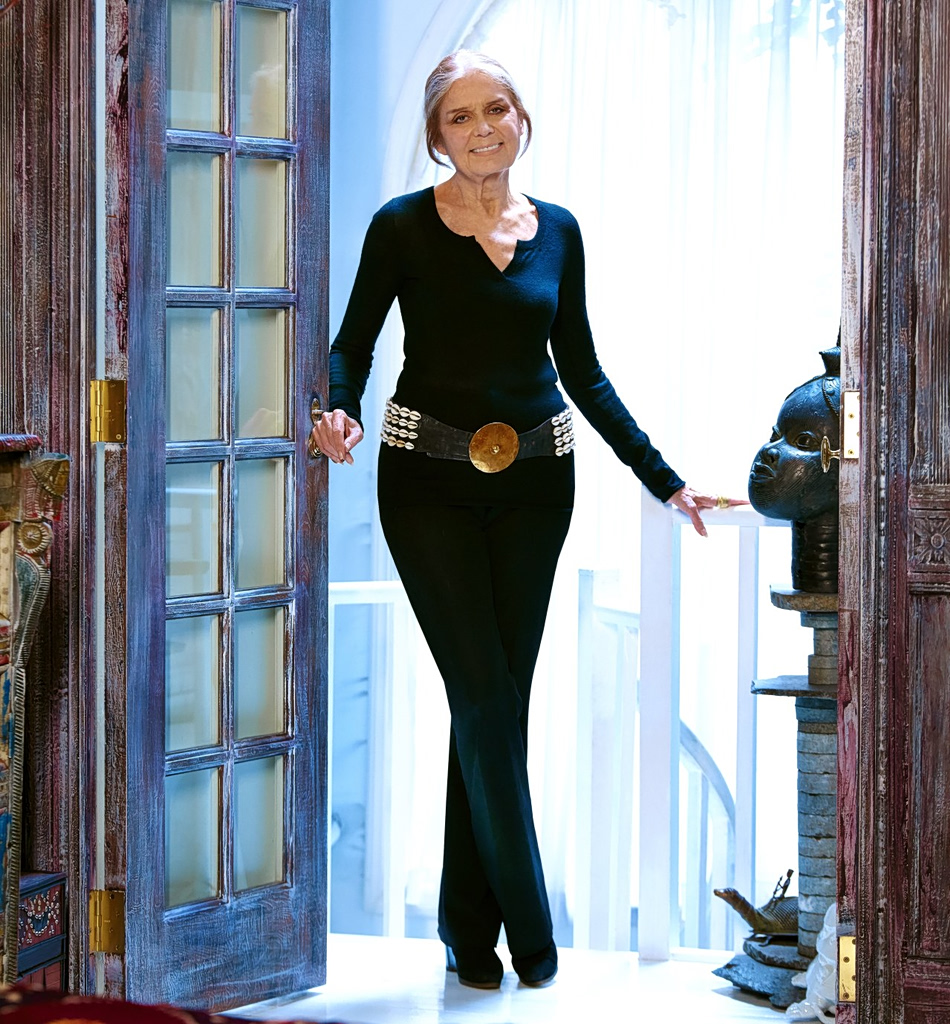
Steinem was active and outspoken in her later life, retaining the sensibility of a journalist on the road. Brad Trent for WSJ
She retained the sensibility of a journalist on the road, eager to listen to strangers’ stories, but was constantly called on to dispense wisdom as well.
When a young audience member asked Steinem at a 2019 event in San Francisco what she would tell a budding feminist like her who wanted to get involved, Steinem answered: “I would say that I’m not here to tell you what to do. I am here to support you in doing anything you f—ing well please.”
Write to Jon Mooallem at jon.mooallem@wsj.com