
 Μake us preferred on Google
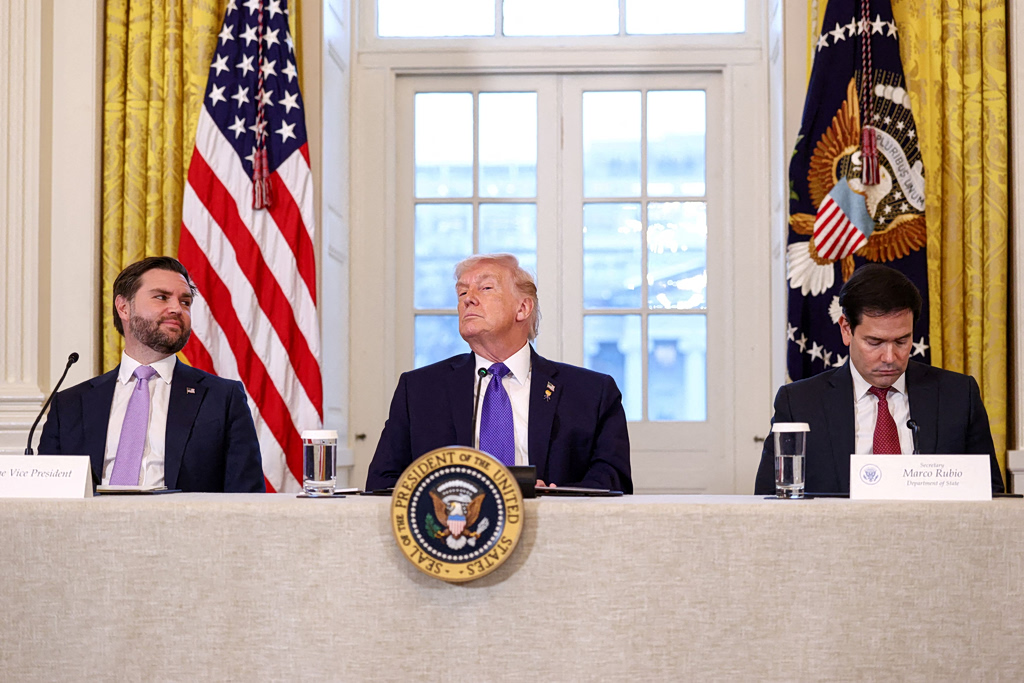
 WASHINGTON—The GOP-led House voted to restrict President Trump ’s ability to continue the war against Iran without congressional approval, a rebuke to the White House and the latest sign that Republican lawmakers’ support for the war is eroding on Capitol Hill.
The measure passed 215-208 , with four Republicans joining Democrats in support. The resolution, which is unlikely to become law, directs the president to remove U.S. armed forces from hostilities against Iran unless explicitly authorized by Congress, other than to defend America, an ally or partner from “imminent attack.”
The war, which began in late February, has morphed from a heavy bombing campaign to a fragile ceasefire as the U.S. and Iran jockey for control of the Strait of Hormuz. Negotiators remain far apart on the future of Tehran’s nuclear program, and skirmishes have ticked up in recent days as the U.S. enforces its blockade of Iran and its ports.
When Trump launched the war, fellow Republicans backed him, saying the president had the authority to act as commander in chief. But as the war dragged on with no clear resolution in sight, some Republicans have started to waver, particularly with the midterm elections drawing closer. Trump’s poll numbers are sagging, and gasoline prices continue to climb.
The four Republicans to vote for the measure were Reps. Thomas Massie of Kentucky, Brian Fitzpatrick of Pennsylvania, Tom Barrett of Michigan and Warren Davidson of Ohio.
“People are tired of $5-a-gallon gas and $6-a-gallon diesel and fertilizer we can’t afford to put on our fields in Kentucky,” said Massie, who lost his primary to a Trump-backed challenger last month. “So I think it sends a good message that the people’s House, which represents the people, is tired of this war.”
House Speaker Mike Johnson (R., La.) condemned the result. “Very unfortunate outcome, and it’s very dangerous at a very serious time,” he said.
Democrats were united in favor of the measure.
“It’s the beginning of the end of the war,” said Rep. Ro Khanna (D., Calif.). “The House of Representatives said the American people are tired of it.”
Beyond Iran, the vote marks the latest in a series of setbacks for Trump in Congress and the courts. On Tuesday, the administration said it would kill a controversial “anti-weaponization” fund that stood to benefit Trump supporters who participated in the Jan. 6, 2021, riot at the U.S. Capitol , after strong pushback from GOP senators. Last week, he said he was giving up on his effort to renovate what he termed the Trump Kennedy Center after a judge ordered his name removed.
His pick of close ally Bill Pulte as acting director of national intelligence also is threatening to derail reauthorization of a critical surveillance power facing a deadline this month, after Democrats and some Republicans called the official unqualified for the job.
The House’s passage of the war-powers resolution won’t, by itself, end the war. Numerous procedural hurdles could make it difficult for such a resolution to reach Trump’s desk. Even if it did, the president can issue a veto, and the House and Senate remain well shy of the two-thirds supermajority that would be required to override him.
Some lawmakers said the vote was ill-considered.
“It really undermines the president’s leverage and ability to negotiate,” said Rep. Michael McCaul (R., Texas). “Because now Iran is going to see this and think that the United States Congress, you know, American people don’t support it.”
But others said Trump had an obligation to seek approval from lawmakers.
“Bring it to Congress, debate it on the merits, and have this vote. That’s the way the system is supposed to work,” said Fitzpatrick. Asked if he was worried Trump would come after him over the vote, he said, “No, no, I’ve got to do my job. I will continue to do my job.”
In his first term, Trump vetoed war-powers resolutions regarding Yemen and Iran, and Congress failed to override his vetoes.
Ahead of Wednesday’s vote, Democrats in the House had previously tried and failed multiple times this year to pass resolutions that would limit the president’s ability to conduct military operations against Iran, arguing that the war is illegal because Trump hasn’t sought or received permission from Congress. Last month, House Republican leaders yanked a planned Iran vote after it became clear that the resolution, forced to the floor by Democrats, would likely pass.
A Fox News poll conducted last month found that 60% of respondents opposed the U.S. military action in Iran, compared with 40% who supported it.
In the Senate, Republicans have thwarted similar war-powers resolutions, voting to block them seven times since the start of the war. But there have been signs that GOP unity is cracking.
Late last month, an Iran war powers resolution cleared a procedural hurdle after Sen. Bill Cassidy (R., La.) voted in favor. He joined Sens. Susan Collins of Maine, Lisa Murkowski of Alaska and Rand Paul of Kentucky as the only Republicans voting with most Democrats on the procedural motion to discharge the resolution from committee and force a vote on the floor.
Republicans played down the significance of the vote to advance the resolution, noting that three GOP senators were absent.
The House also voted 218-204 to advance a bill to fund Ukraine aid Wednesday, after a bipartisan discharge petition reached the threshold last month to force a vote on the House floor. Six Republicans and one GOP-affiliated independent voted with Democrats in favor of moving forward with the bill, which seeks to authorize more than $1 billion in defense aid, $8 billion in loans, as well as new sanctions against Russia. Trump has previously opposed further aid to Ukraine.
Write to Terell Wright at terell.wright@wsj.com , Lindsay Wise at lindsay.wise@wsj.com and Olivia Beavers at Olivia.Beavers@wsj.com