
 Μake us preferred on Google
 Robert Prati splurged on business-class tickets for a trip to Europe in late July.
The 56-year-old retired finance professor paid $5,242 for two round-trip tickets from North Carolina to London, with a stopover in Iceland on the way home.
Everything went smoothly until the last leg. Icelandair made a last-minute plane change and the new aircraft had fewer premium seats.
At the airport, he and his girlfriend were unceremoniously bumped to an aisle and middle seat in economy for the seven-hour flight from Reykjavik to Raleigh. The worst part besides the tight squeeze: The young passenger in the window seat kept the shade down during the total solar eclipse he was excited to see from the sky.
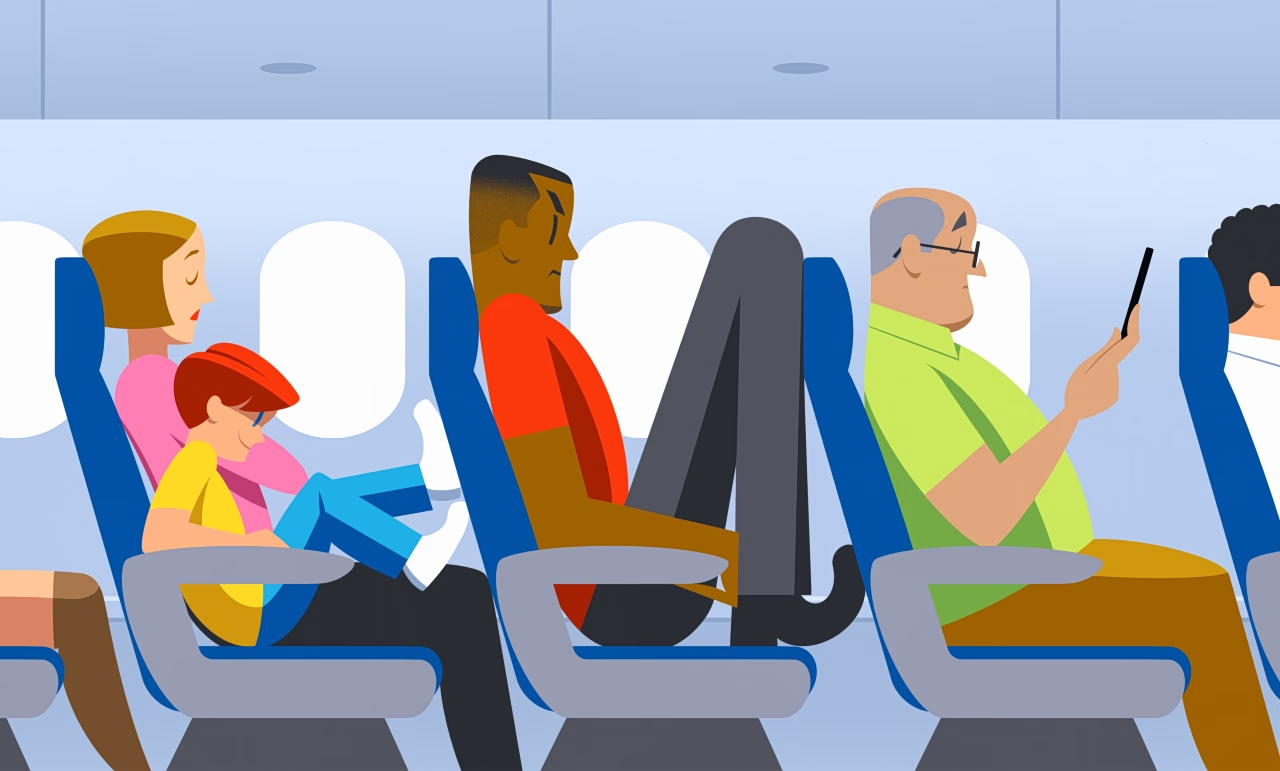
Seat downgrades are increasingly becoming a pain point for passengers in this era of packed flights and fees on practically every seat on the plane. The U.S. Department of Transportation says it has logged more than 350 complaints on the subject this year through June 30.
“The seating charts are a house of cards. They’re just waiting to collapse,” says veteran airline consumer advocate William McGee.
He was an airline dispatcher a few decades ago and says aircraft swaps, due to canceled or delayed flights, maintenance or other issues, were simpler then because planes weren’t as full and so subdivided.
“In the old days, an economy seat was an economy seat, end of story. You didn’t have nine different classes.”
What’s a traveler to do? Stay on top of your reservation and know your rights, whether you get advance notice of seat changes or find out at the airport, like Prati. Don’t just take it as another travel unpleasantry and move on. You might not get all you’re hoping for, or anything in some cases, but you should make your case.
The first step is to try to get ahead of any plane swaps and resulting seat downgrades when you find out in advance rather than at the last minute.
Holly Etlin, a retired executive who has flown millions of miles on Delta, American and United while traveling weekly for her career, books a lot of flights in advance and checks them weekly for any schedule changes.
“When they mix the schedule, they also often mix the airplane,” she says.
As soon as she notices a seat switch, she contacts the airline for a fix. It helps that she has status, but all travelers can benefit by investigating other options quickly. That way you don’t get a nasty surprise at the airport and have to scramble there.
The refund rules
Travelers who pay a fee for advance seat selection or seat upgrades are entitled to a refund if the seat is unavailable due to no fault of their own, the DOT says. The same rule applies to other ancillary services including in-flight Wi-Fi.
The rules are different and more complicated when you get downgraded from one cabin to another, say from first class to economy or business to premium economy on international flights. And, to make things even more confusing, your rights depend on what airline you’re flying and where.
For domestic flights and international departures on U.S. airlines, you’ll be covered by DOT rules and basically have two choices. You can cancel the flight and get a full refund. (That is not ideal when the downgrade happens at the last minute and you need to get to your destination or home.) Or you can take the downgrade and get a refund of the difference between the original fare and what it calls the downgraded fare. One reader calls it a take-it-or-leave-it seat in economy.
How much of a refund? Airlines have a lot of latitude here because the DOT definition of a downgraded fare is murky, McGee says.
The key is to press your case and cite DOT rules, not simply complain and say you’re never flying the airline again. It helps to provide copies of your original booking, communications about the seat switch and other documents. Screenshots are your friend. And so is loyalty status, of course.
“You have to make noise with the airline and say, ‘Look, you did not give me what I paid for,’” he says.
The rules are slightly clearer when flying internationally because the EU and U.K. have more robust passenger rights. Start by checking those links to see if you’re eligible. (You are covered in both cases on flights departing Europe, for example, on any airline. But for flights to Europe, you’re only covered if you’re on an international carrier.)
While there is paperwork and complicated refund formulas, you are entitled to something for involuntary downgrades and shouldn’t let airlines off the hook.
Just keep your expectations in check regardless of how much you plunked down for that round-trip ticket in business class. Prati filed a claim with Icelandair under the EU rules and was told he is only due $466.92 per passenger, or $933.84 of the $5,242 they shelled out for the business-class tickets.
“I wasn’t expecting or looking to win a lottery in terms of compensation, but cruise lines at least offer future cruise credit when their passengers suffer gross inconveniences,” he says. “We suddenly went from being treated like royalty to being sent to the back of the bus.”