 Μake us preferred on Google
 “To understand the Murdochs, you first have to understand the TV series Succession.”
With this line from New York Times journalist Jim Rutenberg, the curtain rises on Dynasty: The Murdochs, the new four-part Netflix documentary that premiered on March 13th, determined to take viewers deep inside one of the most powerful families on the planet.
The quote is undeniably apt, since Jesse Armstrong’s masterpiece on HBO, with the ruthless Logan Roy and his power-hungry children as its (anti)heroes, stands as the ultimate cultural reference point for the toxicity of wealth and its entanglement with power.
But the real story of the most influential, for good, and mostly for ill, family in global media is not a well-written fictional script.
The documentary, directed by award-winning filmmaker Liz Garbus, makes clear from early on that the reality is far darker, far more cynical, and ultimately deeply disheartening.
Behind the closed offices of News Corp, Fox, The Wall Street Journal, The Sun, and just a few of the countless media outlets with which Rupert Murdoch has been associated over the years, the battle for succession was never just about a share of the ancestral billions.
It was mainly about who would hold the remote control of global public opinion. In other words, who would set the agenda for the Western world after the death of the 95-year-old mogul.
Father Rupert Murdoch
It may seem unlikely, but the man who built the media colossus we know today started from almost nothing in the 1950s. From the small local paper The News in Adelaide, Australia, which he inherited from his father, Keith Murdoch. Using that publication as a seed, he built a relentless and unstoppable political machine.
Dynasty: The Murdochs, gathering testimony from top analysts, investigative journalists, and former executives of the Australian-American mogul’s companies, traces the steps of the man who, as the saying goes, has been making and breaking governments for decades.
His strategy was always twofold: on one hand, the ruthless commodification of news through populism and sensationalism. On the other, the use of mass influence as currency for political deals.
When Murdoch moved his empire to the United Kingdom in the late 1960s, he bought News of the World and The Sun, turning them into instruments for producing scandals, tabloid sensationalism, and above all into weapons of mass political influence.
No British prime minister, from Margaret Thatcher to Tony Blair, could govern without his approval, even if only tacit. Murdoch read the public better than anyone.
In a characteristic, almost comedic scene mentioned in the Netflix documentary, he is said to have sat on the London Underground silently observing what young women of the era were reading, in order to decode the instincts of the masses.
He reached the height of his power after crossing the Atlantic and entering the American market.
The acquisition of the New York Post in the 1970s, and the subsequent founding of Fox News in the mid-1990s, permanently changed the American media and political landscape.
The Netflix series underlines his decisive relationship with Ronald Reagan, whose sweeping media deregulation policies were what later allowed Murdoch to bypass antitrust laws and set up his television network.
Fox News evolved into a safe haven for conservative America, but also a mechanism for feeding anger, perpetuating division, and spreading conspiracy theories, which hit overdrive from the moment Donald Trump appeared on the political scene.
Incidentally, the Murdoch–Trump relationship could serve as a case study in cynicism. As revealed through testimony, Murdoch privately called Trump a fool.
But when he realized that the current US president’s populism was generating astronomical ratings and rallying Fox’s base, the patriarch did a spectacular somersault, transforming his network into the ultimate propaganda arm of Trumpism.
It is no coincidence that actor Hugh Grant, himself a victim of phone-hacking by Murdoch’s newspaper machine, with which he eventually reached an out-of-court settlement, makes a brief but caustic appearance in the documentary, describing Murdoch outright as “a genuine threat to liberal democracies.” And he is probably not alone in that view.
The Children: The Unknown Prudence, the Chosen Lachlan & the Prodigal James
At the heart of the labyrinthine power structure Rupert Murdoch created are his children.
The narrative of “who will take over” News Corp and 21st Century Fox (before most of it was sold to Disney) was kept alive for decades. But the documentary, cleverly using the motif of an animated board game, demonstrates that the siblings were never real contenders. They functioned like puppets, or rather, like pawns in their father’s game.
Prudence, the eldest child from Murdoch’s first marriage to Patricia Booker, understood the rules early on and now keeps her distance from her father’s businesses, having settled for financial security.
Lachlan, the firstborn son from Rupert’s second marriage (to Anna Torv), was always the favourite. Visually charming, but politically aligned with his father’s far-right, hard line, he was placed in leadership positions from the age of 22, initially being put in charge of Queensland Newspapers, the publisher of The Courier-Mail in Brisbane.
Despite periodic clashes with his father, which even led to a temporary exile back to Australia in the 2000s, he returned as the ultimate champion of the empire’s conservative vision.
Every family must have its prodigal son. The Murdochs have found theirs in the 53-year-old James.
Perhaps because he was always hot-tempered, restless, and above all ideologically detached from Fox News’ editorial line.
With strong concerns about climate change and a more centrist, liberal outlook, James Murdoch believed the company needed to modernize and break free from its toxic populist rhetoric. To his father, this was not merely the expression of a dissent or disagreement, but the birth of a heresy.
The Wronged Daughter: Elisabeth Murdoch
Of course, even harder than James’s fate is that of his sister, Elisabeth. Although the 57-year-old is widely regarded as the most capable and creative mind in the family, she faced an insurmountable obstacle from birth.
The sexism of her own father, and of the system he created and has consistently represented. Many say that her chromosomes robbed her of the position that, under other circumstances, would have been hers by right.
It is not hard to understand that the dynamic between the Murdoch siblings was always toxic. Exactly as their father orchestrated it.
Indeed, whenever one of his offspring tried to become independent and cut the umbilical cord, Murdoch would appear as a poorly-intentioned deus ex machina. By buying out the companies his children created, or luring them back with positions in the family business, he succeeded in thwarting their independence, keeping them bound to the board of his own game.
Even in private family moments, the toxicity was overwhelming: the children remembered Rupert Murdoch systematically cheating at Monopoly, or ignoring them so conspicuously when they were small that James had come to believe his father had a hearing problem.
The Scandals: Sex, Lies & Phone Hacking
Of course, what served his interests, Rupert Murdoch listened to with wide-open ears.
The Netflix documentary examines in depth the UK phone-hacking scandal, a dark period in which News of the World journalists intercepted the voicemails of celebrities, politicians, and even members of the royal family in pursuit of exclusives.
The scandal, exposed thanks to The Guardian‘s persistence, shocked the country, led to the closure of the historic 168-year-old newspaper (1843–2011), and caused a political earthquake.
Former reporter Paul McMullan vividly describes in the documentary then-editor Rebekah Brooks striding through the offices, throwing articles into the air and screaming: “This is sh*t!”
More significantly, the scandal had a profound impact on the family itself. James Murdoch, as head of the British arm of the business at the time, found himself at the centre of the storm.
He was forced to testify before a parliamentary committee and, though he avoided the worst, his standing within the family empire was irreparably damaged. His father gave him formal protection, but in practice wrote him off as a “burned card” for the top position in the “succession game.”
Meanwhile, in the US, Fox News was experiencing its own moral collapse in almost parallel fashion.
Former executives such as Alisyn Camerota and David Shuster speak openly about the systemic culture of sexual harassment that prevailed at the network, under the stewardship of the powerful Roger Ailes and top presenters such as Bill O’Reilly.
Murdoch’s logic was always cynical: as long as ratings and revenues were sky-high, ethics went in the drawer. The dismissals of Ailes and O’Reilly only came when the public outcry and the financial risk from settlements became unmanageable.
Operation “Family Harmony”
The climax of the Murdoch family drama, the moment reality definitively overtook the fiction of Succession, was written in September 2024, not behind the closed doors of some boardroom, but in a courtroom in Reno, Nevada.
What was at stake was control of the Murdoch Family Trust, which holds the voting shares in News Corp and Fox Corp.
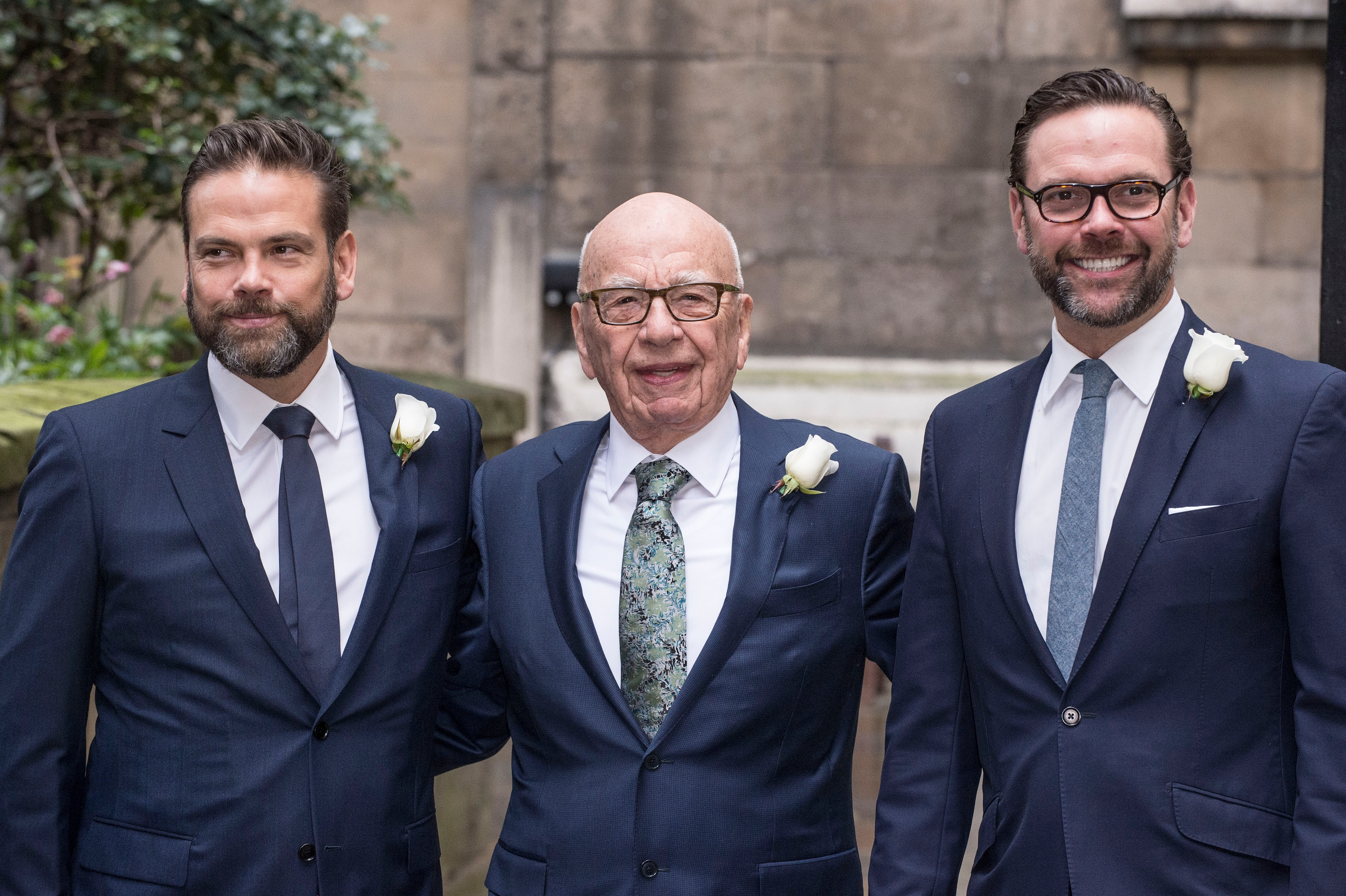
Under the original agreement, after Murdoch’s death, his four eldest children (Prudence, Elisabeth, Lachlan, James) would have equal rights, while his two younger children from his third marriage to Wendi Deng — Grace (now 24) and Chloe (22) — would receive a financial stake at age 30 but no voting rights.
However, knowing that his biological end was inevitably approaching, the pater familias decided to rewrite the rules.
In collaboration with 54-year-old Lachlan, they organized a secret plan, which they baptized with the apt yet ironic name Project Family Harmony. Their goal was to change the terms of the trust to ensure Lachlan’s absolute dominance.
The motivation was not so much financial. After all, the Murdochs, with a fortune currently estimated at $22.3 billion, have more money than they could ever need. It was ideological.
Rupert Murdoch knew that if James and his older sisters gained control, they would inevitably try to shift Fox’s ideological line toward the centre. That would be akin to destroying the life’s work for which he had spent money, years, grey matter, and the last drop of his cunning.
The three siblings discovered the plan and took legal action. The trial that followed was a display of psychological brutality. The 95-year-old mogul’s ruthless nature was chillingly captured during the examination of his own son.
As the Netflix series reveals, while Rupert Murdoch’s lawyer was questioning James Murdoch, Rupert himself sat beside him and dictated cutting questions in real time:
“Have you ever achieved anything on your own?” … “Why were you too busy to call your father on his 90th birthday?”
This was not a simple legal dispute with tabloid undertones. It was the public humiliation of a son by his own father.
Although the three plaintiffs won a favourable initial ruling in Nevada, the intra-family war had its price.
In September 2025, both sides reached an out-of-court settlement. The details remain tightly sealed, but the practical outcome is clear: the conservative wing prevailed.
Lachlan Murdoch secured absolute control of the empire until at least 2050, while the other siblings stepped back, receiving $1.1 billion each as consolation.
Blood Ties? What Blood Ties?
As the documentary’s closing credits roll, the viewer — especially anyone who closely follows the tectonic shifts in the media world — is left with a rather bitter taste.
The Guardian critic Lucinda Everett puts it aptly: the documentary makes it very difficult to feel sympathy over which billionaire will control a few more billions. The endless analysis of who got which promotion often feels like a depressing catalogue of nepotism, without any emotional catharsis.
Rupert Murdoch, who in June 2024, following his divorce from Jerry Hall, married for a fifth time, to Elena Zukova (mother of Dasha, wife of Stavros Niarchos the Younger), built a (toxic) empire but bequeaths to his descendants something more.
A manual for how power can manipulate truth, and corrode, when all is said and done, everything: the laws, professional ethics, democracy itself. Even the bonds of blood.