 Μake us preferred on Google
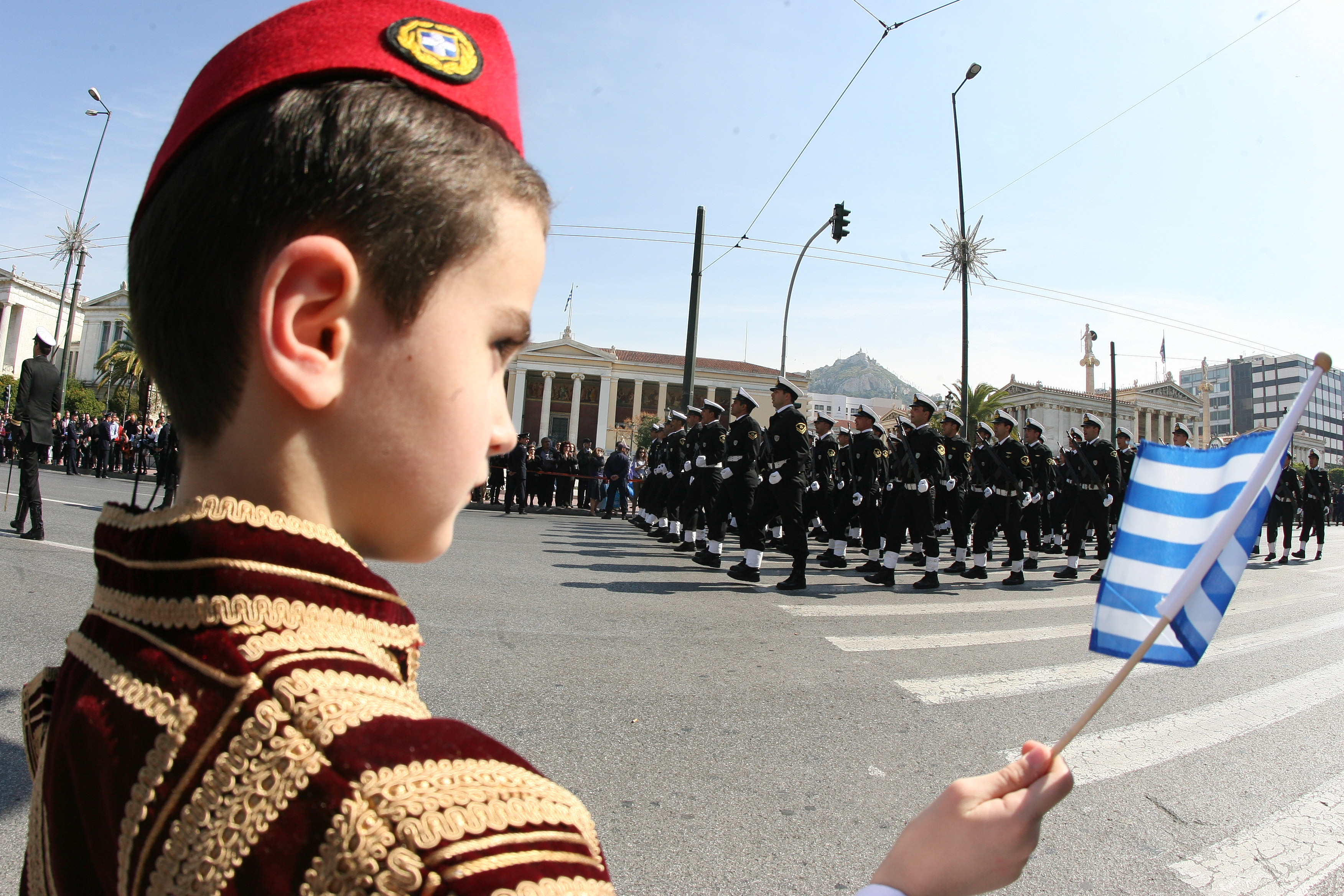
 If you take a stroll through the Athenian city center on the 25th of March, you will witness an electrifying atmosphere. Greek flags are everywhere, draped from balconies, clutched in the hands of children and adults alike, and pinned to lapels of jackets and coats.
Military march music thunders through public speakers lining the roadsides, playing the National Anthem, alongside Stratiotika Emvatiria, the rousing martial compositions that have soundtracked Greek soldiering for two centuries. Bugle calls ring out across the city, cutting through the crowd noise with piercing resonance.
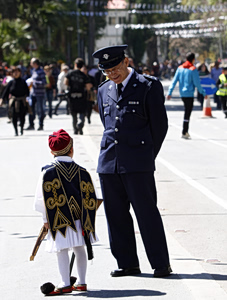
What you see on the street is a cross-section of Greek society in motion. The participants come from all walks of life: the Philharmonic Orchestra of Athens, the Air Force, and the Firefighting Corps, the Special Olympics Team, the Scouts.
Alongside them march various associations and regional societies representing communities across the country, including delegations from Crete, the Mani peninsula, the island of Folegandros, and dozens of other corners of Greece.
These are dressed in their traditional attire meant to emphasize their regional flair, a living tapestry of colours and patterns reflecting the richness and variety of Greek culture.
Yet, a curious modern observer might wonder how this rich visage crystallized into its contemporary form, and which pivotal events served as the formative influences on its development.
Athens News Agency
Back to their Roots
The day commemorates the launch of the Greek Revolution, the decisive birthing moment of the Greek coordinated struggle for independence from the near four-century dominion of the Ottoman Empire.
March 25th is also the Christian Feast of the Annunciation, the day the Archangel Gabriel appeared to the Virgin Mary.
According to legend, the day of the declaration was an engineered choice, fusing faith and freedom. The story claims that on the 25th of March 1821, Bishop Germanos of Patras raised the flag of revolution over the Monastery of Agia Lavra in the Peloponnese, with the cry Eleftheria i Thanatos (Freedom or Death) becoming the de facto motto of the revolution. Historians generally view this proclamation more as a pious legend than a documented event. The truth is certainly more nuanced, as the revolution had already broken out across the Peloponnese a few days earlier, in Mani on March 17th and in Kalamata on March 23rd.
The 25th of March, only became synonymous with the revolutionary struggle after King Otto aligned its beginning with the Christian holiday, to unify the national struggle with the Orthodox faith, in 1838.
The “Freedom or Death” slogan not only remains the national motto of Greece, it is also intimately connected to the nine stripes of the modern Greek flag, which is said to represent the nine syllables of this phrase.
Notwithstanding the exact accuracy of the historical sequence of events, the day itself symbolizes national pride, freedom, cultural identity, and an ironclad spirit of resilience.
The Parades Come to Life – The Early Years
With the London Protocol of 1830, the war of independence was officially resolved and Greece became an independent country. Yet, for the better part of the first 40 years, there were no parades to be found commemorating the spirit of self-determination.
In 1875, for the first time, the army paraded outside the royal palace (what is today the parliament building). The initial constituent elements of the parades were exclusively from the army, with students also joining the fold after 1899.
Student involvement was particularly pronounced during the celebration of March 25, 1924, when parades became associated with the declaration of democracy by Alexandros Papanastasiou, the first prime minister of the newly-formed Greek Republic. Following this momentous event, and until 1935, parades in front of the Parliament became known as the “Celebration of Democracy”.
The Origins of the Modern Parades
After 1936, the parades formally became an annual tradition, after the then dictator of Greece, Ioannis Metaxas institutionalized them. Until his death in 1941, Metaxas would use parades as a way to reinforce his authority and create a sense of unity, as part of his cultural engineering goal of building a “Third Hellenic Civilization”. This meant that the spirit of the parades became closely linked with pledging loyalty to the state and the leader, effectively transforming it into propaganda.
The Modern Parades
Nowadays, the parades are split into two days, the 24th and 25th of March.
The first day is reserved for students, with tradition dictating the best student of the school should carry the Greek flag. By custom, the General Lyceum of Kalavryta leads the student parade in Athens, marching in traditional Greek costume and bearing the original revolutionary flag of 1821 (a blue cross on a white background).
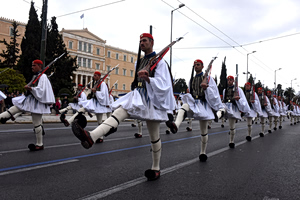
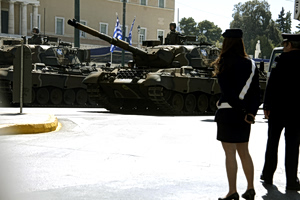
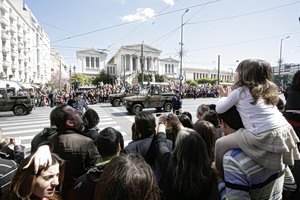
The second day is a military parade, meant to demonstrate the country’s strength and resolve, attended by the president of the country, and other high-ranking officials. It is traditionally initiated by the presidential guard (the men standing guard outside the parliament). Participation includes men and women from the Army, the Fire Service, and the Police, and is intended to be a spectacle for the national and international gaze.
Both parades pass in front of the Greek parliament building, having started in Vasilissis Sofias Avenue, and then continuing onto the Academy of Athens on Panepistimiou Street.
Hellenic Ministry of National Defense
Eurokinissi
Eurokinissi / Georgia Panagopoulou
A Key Debate
For many, these annual parades, particularly the student parade of March 24th, are politically polarizing.
On the one hand, they are seen as unifying events and a celebration of Greek identity and freedom from foreign oppression. Those who espouse this position also argue that school parades are more education-centred, celebrating students as the torchbearers and future of the country.
At the other end of the spectrum, criticism revolves around the perceived glorification of the military. They particularly cite student parades as being closely linked to the authoritarian and nationalist reign of Metaxas, that saw youth mobilization used as a political tool for reinforcing loyalty to the regime.
This debate is a timeless one in the Greek political scene.
What is clear is that the parades have shifted in tone and composition across the more than 100 years since their institutionalization, and will continue to change and adapt with the times, while still carrying the original spark of national freedom and resilience close to heart.