
 Μake us preferred on Google
 This summer, Epidaurus (both the Ancient and Little theaters) seems to circle obsessively around a common theme: humanity ‘under siege’. Against an increasingly unsettling international backdrop spanning both the Mediterranean and the Middle East, the Athens Festival program and the artistic choices of its director, Michail Marmarinos, serve to remind us—sometimes through myth, sometimes through testimony—of the importance of keeping the faith with human values in times of upheaval.
The Greek National Opera’s “Medea” returns as a re-imagining of a legend defined by Maria Callas; Euripides’ “The Bacchae” is interpreted as “Dionysian chaos”; and Alan Lucien Øyen’s “Antigone” strips the Sophoclean myth bare to bring it face to face with the ethical instability of our present. Meanwhile, at the Little Theater of Epidaurus, two further productions shift the focus from myth to contemporary reality. Marta Górnicka’s “Mothers – A Song for Wartime” brings together a chorus of women from different war zones, while Ivan Vyrypaev’s “I-ONE”, directed by Galin Stoev, transports tragedy into a dystopian future where identity and memory are subject to technological erasure.
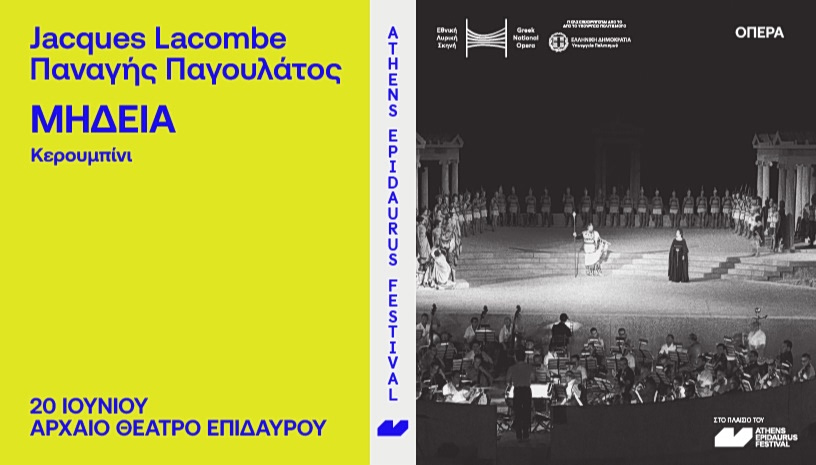
Epidaurus, Medea and the revival of the legend of Maria Callas
Greek National Opera – 20 June 2026
Ancient Theater of Epidaurus
The Greek National Opera returns to Epidaurus with Luigi Cherubini’s “Medea” for a single performance on 20 June 2026. It is a return imbued with a powerful historic charge, given that this year’s staging engages directly with the iconic 1961 production starring Maria Callas in the title role.
Sixty-five years on, the Greek National Opera has set out to transcend mere revival to re-create that historic moment, drawing on material from Alexis Minotis’s stage directions, the designs of Yannis Tsarouchis, and the photographic archive of the performances that immortalized Callas’s bond with Epidaurus. Here, the past functions not as memory, but as material that can be put to work dramaturgically.
This new staging contributes to the thematic focus of the Greek National Opera’s 2025/26 season, which explores the concept of “the opera of the future through the matrix of the past”. Following the closure of the Odeon of Herodes Atticus for restoration work, the Greek National Opera will continue its summer program at the Ancient Theater of Epidaurus, bringing opera back to the venue for the first time in decades.
The music is conducted by Jacques Lacombe, while the direction is handled by Panaghis Pagoulatos. Sets by Lili Pezanou, costumes by Tota Pritsa and lighting by Christos Tziogas combine in this new interpretation of a historic production, which engages closely with the available historical records and archival documents. Anna Pirozzi appears in the role of Medea alongside Jean-François Borras as Jason, Tassis Christoyannis as Creon, Alisa Kolosova as Neris, and Danae Kontora as Glauke, with the participation of the Greek National Opera Orchestra and Chorus.
This year’s Medea at Epidaurus seems to be aiming less at a ‘glorious revival’ and more at exploring what it means to restage a production that already enjoys legendary status in the pantheon of Greek culture.
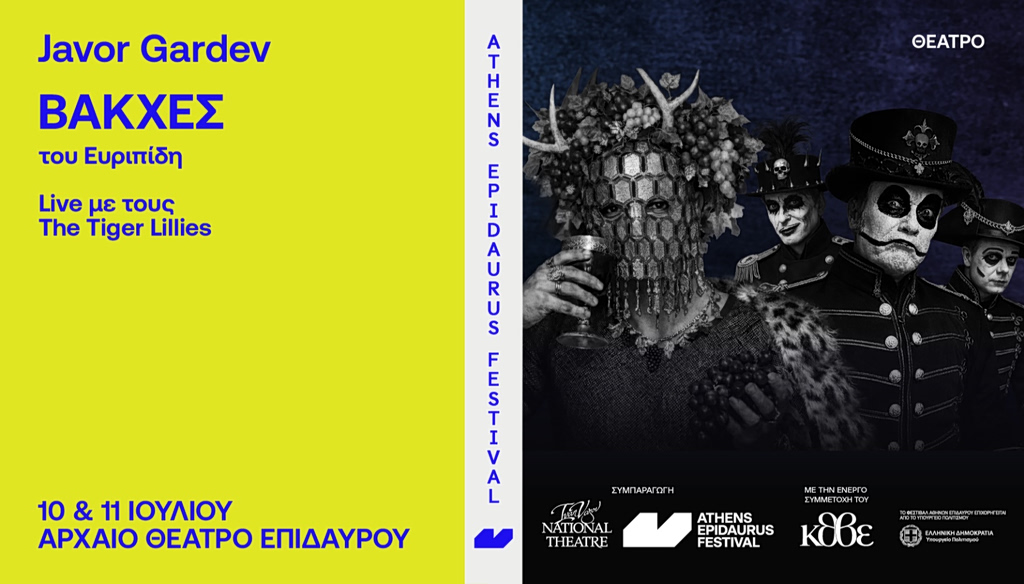
Provocative Bacchae & an Epidaurus in Dionysian ecstasy
Ivan Vazov National Theater of Bulgaria – Javor Gardev
Featuring The Tiger Lillies
Euripides’ “The Bacchae” is presented at the Ancient Theater of Epidaurus, directed by Javor Gardev in a co-production between the Ivan Vazov National Theater of Bulgaria and the Athens Epidaurus Festival, in collaboration with the National Theater of Northern Greece.
The production attempts a contemporary, almost disruptive interpretation of Euripides’ tragedy, centering on the timeless conflict between Apollo and Dionysus. In one of his most characteristic—almost Nietzschean—statements, the director returns to the age-old question: “Can Dionysus prevail completely over Apollo, even only within the confines of the stage?” Gardev’s direction addresses the ancient text as a test of the limits of order—of that point where Dionysian frenzy becomes a fracture in the very fabric of civilization. This Bacchae for our times asks questions about how societies deal with the repressed and the unpredictable, but also how the fear of order’s end manifests itself as a deep-seated collective anxiety that perpetually resurfaces in new forms.
The production’s musical identity is wrought and performed live on stage by The Tiger Lillies, the cult British trio, who bring their customary dark aesthetic to the stage like a troupe of Dionysian troubadours.
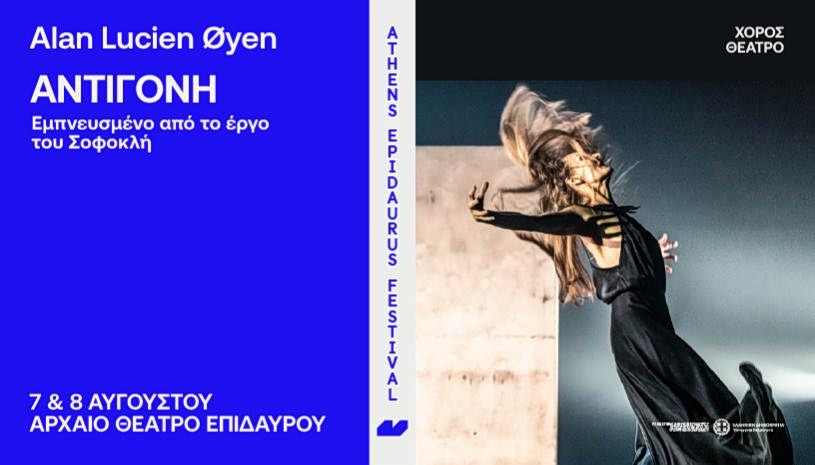
A hybrid Antigone: contemporary and raw
Alan Lucien Øyen – Greek Premiere
7 & 8 August
Norwegian creator Alan Lucien Øyen makes his Greek debut with a different interpretation of “Antigone” in which he attempts a deconstruction of the myth’s dramatic essence—to strip away every unnecessary “layer of artifice”, as he puts it.
This is a complex production in which dance is combined with the spoken word and theatrical narrative. Using a theatrical idiom that verges on the abstract, the production re-examines the weight of responsibility before the law and one’s conscience. Øyen crafts a work that eschews didacticism and simplistic interpretations, opting instead for a more existential and physical approach to tragedy.
At the heart of the project is winter guests, the artistic collective founded by Øyen: a hybrid ensemble that unites dancers, actors, writers and designers together into a single dramaturgical unit. The production also features key collaborators from Tanztheater Wuppertal, carrying forward the creative legacy of Pina Bausch. Notably, Øyen was among the first choreographers commissioned to create a new work for the company following Bausch’s death.
A women’s choir sings to exorcise the horrors of war
Marta Górnicka
Little Epidaurus – 4 July
At the Little Epidaurus Theater, “Mothers – A Song for Wartime” by Marta Górnicka shifts among musical theater, choral performance and collective testimony against the backdrop of contemporary war and the traces it leaves on the female body and voice.
The performance is built around a polyphonic ensemble of 21 women from Ukraine, Belarus and Poland, ranging in age from 9 to 71. Mothers and daughters, refugees and survivors form a unique choir that serves as a beacon for the preservation of collective memory. Among them are women from places such as Mariupol, Kyiv, Irpin and Kharkiv, bringing their lived experience of displacement, loss and survival to the stage.
Marta Górnicka, founder of the CHORUS OF WOMEN in Warsaw and the Political Voice Institute in Berlin, organizes a collective on-stage body in which the voice becomes both a political act and a means of survival. The piece begins with a shchedrivka, a traditional Ukrainian song of blessing, and evolves into a dense soundscape of folk songs, lullabies, nursery rhymes, incantations and political slogans. At the core of the performance is the idea that war, over and above the absolute and multi-layered destruction it wreaks, also inflicts a radical ‘fracture’ on language itself.
The production takes on an extra dimension in the intimate setting of Little Epidaurus, as the theater’s ancient acoustics and ritualistic proximity amplify its choral essence. “Mothers – A Song for Wartime” seeks to confront war in the present tense, utilizing the choir to articulate—and perhaps exorcise—the inexpressible.
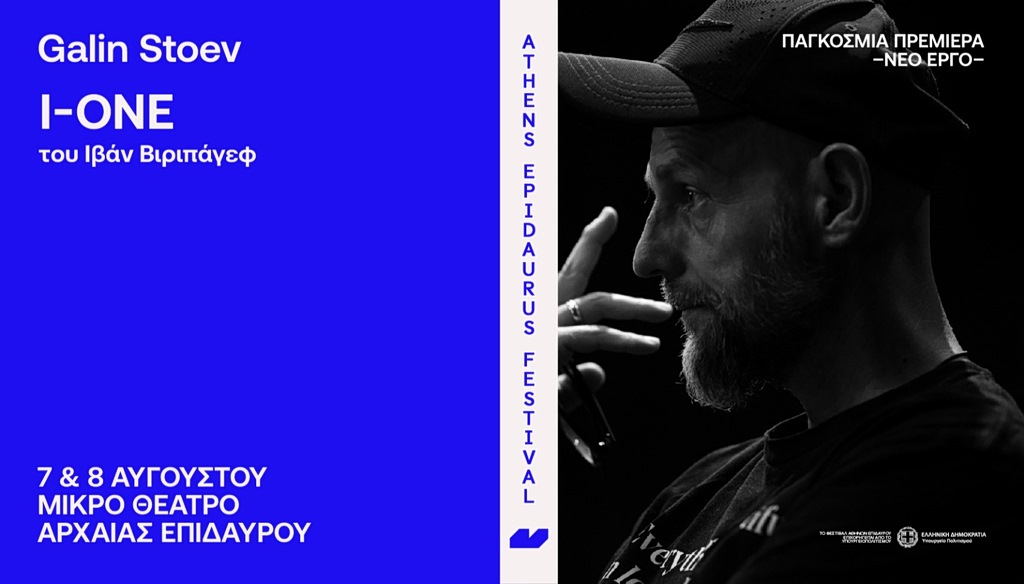
“What if they could erase our consciousness one day? The modern world as a variable at the dawn of the technological age”
Galin Stoev
Little Theater of Ancient Epidaurus – 7 & 8 August
The Little Theater of Ancient Epidaurus hosts the world premiere of Ivan Viripaev’s “I-ONE”, directed by Galin Stoev—a creator with a steady presence in contemporary European theater and a distinctive focus on the dramaturgical deconstruction of classical forms.
Viripaev’s futuristic text, written in English, is positioned from the outset within an international dramatic context. Drawing on the form of ancient tragedy, it transposes it into a contemporary, technological setting. The story is set in a dystopian United States in the year 2050, where the protagonist, Judith, is confronted by a crime that shatters her personal identity: the murder of her stepson and his nanny, who was also her husband’s lover. This act triggers a chain of consequences that shift the narrative from the realm of ethics into the sphere of technological intervention. Judith undergoes an experimental ‘conversion therapy’ via the I-ONE neural implant, which is designed to reshape criminal behavior. However, a technical glitch erases her memory and consciousness, leaving her without a stable sense of identity.
Galin Stoev’s direction treats technology as a mirror of the human condition. The work reframes the questions from “what happened” to “who is it who remembers or no longer remembers”, placing the instability of identity at its epicenter. The production is a global on-stage encounter featuring three actresses from different nations: Sofia Kokkali from Greece, Karolina Rzepa from Poland and Antigone Duchesne from Australia.