
 Μake us preferred on Google
 The Bank of Greece expects the economy to grow 1.9% this year, outpacing the eurozone, and predicts the outlook could improve further if a durable US-Iran agreement brings a permanent reopening of the Strait of Hormuz and pushes energy prices lower.
The forecast, set out Tuesday in the central bank’s Monetary Policy Report 2026, puts GDP growth at 1.9% in both 2026 and 2027, rising to 2.0% in 2028. Private consumption, investment and exports would drive the expansion, the bank said, despite elevated uncertainty in the global economy.
Inflation, measured by the EU’s harmonized index, is projected to rise to 3.8% in 2026 from 2.9% in 2025 before falling to 2.6% in 2027 and 2.3% in 2028 as energy and food prices ease. The bank attributed the near-term increase to volatility in international energy markets.
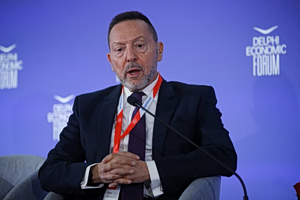
Governor Yannis Stournaras said a permanent de-escalation in the Middle East, accompanied by further declines in oil and natural gas prices, would raise the likelihood of more favorable outcomes. Under that scenario, growth would reach 2.0% in 2026 and 2.1% in both 2027 and 2028, while inflation would settle at 3.7% in 2026, 2.5% in 2027 and 2.2% in 2028. Greece imports most of its energy, leaving consumer prices exposed to swings in global fuel costs.
The bank said Greece had made significant progress in recent years, growing faster than the European average, strengthening fiscal and financial stability and advancing reforms. The European Commission no longer considers the country to have macroeconomic imbalances, a designation Greece carried through much of the debt crisis that began in 2010.
Significant challenges remain. The bank cited low productivity, an aging and shrinking population, skills shortages, weak household purchasing power and limited access to affordable housing. Public debt remains high despite a downward trajectory, and inflation above the eurozone average continues to weigh on competitiveness.
The central bank also set out a series of policy recommendations. In the near term, it called for prudent fiscal policy that does not add to inflationary pressure, with support for households and businesses kept targeted and temporary. Over the medium term, it urged measures to raise productivity, among them reduced bureaucracy, faster judicial and licensing processes and a stable tax framework. European funds, including resources from the programs succeeding the post-pandemic Recovery and Resilience Facility, should flow to sectors that strengthen productive capacity such as industry, logistics, research, artificial intelligence and pharmaceuticals, it said. It also called for increased housing supply, broader labor market participation and continued reduction of non-performing loans.
Stournaras said Greece was entering the coming period from a stronger position than in the past, crediting political and economic stability with allowing the consistent implementation of reforms and supporting confidence among investors and markets. Maintaining that stability, alongside continued reforms and the use of European funds, was a basic precondition for shifting to a more productive and resilient growth model, he said.
At the European level, Stournaras said geopolitical shifts, energy and defense security concerns and the green and digital transitions pointed to a need for closer cooperation and stronger financing mechanisms. He cited deeper integration and the completion of initiatives such as the Banking Union and a union for savings and investment as ways to support investment, reduce financial fragmentation and reinforce Europe’s strategic autonomy.
Source: ot.gr