 Μake us preferred on Google
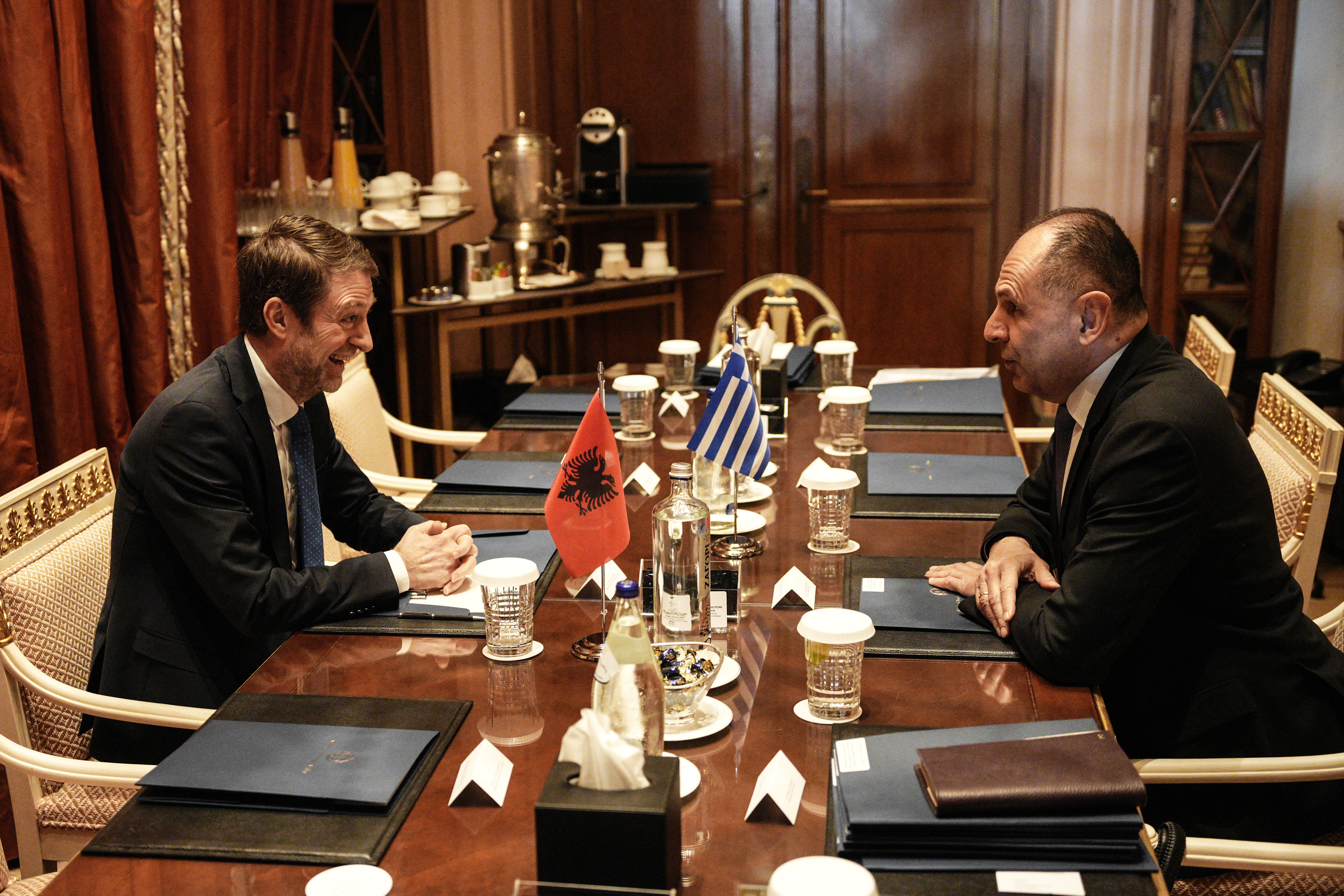
Following the meeting of the “Group of Friends of the Western Balkans and Western Balkan Partners,” organized by the Greek Foreign Ministry in Athens, Ferit Hoxha, Albania’s Minister for Europe and Foreign Affairs, spoke to Ta Nea about his participation in the process and about Tirana’s European prospects.
Commenting on the Greek initiative to advance EU enlargement in the Western Balkans, Hoxha said that “Greece knows the Western Balkans better than any other EU state.” He also stressed that Albania hopes Greece will use its presidency of the Council of the EU to deliver tangible and lasting results.
How do you assess the process you took part in on Monday in Athens?
Meetings like this one, under the “Friends of the Western Balkans” initiative, matter because they help turn enlargement from an abstract European principle into a shared political responsibility.
For a long time, the Western Balkans were treated mainly as a challenge to be managed. Today, more and more, we are treated as partners who are going to join. This change in perspective is not just a change in wording. It reflects a shift in political thinking and ambition.
It is especially symbolic that this discussion is taking place in Athens. Greece was one of the first countries to clearly and firmly support the European future of our region.
That was the promise of Thessaloniki in 2003, during the Greek presidency of the Council of the EU. More than two decades later, the question is no longer whether that promise still stands, but how quickly and how effectively we can turn it into reality.
As I said during the meeting, from 2003 until just a few years ago, the discussion about enlargement was almost always held in the future tense. Today, at last, we can talk about it in the present tense. Thanks in large part to the continuous efforts of this group, enlargement is once again a concrete political prospect. The question now is not whether it should happen, but whether we have the determination, the discipline and the political courage to complete it.
My assessment is therefore positive, but it in no way allows for complacency. The momentum is real, and we must make use of it. But momentum alone is not enough. It must be sustained and turned into tangible progress.
Above all, we must safeguard the credibility of the enlargement process. I often compare credibility to the “currency” of this process. Candidate countries must keep carrying out reforms, showing commitment and meeting their obligations.
In turn, when these efforts bear fruit, member states must honor their commitments, recognize progress and respond accordingly. Credibility works both ways.
That is exactly why meetings like Monday’s are important. They help maintain political momentum, strengthen mutual accountability and ensure that both sides stay true to their commitments. I would also like to thank my colleague and friend, Minister Gerapetritis, for bringing us together and for his warm hospitality.
EU Enlargement Commissioner Marta Kos has said that Montenegro and Albania are leading the accession race. Could Albania become a member during the second half of 2027, under the Greek presidency, or will it take longer?
Let me be precise, because precision strengthens credibility. Our goal is to complete accession negotiations by the end of 2027.
Membership itself comes after that. The accession treaty has to be signed and then ratified by all member states, a process that takes time. Realistically, we expect Albania to join the Union before the end of this decade.
The pace achieved so far speaks for itself. On October 14, 2024, we had not opened a single negotiating chapter. Within thirteen months, we opened all thirty-three. In May of this year, we became the first country to meet the interim benchmarks on the rule of law under the new methodology. Since then, we have started provisionally closing chapters.
If the completion of our negotiations were to coincide with the Greek presidency, and I hope that wish comes true, it would carry real meaning. The journey that began with the promise of Thessaloniki would reach a decisive milestone under the presidency of the country that made that promise. I prefer, however, that the timeline be set by results, not by symbolism. Our job is to make that result achievable through reforms that are substantive, sustainable and verifiable.
What was on the agenda with Foreign Minister Giorgos Gerapetritis? Did you discuss the delimitation of maritime zones?
We had an open and friendly discussion, as good neighbors and NATO allies who share not only a border but also a European future.
We discussed the critical importance of enlargement as an investment in Europe’s security, Albania’s European path and how Greece can support it, as well as regional security and economic cooperation.
We also talked about the people who are at the heart of our relationship and form a living bridge between us: the Greek minority in Albania and the Albanian community in Greece.
We did not go into every detail today, as we will have the opportunity to continue our discussions when I welcome the minister to Tirana in the near future.
As for the delimitation of maritime zones, our position remains firm and unchanged. In 2020, our two governments agreed to jointly refer the matter to the International Court of Justice in The Hague.
We remain fully committed to that approach. It is the right way for two neighboring European countries to resolve a legal issue: through international law, specifically the law of the sea, and through a rules-based process free from pressure or unnecessary politicization. These are important issues, but they are also complex and highly sensitive.
As with all neighbors, there are issues we need to address. What matters is how we approach them: looking each other in the eye, keeping an open, honest and constructive dialogue, and dealing with every issue with maturity and mutual respect.
Our relationship is much broader than any single issue. It is a relationship with deep roots, shared interests and a common European destination. It is also mature enough to handle outstanding issues calmly and responsibly, without letting them overshadow the broader strategic interests and common goals that unite us.
What are your immediate priorities? And what do you expect from the Greek presidency?
Our immediate priority is clear and specific: to close as many negotiating chapters as possible before the end of this year and to enter 2027 with a credible, clearly defined roadmap for completing the negotiations.
2027 will be the most demanding year of the entire process. It will require an exceptional effort in legal alignment, institutional readiness and administrative capacity. Above all, it will require tangible and lasting progress on the rule of law. That is the backbone of the accession process: the related chapters are the first to open and the last to close, and they ultimately set the pace of the entire negotiation.
We have no illusions about the scale of the work ahead of us. We know what is required, we are ready to do the hard work, and we are not looking for shortcuts. We are looking for results.
We will have further opportunities to discuss our priorities in detail with our Greek colleagues ahead of their EU presidency. Allow me, however, to share three expectations.
First, pace. In Athens, we talked about the importance of maintaining momentum in the enlargement process. This will become even more critical in the second half of 2027. Every previous round of enlargement has taught us an important lesson: timing is a decisive factor.
When candidate countries meet the set criteria, decisions must follow without unnecessary delay. Progress must be recognized, not postponed. The presidency plays a particularly important role here: it sets the agenda, keeps up the pace and makes sure that political momentum is turned into concrete decisions.
Second, fairness. Greece has been one of the most ardent supporters of enlargement. And although its own accession took place decades ago, Greece knows from experience what EU membership requires, what it takes to get there and what it gives in return.
We therefore expect the process to remain firmly and consistently based on merit. Reforms, tangible results and meeting the accession criteria must remain the only measure of progress. Nothing more, nothing less.
Third, leadership. Greece has the opportunity to show that enlargement is not a burden for the European Union but a strategic investment in Europe’s own security, stability and influence in its immediate neighborhood. At a time of deep geopolitical change, bringing the Western Balkans closer to the Union is not only about fulfilling a long-standing European commitment. It is also about making Europe itself stronger.
Greece knows the Western Balkans better than almost any other EU member state. It understands the region’s challenges, but also its prospects. That is why its voice in favor of our European future carries special weight: it is the voice of a neighbor, a partner and an EU member state with a direct interest in the success of enlargement.
We look to Greece to use its presidency to help turn the renewed momentum for enlargement into concrete decisions and tangible, lasting results.
How important are the Greek minority and the Albanian diaspora to relations between Greece and Albania?
They are not just a footnote in our relationship. They are part of its very foundations.
The Greek national minority in Albania is an integral part of our society. Its rights, language, religious life, cultural identity and property are protected by our Constitution and our laws, in line with European standards. We are committed not only to preserving these guarantees but to continuously strengthening them. Because protecting minority rights is not a concession to a neighbor. It is the duty of a democratic European state, and it reflects the society we aspire to be.
Likewise, the Albanian community in Greece is one of the great, and often untold, success stories of modern Europe. Hundreds of thousands of Albanians came to Greece during some of the hardest years of our country’s transition. They worked hard, started families and businesses, and built their lives here. Today their children study, work and contribute to Greek society, of which they are an integral part.
I had the opportunity to meet many of them here in Athens. They are a living bridge between our two countries. They carry two languages, two cultures and a sense of belonging that connects the two societies. Their stories are, at the same time, stories of integration, resilience and contribution.
When people live, work and build their future on both sides of the border, relations between two countries can never be defined by distance, nor stay cold for long. They take on a human dimension that goes far beyond diplomacy.
Our responsibility as governments is to live up to this reality: to make people’s lives easier, to address their everyday concerns, from pension issues and paperwork to education and the recognition of their rights, and to make sure that the human bridge they have built over decades is matched by an equally strong political bridge between our two countries.
In the end, the strength of our relationship should be measured not only by the agreements we sign or the declarations we make, but also by how well we serve the people who connect us.