 Μake us preferred on Google
 Following the recent summit in Delphi, the next diplomatic meeting with the foreign ministers of the Western Balkans has now been set for Brussels, where the six countries’ top diplomats are scheduled to attend a working breakfast on Monday with their 27 European counterparts, ahead of the next EU Foreign Affairs Council meeting.
Beyond the war in Ukraine and developments in the Middle East — the main issues on the Foreign Affairs Council agenda — EU relations with the Western Balkans are also expected to feature prominently during today’s discussions among European foreign ministers in Brussels.
Both the European Union and Greece — which has taken a leading initiative to accelerate the accession process of the six Western Balkan countries (Albania, Montenegro, Bosnia and Herzegovina, Kosovo, Serbia and North Macedonia) into the European family — have increasingly emphasized EU enlargement as a strategic priority amid broader geopolitical uncertainty and emerging security threats in the wider region.
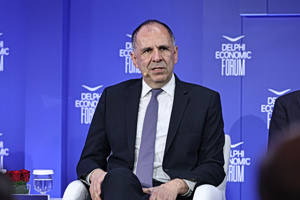
The day after the Foreign Affairs Council meeting, Greek Foreign Minister Giorgos Gerapetritis, who is planning to visit the capitals of all six Western Balkan states in the near future — most likely within May — will travel to Bratislava, where the next ministerial meeting of the “Friends of the Western Balkans” group is set to take place.
According to a recent briefing by the Greek Foreign Ministry, a similar ministerial meeting is also expected to be hosted in Athens before the end of the year.
With Greece set to hold the Presidency of the Council of the European Union during the second half of 2027 — a period during which there is shared political will for the accession of the first Western Balkan country, most likely Montenegro — the Greek side intends to continue expanding its initiatives while also setting strict timelines and targets, particularly regarding the technical assistance it plans to provide to each of the six states.
Greece and Albania Still at Odds Over Maritime Zones
Asked about the current status of bilateral talks with neighboring Albania regarding the delimitation of Exclusive Economic Zones (EEZs), Greek Foreign Ministry spokesperson Lana Zochiou responded to questions on the issue by stating:
“Discussions with the Albanian government regarding referring the delimitation issue began years ago. They were interrupted following the negative ruling by Albania’s Constitutional Court. If certain obstacles are overcome, this option remains on the table. However, at this stage, there is no indication that we are close to such a development.”
When asked whether the EEZ delimitation issue with Albania should be considered urgent in connection with Albania’s EU accession prospects, the Foreign Ministry spokesperson clarified Greece’s position.
As Lana Zochiou stressed, “There are specific conditions for the accession of every Western Balkan partner into the European Union. For Albania, these conditions include respect for the indigenous Greek National Minority, as well as issues related to the rule of law and good neighborly relations.”
Diplomatic sources in Tirana, however, insist that the delimitation of EEZs and continental shelf boundaries with Athens is a bilateral issue and not a formal prerequisite for Albania’s accession to the EU.
Nevertheless, with the maritime dispute remaining the dominant unresolved bilateral issue between Greece and Albania, it is widely expected that before Greece gives the “green light” to Albania’s EU accession, Athens will at least seek a formal agreement for the dispute over maritime zones to be referred to the International Court of Justice in The Hague.
In this way, even if the disagreement over EEZ and continental shelf delimitation has not been fully resolved before Albania joins the European Union, the Greek side would be able to consider the process for resolving the issue officially underway.