 Μake us preferred on Google
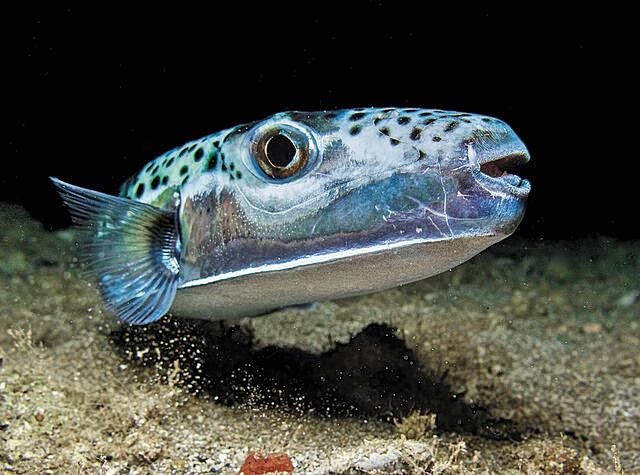
 The silver-cheeked toadfish (pufferfish), although most of us discovered it only recently, did not arrive now. The Hellenic Centre for Marine Research (HCMR) has been “monitoring” and studying it since 2005, when it was first detected in Greece. Gerasimos Kondylatos, fish expert (TE) Research Associate B’, Hydrobiological Station of Rhodes / Institute of Marine Biological Resources and Inland Waters / Hellenic Center for Marine Research (HCMR), in his article records seven myths and one truth about the new “resident” of the Mediterranean.
Myth 1: The silver-cheeked toadfish systematically attacks swimmers
This is perhaps the most widespread fear. In general, the silver-cheeked toadfish is not considered an aggressive species toward humans. According to scientific publications, most divers, spearfishermen, and researchers who encounter it report that it usually moves away when approached by a person. I reach the same conclusion through personal discussions with people in the field. Even the recent scientific review concludes that aggressive behavior remains relatively rare and cannot, at present, be considered a direct threat to public health.
This does not mean that incidents do not occur. There are recorded bites in Greece, Turkey, Cyprus, Libya, and Syria, while in a few cases they resulted in serious injuries or even finger amputations. However, these are extremely rare incidents compared with the millions of people who swim every year in the seas of the Eastern Mediterranean.
Myth 2: If it bites you, you will die from its poison/toxin
It does not inject toxin through its bite. It does not have venom glands or a stinger. The danger from its bite is mechanical and not toxicological. Its teeth form an extremely powerful “beak,” capable of crushing crabs, sea urchins, shells, and even metal hooks. This force can cause serious injuries to fingers and toes.
Myth 3: The silver-cheeked toadfish is the most dangerous fish in the Mediterranean
In terms of toxicity, it is indeed among the most dangerous fish in the Mediterranean. It contains tetrodotoxin (TTX), one of the strongest naturally occurring neurotoxins known, which blocks the transmission of nerve impulses and, in severe cases, can lead to respiratory system paralysis and death.
However, the danger mainly concerns consumption of the fish and not simply its presence in the sea. We should not forget that the silver-cheeked toadfish is in its “home,” meaning the sea.
Myth 4: Anyone who eats silver-cheeked toadfish dies
The reality is more complex. There are recorded deaths from the consumption of silver-cheeked toadfish in the Eastern Mediterranean. A recent study recorded at least 27 deaths between 2004 and 2023 in the region. Nevertheless, not all patients die. The same study recorded at least 143 non-fatal poisonings.
Symptoms can begin within minutes or hours after consumption and include numbness, nausea, paralysis, and respiratory distress. There is no specific antidote and treatment is based on supportive care (hospital treatment).
The conclusion is simple: consuming silver-cheeked toadfish represents a real and serious danger and must be completely avoided!
Myth 5: The silver-cheeked toadfish is responsible for all fishing problems
Its presence has undoubtedly had serious impacts on fisheries. It damages fishing gear, bites fish caught in nets, and consumes commercial species. The damage it causes to coastal fishermen is real and has been recorded in many Mediterranean countries.
However, the decline of many native fish populations is also caused by overfishing, rising sea temperatures, habitat degradation, and other pressures. The silver-cheeked toadfish is an important part of the problem, not the sole cause.
Myth 6: We can eliminate it
Many may believe that an intensive fishing campaign would be enough to solve the problem. Unfortunately, after more than twenty years of presence and expansion, the silver-cheeked toadfish has become established throughout almost the entire Eastern Mediterranean and continues to spread.
Its complete eradication is considered practically impossible. Current efforts focus on limiting its impacts and controlling its populations, rather than on the complete disappearance of the species from the Mediterranean.
Myth 7: All stories about bites are false
No. However, to be scientifically accurate, there is a need for the correct context. At present, there is no predetermined, central, and official system for recording incidents related to attacks or poisoning from silver-cheeked toadfish consumption in Greece. Therefore, it is not possible to have sufficient reliable data regarding such incidents.
A recent publication records dozens of bite incidents and several serious injuries in the Eastern Mediterranean. Nevertheless, it should be emphasized that the sources of information about these incidents do not include only scientific publications but also social media publications and grey literature.
For Greece, there is only one scientifically documented case of amputation, that of Crete. Scientists emphasize that these are rare events and that the image of the “aggressive beach killer” does not correspond to the available data.
The Greatest Truth
The silver-cheeked toadfish is neither an innocent fish nor the monster often portrayed in headlines. It is an extremely successful invasive species that has become permanently established in the Mediterranean.
It has serious impacts on fisheries, can be deadly if consumed, and in rare cases can injure humans. At the same time, however, most of the horror stories circulating are based on exaggerations, fragmented information, or misinterpretations.
Proper information, not panic, remains the most important tool for managing this new “neighbor” of Greek seas.
Gerasimos Kondylatos is a fish expert (TE) Research Associate B’, Hydrobiological Station of Rhodes / Institute of Marine Biological Resources and Inland Waters / Hellenic Centre for Marine Research (HCMR).