 Μake us preferred on Google
 An introduced trout species introduced decades ago into the Aoos river system, in extreme northwest Greece, has still not achieved a self-sustaining population, according to new research by the Hellenic Centre for Marine Research (HCMR).
Researchers say the finding offers an opportunity to prevent the species from becoming established and to protect native trout populations.
Rainbow trout (Oncorhynchus mykiss) was introduced to Greece in 1951 for fish farming and is considered a non-native species. Surveys conducted in the Aoos, Voidomatis and Sarantaporos rivers found the species in very low numbers and with a limited distribution, with sightings concentrated in the Voidomatis, and near riverine fish farms. The pattern is consistent with occasional escapes from fish farms rather than the existence of an established wild population.
Fish farms have operated in the area since the 1970s.
Despite occasional escapes, there is so far no evidence of a self-sustaining rainbow trout population in the Aoos basin, one of Europe’s last largely free-flowing river systems. Researchers say this suggests that farmed stocks entering the natural environment have limited reproductive capacity, although suitable habitat is available.
The risk is not considered negligible. In a small number of areas in Greece, rainbow trout has established self-sustaining populations, demonstrating that it can become permanently established under suitable conditions. Genetic mixing among farmed stocks from different origins could also alter their characteristics.
Preventing escapes from fish farms therefore remains the simplest and most effective way of limiting the risk, researchers say. Rainbow trout has not been recorded in the protected sections of the Voidomatis where significant populations of native wild, or Ionian, trout are found.
The native trout is itself under pressure from artificial barriers, changes to river channels and water flows and illegal fishing. Climate change is adding another layer of pressure to river ecosystems, with changing temperatures, rainfall patterns and water availability affecting cold-water species such as trout. These pressures are particularly significant in a river system whose ecological value depends on cold, clean and free-flowing waters.
The presence of rainbow trout in a river does not automatically mean that it is an invasive species or that it is already causing significant ecological damage. The risk increases if it begins reproducing consistently and establishes a self-sustaining population. At that point, it could compete with native fish, particularly wild trout, for food and habitat and alter the balance of the river ecosystem.
The latest research was conducted by HCMR as part of the Consult-RiCo project for the Mediterranean Institute for Nature and Anthropos (MedINA). It forms part of the broader Ri-Connect II program, which seeks to protect the Aoos-Vjosa river as a single transboundary ecological corridor between Greece and Albania.
The research examined the current distribution of rainbow trout in the Aoos basin, whether there are indications of natural reproduction and establishment and whether the species could threaten native fish populations, particularly the Ionian trout (Salmo farioides), an endemic species of the western Balkans associated with the region’s cold, clear waters.
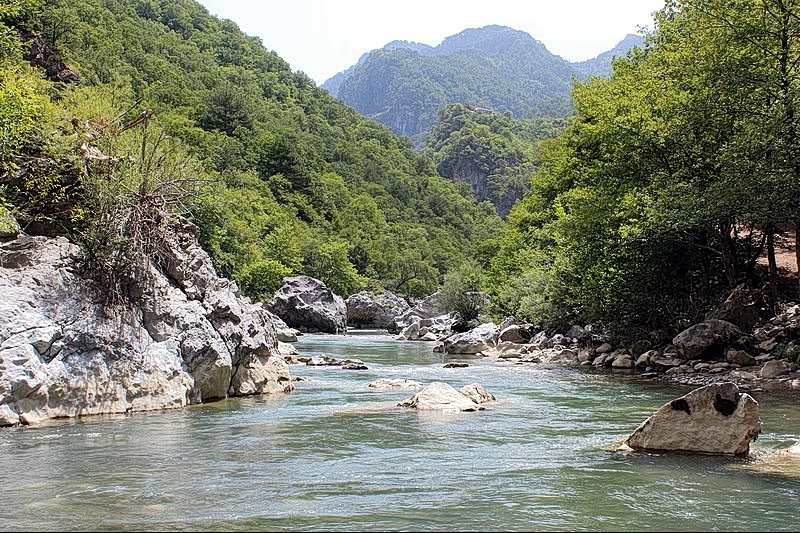
The Aoos rises in the Pindus mountain range in northwestern Greece and flows into Albania, where it is known as the Vjosa. The river is widely regarded as one of Europe’s last major free-flowing rivers, with its largely undammed character supporting a diverse range of habitats and species. The Vjosa-Aoos system has increasingly been treated as a single ecological unit spanning the Greek-Albanian border.
“The positive thing is that today we are not dealing with an already widespread situation,” said Leonidas Vardakas, an ichthyologist and scientific coordinator of the Consult-RiCo research program at HCMR. He said systematic monitoring and cooperation among those connected to the river could help preserve or improve the current situation and protect native trout populations.