
 Μake us preferred on Google
 Greeks overwhelmingly see Athens as a city of history, culture and opportunity, but most of those who live there describe it as stressful, expensive and unsafe, according to a Metron Analysis survey presented Wednesday at TO BHMA’s “Dialogues for Athens: From Myth to the Modern City” forum.
The survey, found that 71% of residents of Attica, the region that includes the capital and its suburbs, associate Athens with stress and psychological strain, more than any other problem. Sixty-six percent cited insecurity and crime, and 61% the cost of living and housing. Residents of the region were also gloomier than other Greeks about the direction of their lives. In Attica, 44% said their living conditions had deteriorated in recent years and 19% said they had improved. Elsewhere in Greece, 38% reported a decline and 26% an improvement.
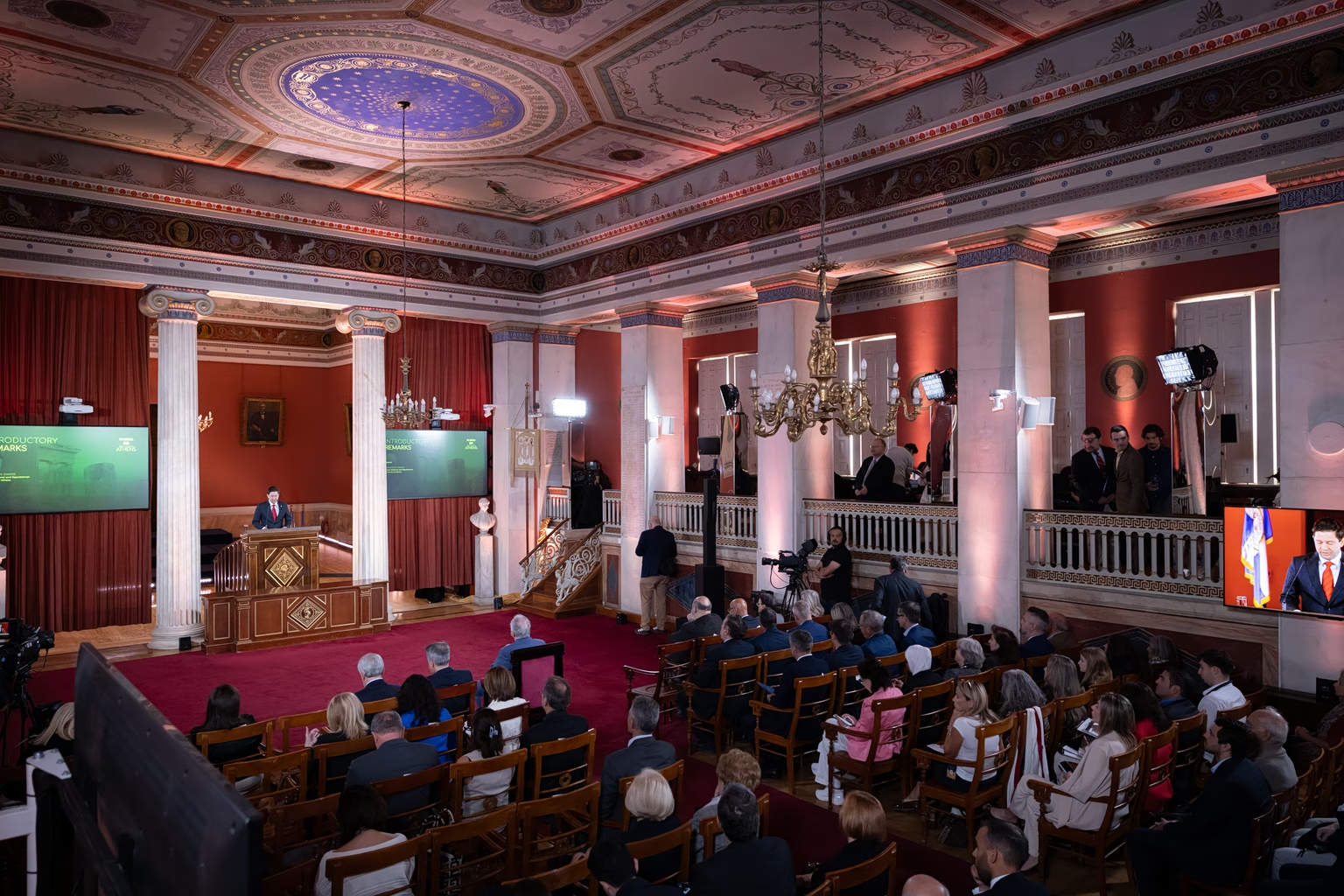
On the forum’s second day, officials, writers and academics gathered at the Ceremonial Hall of the National and Kapodistrian University of Athens kept returning to the same concerns: tourism, housing, drugs and the state of the city’s streets and public spaces.
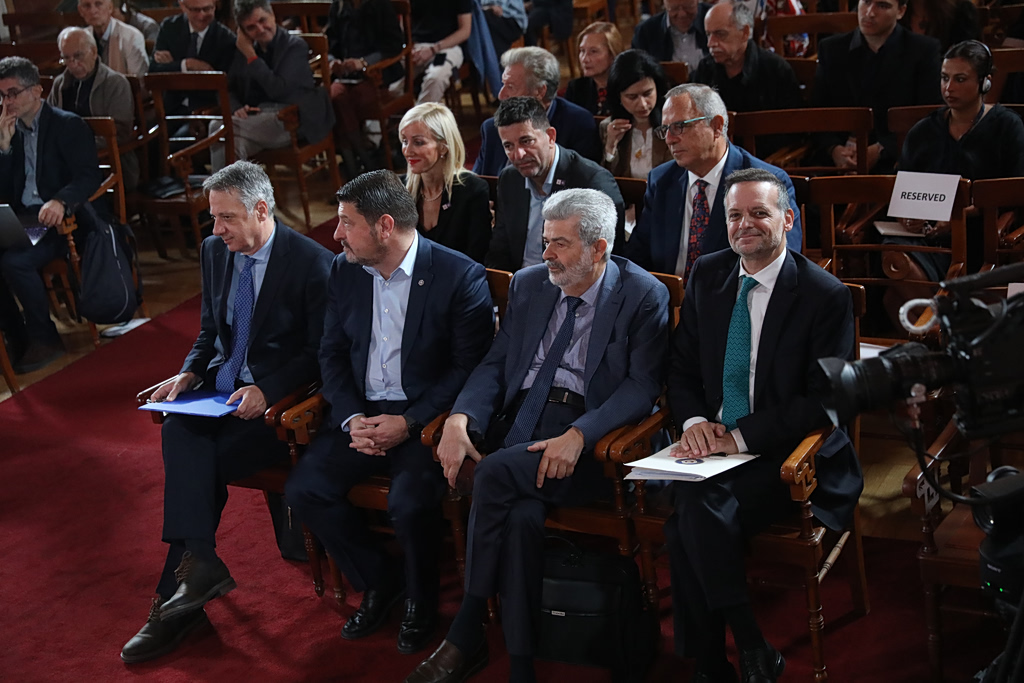
The “Dialogues for Athens: From Myth to the Modern City” forum at the National and Kapodistrian University of Athens, Wednesday, Oct. 7, 2026. (Danai Davlopoulou/Eurokinissi)
A Hard Place to Live
Metron Analysis polled 1,009 people aged 17 and older across Greece from Sept. 23 to 28, by phone and online. Thirty-five percent of them lived in Attica. Giannis Balabanidis, who heads the firm’s political and social research and presented the results, said the survey covered the whole country because Athens is part of the lives of former residents and frequent visitors as well as those who live there. Respondents gave the city high marks for its strengths. Eighty-five percent associated Athens with culture and history, 76% with entertainment and social life and 73% with opportunities for education and work. Smaller majorities described it as cosmopolitan and praised its climate and economic prospects.
Quality of life scored lowest. Only 25% of respondents said the term fit Athens, while 41% said it did not. “Quality of life is ultimately the element that scores lowest,” Balabanidis said. Across the full sample, stress topped the list of problems at 66%, followed by insecurity and crime, a deteriorating natural environment and the high cost of living and housing. More than half also pointed to traffic and public transportation, the pressure of tourism and a lack of cleanliness.
People living in Attica judged the city more harshly than those who know it from a distance. “Those of us who live here, who experience the city rather than just having an idea or an image of it, find it even more of a burden,” Balabanidis said. Asked how Athens compares with other European cities, 65% of respondents said it falls well short, a view shared by 72% of Attica residents. Only a third said it holds its own. Overall, 60% said life in the city has more drawbacks than advantages. Balabanidis said quality of life, shaped by all of these factors, was the key to changing how people feel about the city.
Here by Chance
Fifty-five percent of Attica residents said they live there by choice, compared with 63% of people elsewhere in Greece. Thirty-five percent said they had simply ended up in the region, against 26% outside it. Among Greeks aged 17 to 34, the figure was 36%.
Stratos Fanaras, the firm’s chief executive, said Metron Analysis research shows that people in Thessaloniki, Greece’s second largest city, and in Piraeus, the port city next to Athens, feel strongly attached to where they live. Athenians do not, he said. That may be because so many moved to the capital from other parts of Greece, he said, “and above all because what keeps us here is practical reasons such as the ability to make a living, not the quality of our everyday lives.”
Fanaras contrasted the leisurely stroll that former President Katerina Sakellaropoulou said she enjoys in her intervention earlier in the day with the answer people usually give his researchers when asked what they do: they go for a walk. The difference, he said, goes to the heart of what quality of life means. He also pointed to housing, an acute problem in big cities worldwide, and to long commutes that leave people feeling their time has been wasted.
‘So We Don’t Become Barcelona’
Haris Doukas, the mayor of Athens, said that when his administration took office, the city center drew about 1.5 million to 2 million tourists a year. This year, he said, it will draw 10 million, who stay an average of three and a half days. He also pointed to Spain, where Prime Minister Pedro Sánchez on Monday called a snap election for Nov. 29 after right-wing lawmakers in the lower house voted down two decrees aimed at the housing crisis. On a visit to Madrid two years ago, Doukas said, he saw signs on homes and shops calling for the city center to be saved from Airbnb and tourists. “What started as a social issue became a political one,” he said.
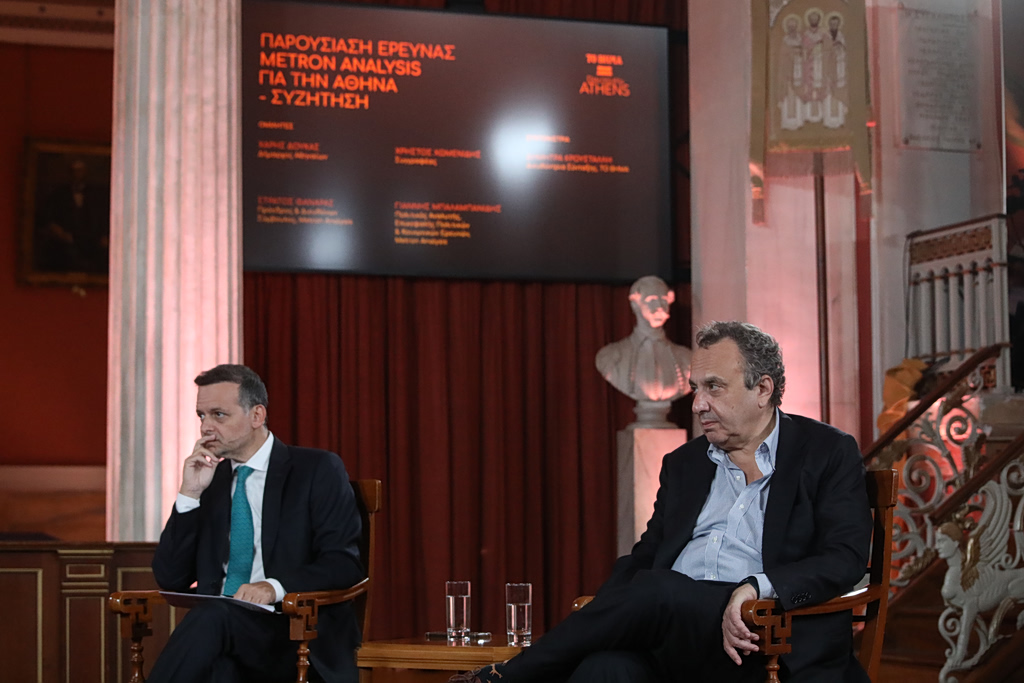
Athens Mayor Haris Doukas and writer Christos Chomenidis during the second day of “Dialogues for Athens: From Myth to the Modern City” forum at the National and Kapodistrian University of Athens, Wednesday, Oct. 7, 2026. (Danai Davlopoulou/Eurokinissi)
The historic centers of Barcelona and Florence have no residents left, only visitors, Doukas claimed, and it is too late for their mayors to change that. To prevent the same thing from happening in Athens, the city commissioned a study of how many visitors its neighborhoods could absorb and sent the results to the government, which froze short-term rentals in three central districts that were close to saturation.
Doukas said the City Hall was also fighting powerful lobbies to stop new hotels from opening in those areas and to keep neighborhoods from filling up entirely with restaurants and bars. That fight, he said, had put Athens on the front page of The Guardian.
He described the Acropolis as a democratic monument because it can be seen from almost everywhere in the city, and said Athens had capped building heights and density so that new construction would not block the view. Before he became mayor, Doukas, then a university professor, joined the Hellenic Society for Environment and Culture in a legal challenge seeking the demolition of the Coco-Mat building, which blocks views of the Acropolis.
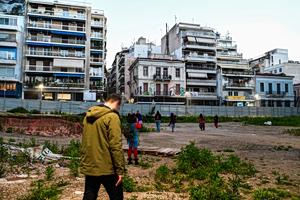
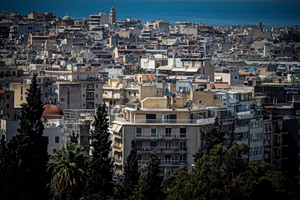
Cramped streets that never see the sun and leave no room for greenery take a toll on mental health, he said, citing the narrow lanes of Kypseli, a densely built neighborhood north of the center.
‘A Postcard’ for Visitors
Christos Chomenidis, a novelist who appeared alongside Doukas, said he worried that Athens would go the way of other cosmopolitan cities that have ceased being homes to their citizens and are rented out entirely to tourists, while residents move to distant suburbs and commute two hours each way.
He lamented neighborhoods that lose the small shops where clothes are mended and the traditional coffeehouses where people gather to talk. He asked how a large city could defend itself against “the barbarians” who see it only as a postcard, a toursit product there to be consumed.
Chomenidis, who does not drive, said the true measure of a city is the width of its sidewalks. He stated that he enjoys walking in New York and Paris because there is room to do so, and he wants sidewalks in Athens that are not blocked by motorbikes.
A Former President’s Neighborhood
Katerina Sakellaropoulou, who was Greece’s president from 2020 to 2025 and previously headed the Council of State, the country’s highest administrative court, grew up in Kypseli after her family moved from Thessaloniki. In 2009 she moved to Metaxourgeio, near the ancient Kerameikos cemetery and the Sacred Way, so she could walk to the court in 20 minutes. Friends could not understand the choice, she said, and when she worked late she drove home rather than walk.

The “Dialogues for Athens: From Myth to the Modern City” forum at the National and Kapodistrian University of Athens, Wednesday, Oct. 7, 2026. (Danai Davlopoulou/Eurokinissi)
At the time, she said, judges leaving late deliberations walked to the parking garage together because of drug dealing nearby, and Omonia Square was in a terrible state. “We were debating the country’s borders, what was going on at Evros,” she said, referring to the river that marks Greece’s land border with Turkey, “and here we had lost the center of the capital.”
Tourism, short-term rentals and new hotels have since helped turn Omonia into “a beautiful square again,” she said. But the drug problem is being pushed out of Syntagma and Omonia and back toward Metaxourgeio and other neighborhoods, she warned, and the center needs close attention. As president, she supported city efforts to open shelters and spaces where people can use drugs safely. “These people are unhappy and need support, not ghettoization,” she said.
She also defended the phenomeno of athenian apartment building (polykatoikies), often blamed for replacing the city’s neoclassical homes. The apartment blocks, along with the uniquely Greek system under which landowners traded their plots to builders in exchange for apartments, “saved us during the crisis,” she said. What Athens lacks, Sakellaropoulou said, is a sense of shared responsibility. She recalled residents who threw their garbage from a fifth-floor window into the neighboring yard, and said young people now grow up without a neighborhood. “The neighborhood of young Athenians is the cellphone and the internet,” she said. “We don’t only need to respect the myth,” she said. “We should also love the present.”
A Region of 66 Municipalities
Nikos Hardalias, the governor of Attica, said the regional authority aims to have 352 projects either finished or underway by December 2028. He argued that the Athens area needs a metropolitan authority, following the example of greater Paris, London and Los Angeles, to take charge of issues such as traffic and flood protection, which are now split among too many bodies. Responsibility gets passed back and forth, he said, and residents pay the price. Flood protection is the region’s top priority as climate change increases the risk, he said.
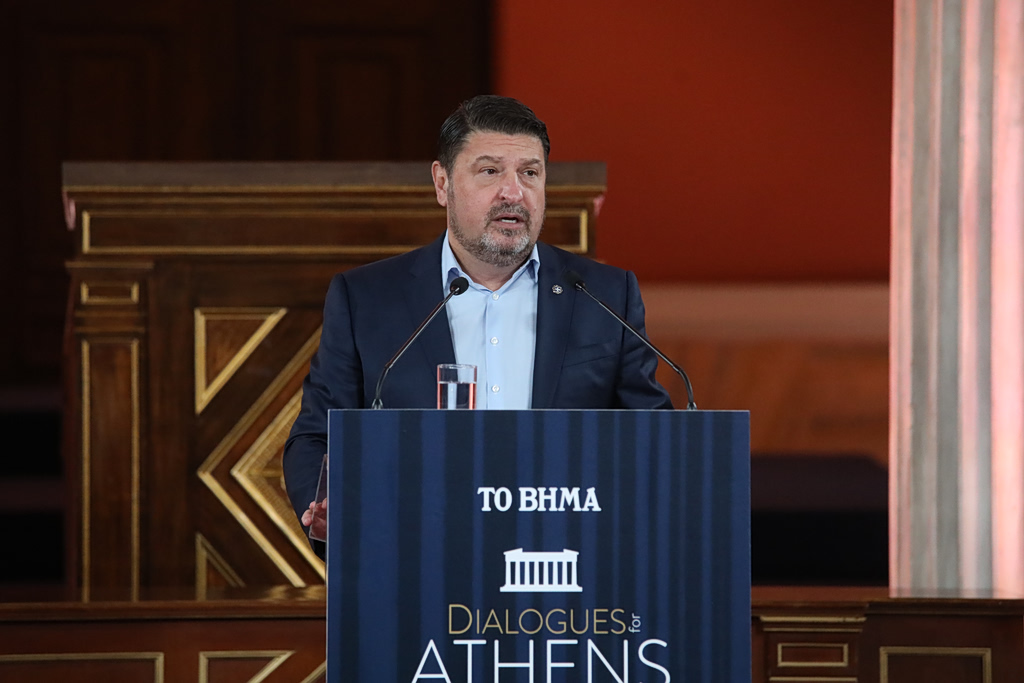
Nikos Hardalias during the second day of “Dialogues for Athens: From Myth to the Modern City” forum at the National and Kapodistrian University of Athens, Wednesday, Oct. 7, 2026. (Danai Davlopoulou/Eurokinissi)
Hardalis stressed the significance of a project like Aenaon, a 741 stremmata park on Faliro Bay that governor claimed would help reconnect Athens with the sea for the first time in nearly six decades. There are also plans to turn the nearby Olympic taekwondo venue into a conference and exhibition center. “The Athens of the future is not being designed only with visitors in mind,” Hardalias said. “It is designed first and foremost for those of us who live here.”
History Underfoot
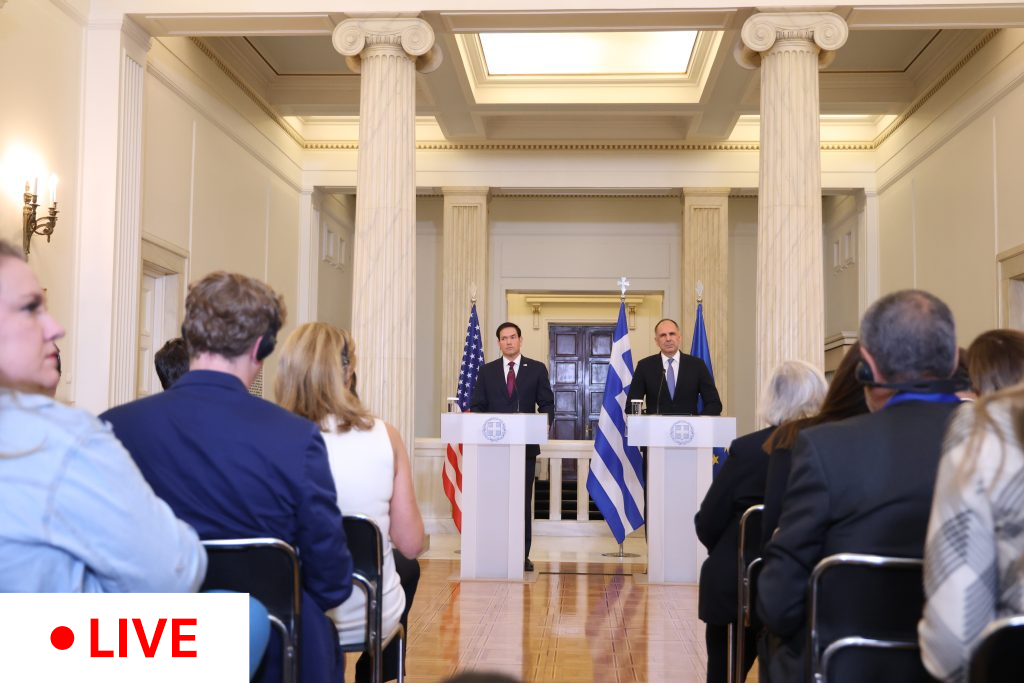
The day opened with remarks by Periklis Dimitrolopoulos, TO BHMA’s executive editor, who thanked guests for coming despite “rumors that a visit by the U.S. secretary of state would paralyze the city”.
Nikitas Kaklamanis, the speaker of Parliament, a physician and a former Athens mayor and health minister, recalled the city of his teenage years in the 1960s. He traced its decline through decades of concrete, cars and smog, and its partial recovery with the metro, the 2004 Olympics and the Acropolis Museum. He closed with what the late President Konstantinos Tsatsos once told Jacques Chirac, then mayor of Paris: some cities are powerful and some are rich, but Athens is “a city of ideas.”
Spyros Vlachopoulos, a law professor at the university, then walked the audience through the history of the hall and the streets around it. On New Year’s Day 1942, German officers of the occupying army got drunk in the same room, he said, then went outside and vandalized busts of heroes of the 1821 War of Independence. During the December 1944 fighting in Athens between British-backed government forces and communist-led ELAS fighters, British troops turned the building into a military hospital. A few blocks away, a company of ELAS fighters was trapped, and the future composer Iannis Xenakis lost an eye. Walter Gropius, a founder of the Bauhaus, designed the U.S. Embassy on Vasilissis Sofias Avenue as an open, democratic building without walls. Today it is the opposite, Vlachopoulos said. In Exarchia, the Blue Building, an interwar apartment block, once offered residents a restaurant, a laundry and even a swimming pool.
Vlachopoulos said the city once had a sense of community and of public space that it has since lost. “Today most Athenians feel that their apartment belongs to them,” he said, “but not the city, and not its public space.”