
 Μake us preferred on Google
 New York is becoming the center of international diplomacy this week as leaders and senior officials from 130 countries gather for the 81st United Nations General Assembly, with wars in the Middle East and Ukraine, their impact on the global economy, tensions among major powers, artificial intelligence and the future of the international order high on the agenda.
World leaders will deliver their official addresses to the General Assembly in the coming days, but many of the most consequential discussions are expected to take place on the sidelines, through bilateral meetings that could shape the next phase of international developments.
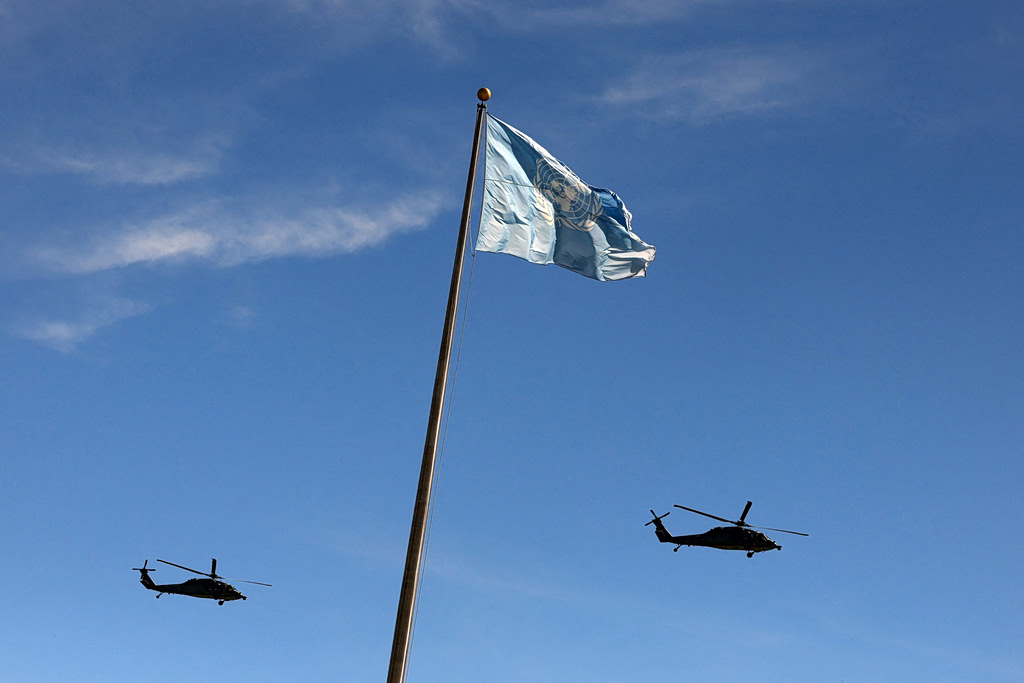
Military Helicopters fly over the United Nations plaza as the United Nations prepares for world leaders to convene for the 81st United Nations General Assembly in New York City, US, September 21, 2026 REUTERS/Brendan McDermid
U.S. President Donald Trump, Ukrainian President Volodymyr Zelenskyy, Turkish President Recep Tayyip Erdogan, Israeli Prime Minister Benjamin Netanyahu, Iranian President Masoud Pezeshkian, Canadian Prime Minister Mark Carney and other leaders are expected to use their presence in New York to discuss Ukraine, Gaza, Iran and Syria, as well as broader relations among the United States, Europe, Russia and China.
The gathering also has a historic dimension: it is the final General Assembly to take place with Antonio Guterres as UN secretary-general, as his term ends on Dec. 31, 2026.
Xi’s absence highlights key talks outside the UN
While New York will bring together many of the world’s major political figures, some of the most significant discussions will take place away from UN headquarters.
One of the most notable absences is Chinese President Xi Jinping, who will not attend the General Assembly and is expected to travel to Washington for a meeting with Trump on September 24.
Xi’s absence is perhaps the most prominent, but particular attention is also being paid to the absence of Friedrich Merz, as well as the U.S. decision not to grant entry permits to Palestinian officials, including Mahmoud Abbas, for a second consecutive year.
Russian President Vladimir Putin is also absent, although his absence was considered expected.
Trump and Zelenskyy put Ukraine at the center
One of the week’s most important meetings will be between Trump and Zelenskyy.
The Ukrainian president announced Sunday that the two leaders had agreed to meet in New York, describing the encounter as important to efforts to end the war.
Zelenskyy said he and Trump had agreed to hold a meeting that would be a “critical discussion” that “could change a lot.” He said Ukraine was ready to take “really serious steps” toward a de-escalation agreement.
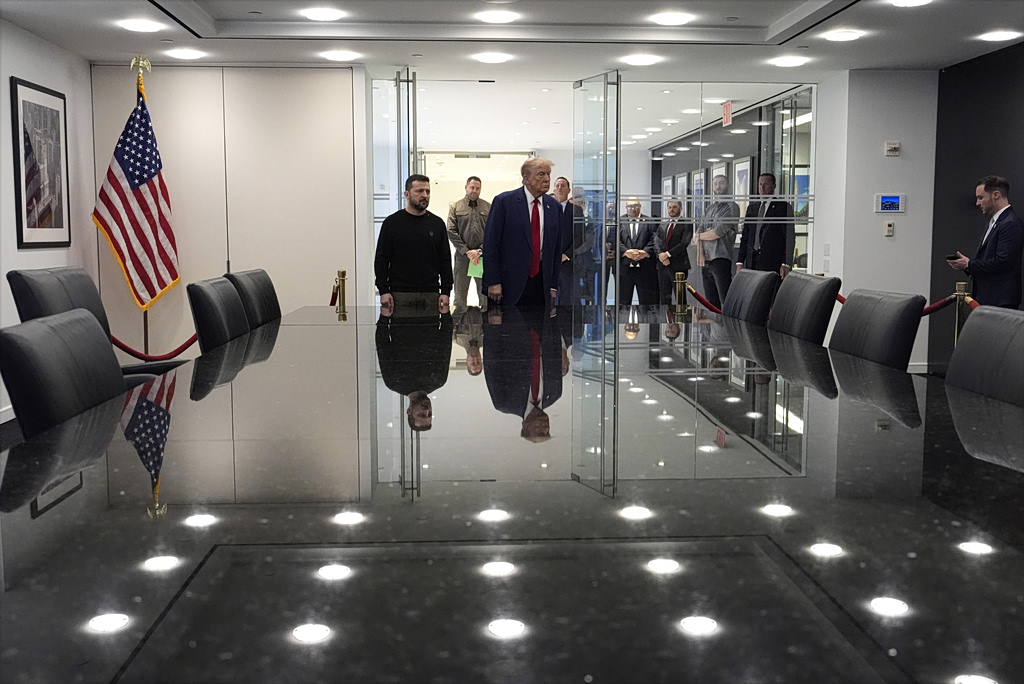
Republican presidential nominee former President Donald Trump meets with Ukraine’s President Volodymyr Zelenskyy at Trump Tower, Friday, Sept. 27, 2024, in New York. (AP Photo/Julia Demaree Nikhinson)
The talks are expected to focus on the progress of negotiations as well as the continuing military escalation.
Ukraine’s chief negotiator and head of the country’s Foreign Intelligence Service, Rustem Umerov, told Axios that contacts with White House envoys Steve Witkoff and Jared Kushner were continuing. According to the Ukrainian side, the points of disagreement in the negotiations had been reduced from dozens to “one or two” key issues.
At the same time, military tensions remain.
A source familiar with a phone conversation between Trump and Zelenskyy told Axios that the U.S. president had repeatedly asked his Ukrainian counterpart to stop attacks on Russian oil refineries. According to the source, those attacks were contributing to higher international diesel prices.
The meeting comes days after Trump signed legislation imposing new sanctions on Russia and approved a major U.S.-Ukraine arms agreement, two measures Kyiv had sought for months.
Meanwhile, Russia and Ukraine continue to conduct long-range attacks. Ukraine has struck targets in Moscow and Russian oil infrastructure, while Russia has carried out almost daily missile attacks on Kyiv and other major Ukrainian cities.
Erdogan to discuss Gaza, Syria and Iran
Turkish President Recep Tayyip Erdogan already is in New York and will address the General Assembly on Tuesday, marking his 16th speech before the UN.
Gaza and recognition of a Palestinian state are expected to be central themes of his address, while the Turkish presidency has announced a series of bilateral meetings.
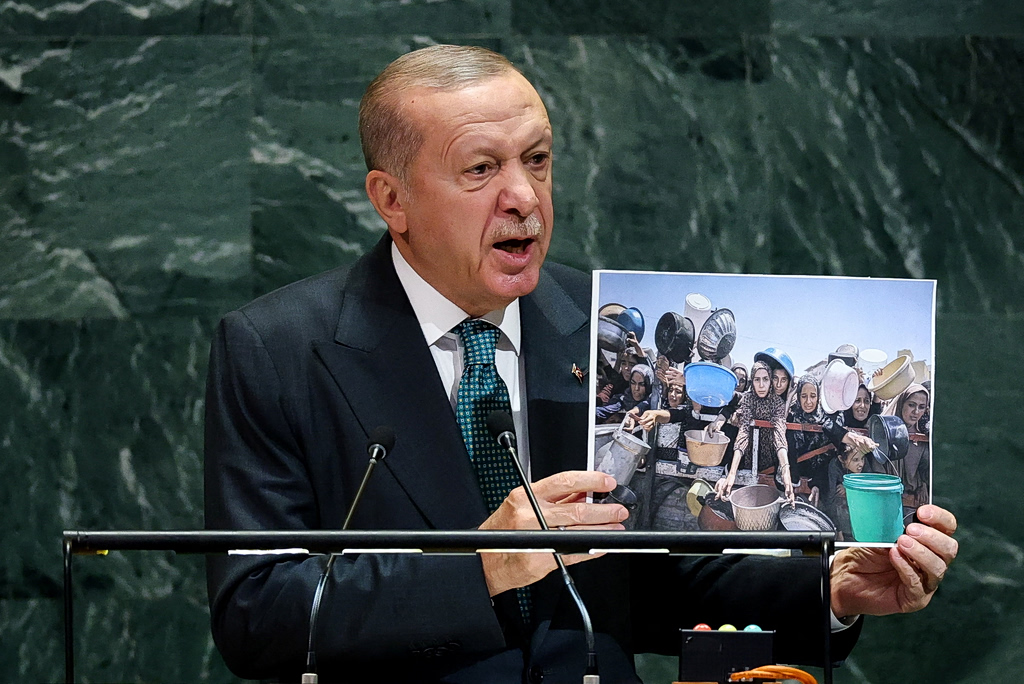
Turkey’s President Tayyip Erdogan shows a picture as he addresses the 80th United Nations General Assembly at U.N. headquarters in New York, U.S., September 23, 2025. REUTERS/MIKE SEGAR
Erdogan will also meet with UN Secretary-General Antonio Guterres. Gaza, Iran, Syria and the Russia-Ukraine war are expected to be among the subjects discussed.
Particular attention is focused on Erdogan’s planned meeting with Trump.
U.S. Ambassador to Turkey Tom Barrack has said the two presidents will meet on the sidelines of the General Assembly, although the exact time of the meeting has not been announced. Erdogan is also expected to attend a reception hosted by Trump for leaders visiting New York.
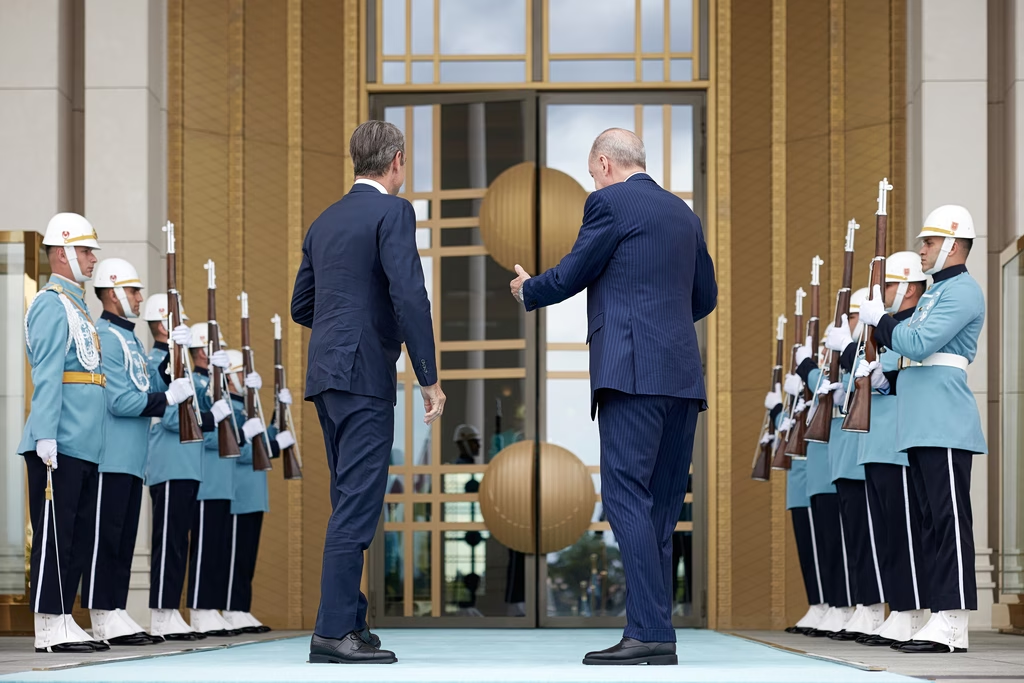
For Greece, there is particular interest in whether Erdogan will ultimately meet with Greek Prime Minister Kyriakos Mitsotakis. As of September 22, no bilateral meeting between the two leaders had been scheduled, although a last-minute meeting had not been ruled out.
Netanyahu faces questions over Gaza and Iran
Israeli Prime Minister Benjamin Netanyahu will also travel to New York for the General Assembly, although his stay is expected to be brief.
His visit comes at a particularly tense moment, with the war in Gaza and the conflict with Iran remaining at the center of international diplomacy.
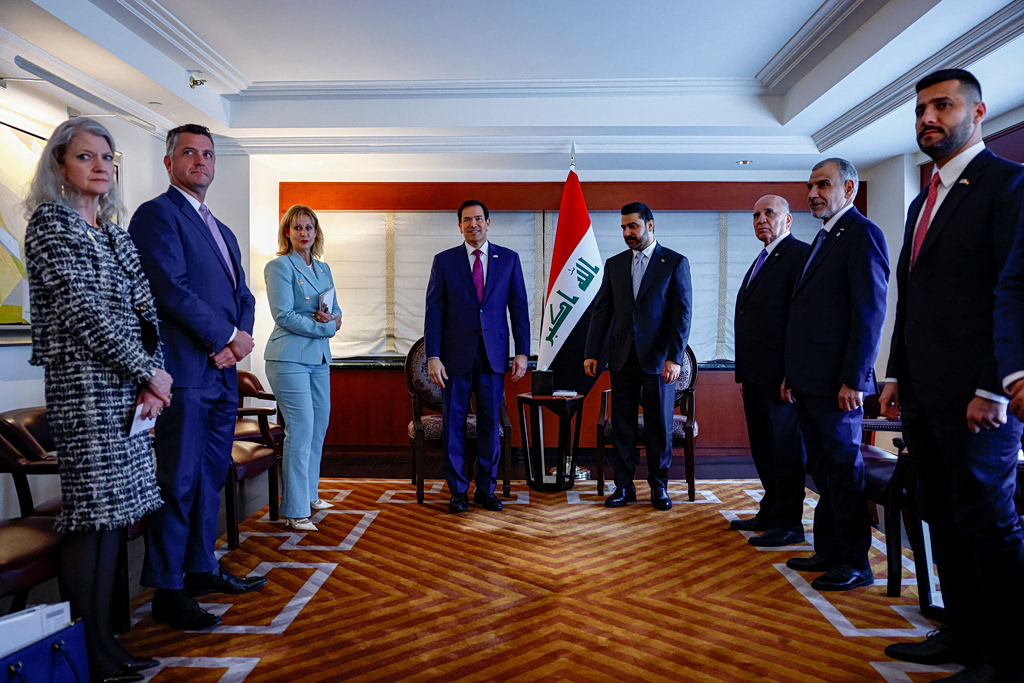
Iraqi Prime Minister Ali al-Zaidi meets with US Secretary of State Marco Rubio on the sidelines of the 81st United Nations General Assembly in New York City, US, September 21, 2026. REUTERS/Jeenah Moon/Pool
The issues have also generated deep divisions in the United States and are a major concern for New York’s political leadership and Zohran Mamdani, according to the source text.
A meeting between Netanyahu and Trump is not currently on the schedule. U.S. officials have said no meeting has been planned, as the two leaders will be in New York at different times and Netanyahu’s schedule is expected to be highly restricted.
Netanyahu is also likely to face questions about the two-state solution. Canada, France and Britain have announced that they will coordinate efforts in New York to promote the proposal. The three countries have also announced a joint policy addressing the expansion of Israeli settlements in the West Bank.
Pezeshkian’s visit raises possibility of Trump meeting
Iranian President Masoud Pezeshkian is also expected to attract significant attention at this year’s General Assembly.
Pezeshkian has received permission to enter the United States and is expected to address the General Assembly on Wednesday, September 23, even as the United States and Iran remain at war.
However, not all members of the Iranian delegation have received permission to enter the country, particularly members of the president’s communications team.
One of the major questions of the week will be whether Pezeshkian meets with Trump.
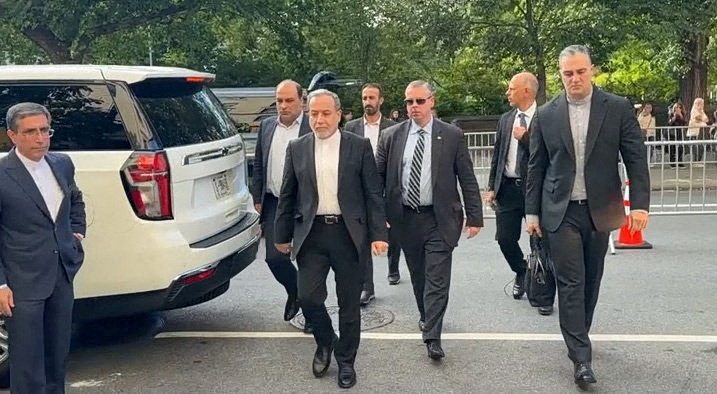
Iranian Foreign Minister Abbas Araqchi arrives for the 81st United Nations General Assembly, in New York City, US, in this screengrab from a video released on September 22, 2026. Araqchi Telegram Channel/Handout via REUTERS
The U.S. president has said he is open to a meeting with the Iranian leader, but no such encounter has yet been confirmed.
Such a meeting would represent the first high-level political encounter between the two sides at a time when military operations have created a wider regional crisis and affected energy markets and international shipping.
The possibility of a meeting comes as Iran has conveyed terms to Washington through Qatar for restarting negotiations and is awaiting Trump’s response.
The terms made public include an end to the war on all fronts, the release of frozen Iranian assets and an end to the U.S. naval blockade.
Trump to meet British and Japanese leaders
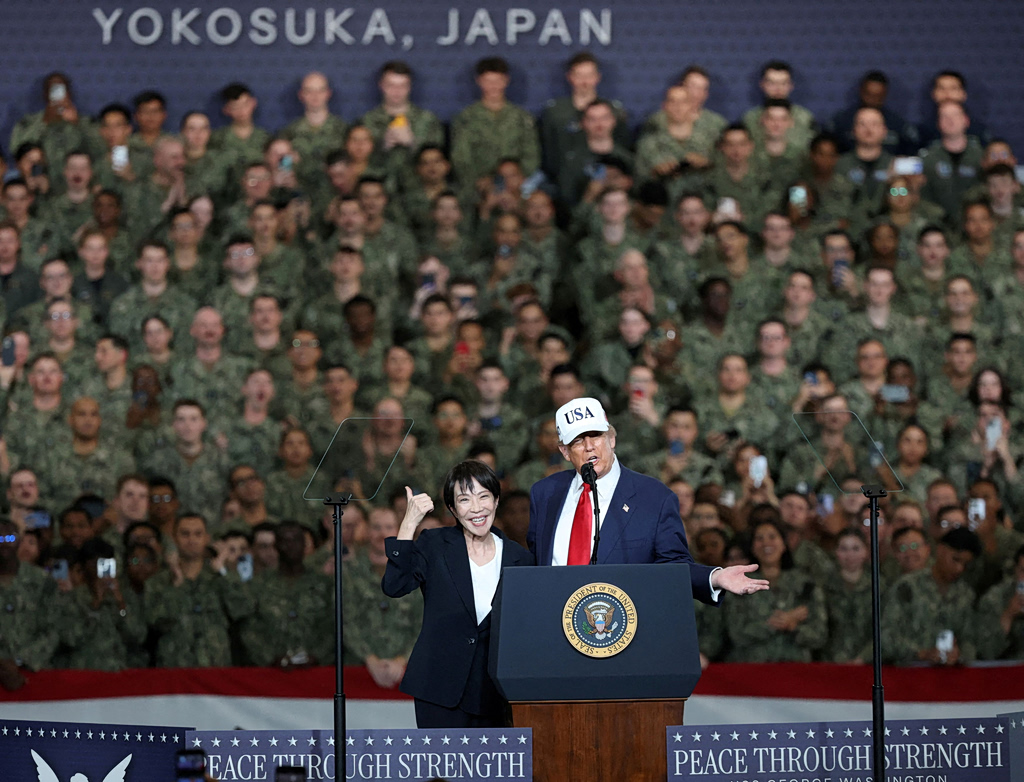
U.S. President Donald Trump speaks as Japanese Prime Minister Sanae Takaichi gestures towards military personnel, aboard the aircraft carrier USS George Washington, during their visit to the U.S. Navy’s Yokosuka base in Yokosuka, Japan, October 28, 2025. REUTERS/Kim Kyung-Hoon TPX IMAGES OF THE DAY
Beyond his meetings on Ukraine, Gaza and Iran, Trump is also expected to meet with British Prime Minister Andy Burnham and Japanese Prime Minister Sanae Takaichi.
He is also expected to hold talks with leaders of the Gulf Cooperation Council and Venezuela’s interim president, Delcy Rodriguez.
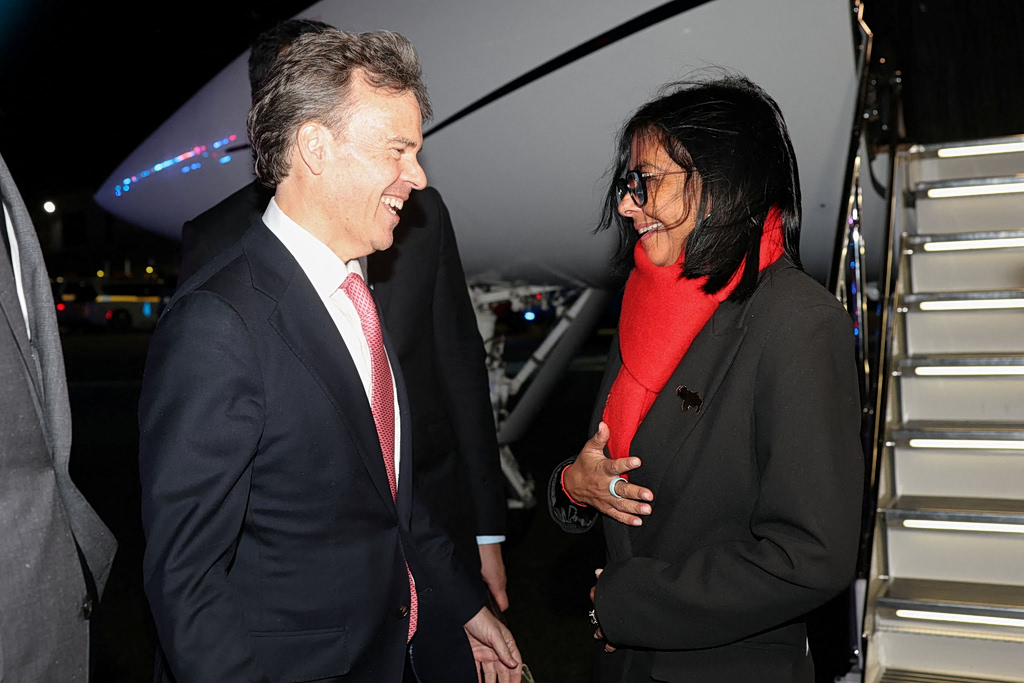
Venezuela’s acting President Delcy Rodriguez talks with United States Charge d’Affaires for Venezuela John Barrett upon arriving in New York City for the 81st session of the United Nations General Assembly, in New York City, US, September 21, 2026. Miraflores Palace/Handout via REUTERS
The meeting between Trump and Burnham will be their first face-to-face encounter and comes at a time when Washington and London have several unresolved issues in their relationship.
The two leaders are expected to discuss Ukraine, the Middle East and maritime security in the Strait of Hormuz. Burnham is also expected to raise the issue of strengthening Ukrainian air defenses ahead of winter.
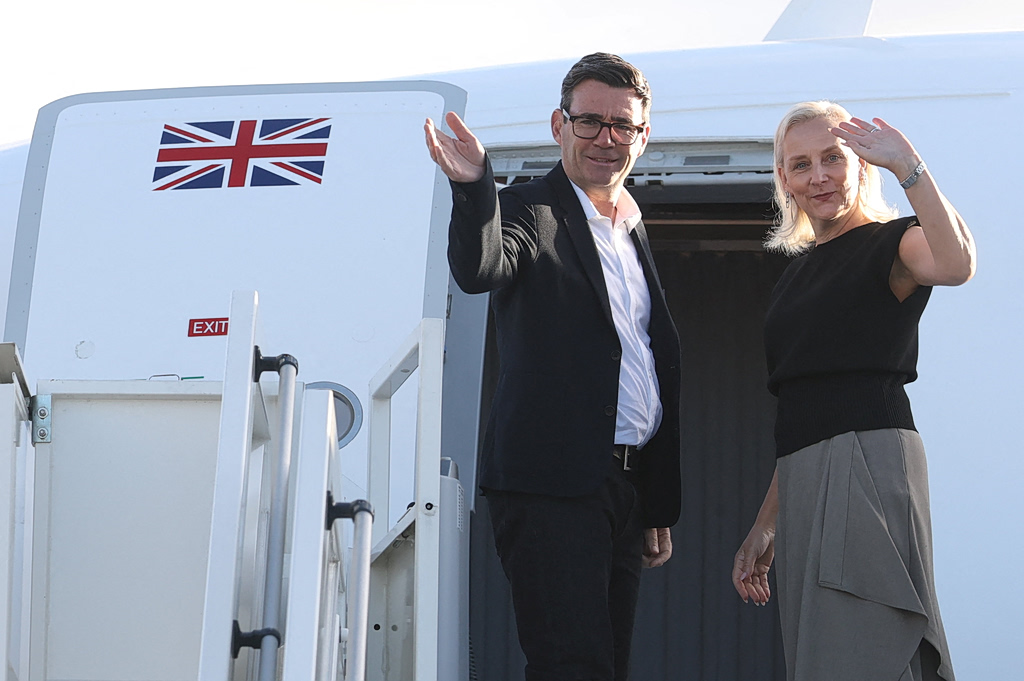
Britain’s Prime Minister Andy Burnham and his wife Marie-France van Heel board a plane for the United States, ahead of attending the 81st United Nations General Assembly (UNGA) in New York City, at Stansted Airport, Britain, September 21, 2026. REUTERS/Toby Melville/Pool
The talks could also expose differences over Britain’s energy policy, as Trump has pushed for greater exploitation of North Sea oil and gas resources, as well as disagreements over Britain’s position on Iran and Israel.
The Falkland Islands could also become an issue following Trump’s support for Argentina, while London maintains its commitment to the islands and their residents.
Britain, Canada and France push two-state solution
While the Trump-Burnham meeting will carry significant weight, another meeting involving Burnham could take place in a very different diplomatic context.
Burnham is expected to meet with Canadian Prime Minister Mark Carney and French President Emmanuel Macron on the Palestinian issue.
The three leaders have agreed to co-host a meeting at the United Nations to promote the two-state solution. Their governments have also announced measures to restrict trade in products from Israeli settlements in the West Bank.
Their meeting is expected to focus on advancing the two-state solution and preventing further erosion of the prospect through settlement expansion and increased violence in the West Bank.
London, Paris and Ottawa have described settlement expansion as a direct threat to the two-state prospect and have committed to coordinated action.
Trump and Gulf leaders to discuss Iran
Trump’s meeting with leaders of the Gulf Cooperation Council will also be closely watched.
The discussion is expected to focus primarily on the war with Iran and what follows the conflict, as Gulf countries have experienced consequences from the crisis in terms of security, energy and trade.
Developments in Yemen are also likely to be discussed, although the Houthis have said that their targets are not U.S. ships but Saudi Arabian vessels.