
 Μake us preferred on Google
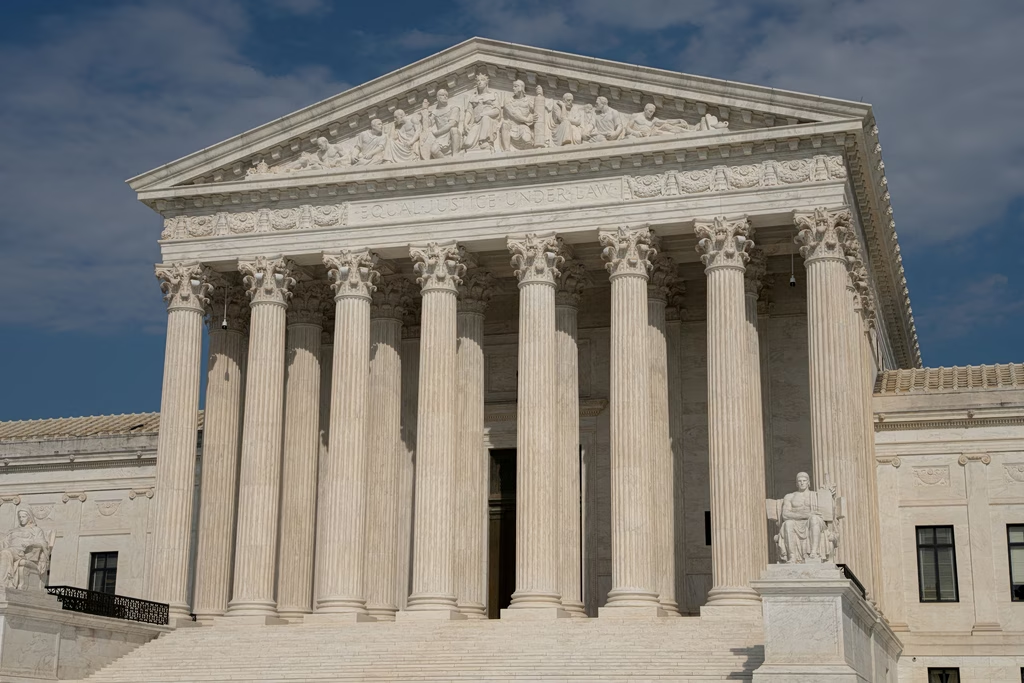
 DENVER—A state known for its ski slopes and craft breweries is garnering an unlikely reputation: a breeding ground for politically charged Supreme Court showdowns.
Colorado in recent years has landed at the court twice over wedding services for same-sex couples, defended a ban on so-called conversion therapy for LGBTQ youth and advocated for the removal of Donald Trump from the state’s 2024 ballot.
The state has lost each time. This fall, it is back for more.
The justices on Monday will open their new term with a major climate-change case that originated in Boulder. Next month, the court will consider whether the state’s universal preschool program unconstitutionally withheld financial support for Catholic schools, in a case that could set new rules for the relationship between church and state.
At first glance, Colorado isn’t an obvious backdrop for culture-war clashes. Deeper-blue bastions like California and Massachusetts are more often associated with the sorts of boundary-pushing liberal policies that draw backlash from the Supreme Court’s conservative majority.
But longtime Colorado residents and legal experts say they aren’t surprised. The state’s politics have shifted leftward amid rapid growth, as newcomers flock to Denver and its suburbs.
“The laws we’re seeing enacted at the state level certainly are a deviation from what you would see in Colorado in the ’90s,” said Frederick Yarger, a former Colorado solicitor general who defended the state in one of the wedding cases.
The shift is starkest on gay rights. Three decades ago, Colorado voters approved a state constitutional amendment denying legal protections based on sexual orientation—and in a landmark decision, a less conservative Supreme Court struck it down . Now the state has emerged as a pioneer of pro-LGBTQ laws and policies, at a time when the high court has moved considerably to the right.
“The script has sort of flipped, but you still have the same cultural dynamics at play,” said University of Colorado law professor Scott Skinner-Thompson.
The state still has a sizable contingent of religious conservatives, so when right-leaning legal groups need sympathetic plaintiffs to challenge progressive policies, it isn’t hard to find them.
And the high court’s recent rulings against Colorado are now key precedents in pending challenges that seek to move the law further to the right for the entire nation.
“Their own losses are part of the argument that’s being made at the Supreme Court,” said Nicholas Reaves, a senior counsel at the Becket Fund for Religious Liberty, which is litigating the coming preschool case on behalf of Catholic parishes that run schools in the Denver suburbs.
Set to be argued on Nov. 3, that case also involves LGBTQ protections. Colorado will pay for a child’s preschool at private institutions, on the condition that those schools promise not to discriminate, including on the basis of sexual orientation or gender identity. The challengers say the condition violates their religious rights because they don’t want to enroll children from LGBTQ households.
The challenge draws on an earlier victory by Jack Phillips, a Colorado baker who has made his Supreme Court drama a central feature of his business. Phillips’s Masterpiece Cakeshop, nestled in a suburban shopping strip in the Rocky Mountain foothills, refused to create custom wedding cakes for same-sex couples. In 2018, the Supreme Court ruled that a commission enforcing a state antidiscrimination law had violated Phillips’s religious rights by displaying hostility toward his beliefs.
The cakeshop now celebrates its status as a conservative icon. Memorabilia from the court victory hang on its walls. Alongside pineapple upside down cakes and chocolate chip cookies, customers can buy Phillips’s book about the case, “The Cost of My Faith.”
A similar case followed in 2023, when the Supreme Court sided with a Denver website designer who didn’t want to design wedding websites for same-sex couples. And this spring, the court ruled in favor of a Christian counselor in Colorado Springs who challenged the state’s ban on psychological therapy that encourages gay or transgender minors to change their sexual orientation or gender identity.
Dafna Michaelson Jenet, a former Colorado state legislator who sponsored the conversion therapy ban, expressed despair that the state’s policies have come under legal attack.
“As far as LGBTQ rights are concerned, we are pushing the envelope,” she said. “We are trying to make it the best place to live for someone who is LGBTQ.”
That progressive push, Michaelson Jenet acknowledged, makes the state a target for conservatives. “They’re just waiting for pieces of legislation that they can get to the conservative court to overturn for the entire country,” she said.
Not all of Colorado’s cases have been about social issues. In 2024, the state was at the vanguard of efforts to disqualify Trump from running for re-election because of his encouragement of supporters who stormed the Capitol on Jan. 6 , 2021. The Supreme Court quickly intervened , ruling that only Congress, not states, can make that call.
Perhaps the most consequential Colorado case of all is the climate-change case being argued next week. The justices are considering whether Boulder can sue oil companies for local damages allegedly caused by the widespread burning of fossil fuels. Their decision will likely determine the fate of dozens of similar lawsuits around the country. Taken together, the lawsuits threaten giant energy companies with massive financial liability.
Reina Pomeroy, who lives in neighboring Louisville, will be watching. In 2021, she lost her home in a catastrophic wildfire that she and other locals attribute to climate change.
“Whatever resources you have to set a precedent to say, ‘This is harming our community,’ makes sense to me,” Pomeroy said over matcha at a local food hall.
The case might seem poised to be the next legal defeat for a progressive initiative out of Colorado. But the outcome isn’t guaranteed, legal experts say, because Justice Samuel Alito is recused and some other conservative justices have previously voiced skepticism about a key legal theory that the oil companies are relying on.
One justice in particular, Neil Gorsuch, may take a special interest in the case: He grew up in Colorado.
Write to James Romoser at james.romoser@wsj.com