
 Μake us preferred on Google
 The only thing growing faster than the artificial-intelligence industry may be Americans’ negative feelings about it—as former Google Chief Executive Eric Schmidt saw on Friday.
Delivering a commencement address at the University of Arizona, Schmidt told students the “technological transformation” wrought by artificial intelligence will be “larger, faster and more consequential than what came before.” Like some other graduation speakers mentioning AI, Schmidt was met with a chorus of boos.
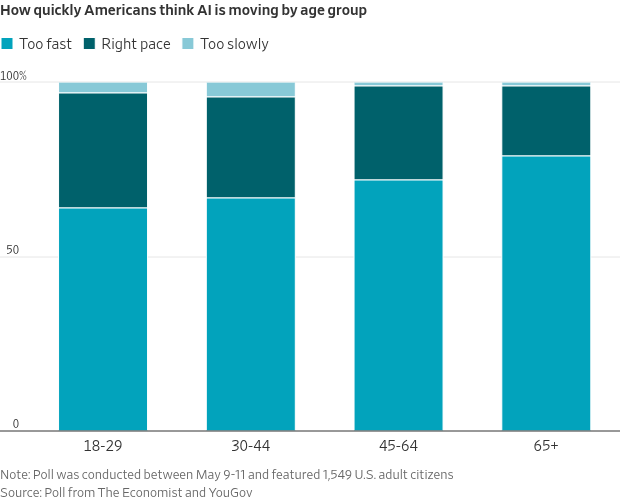
In one poll after another in recent weeks, respondents have overwhelmingly voiced concerns about AI , a challenge to claims by industry executives that their technology would gain popularity by improving people’s lives.
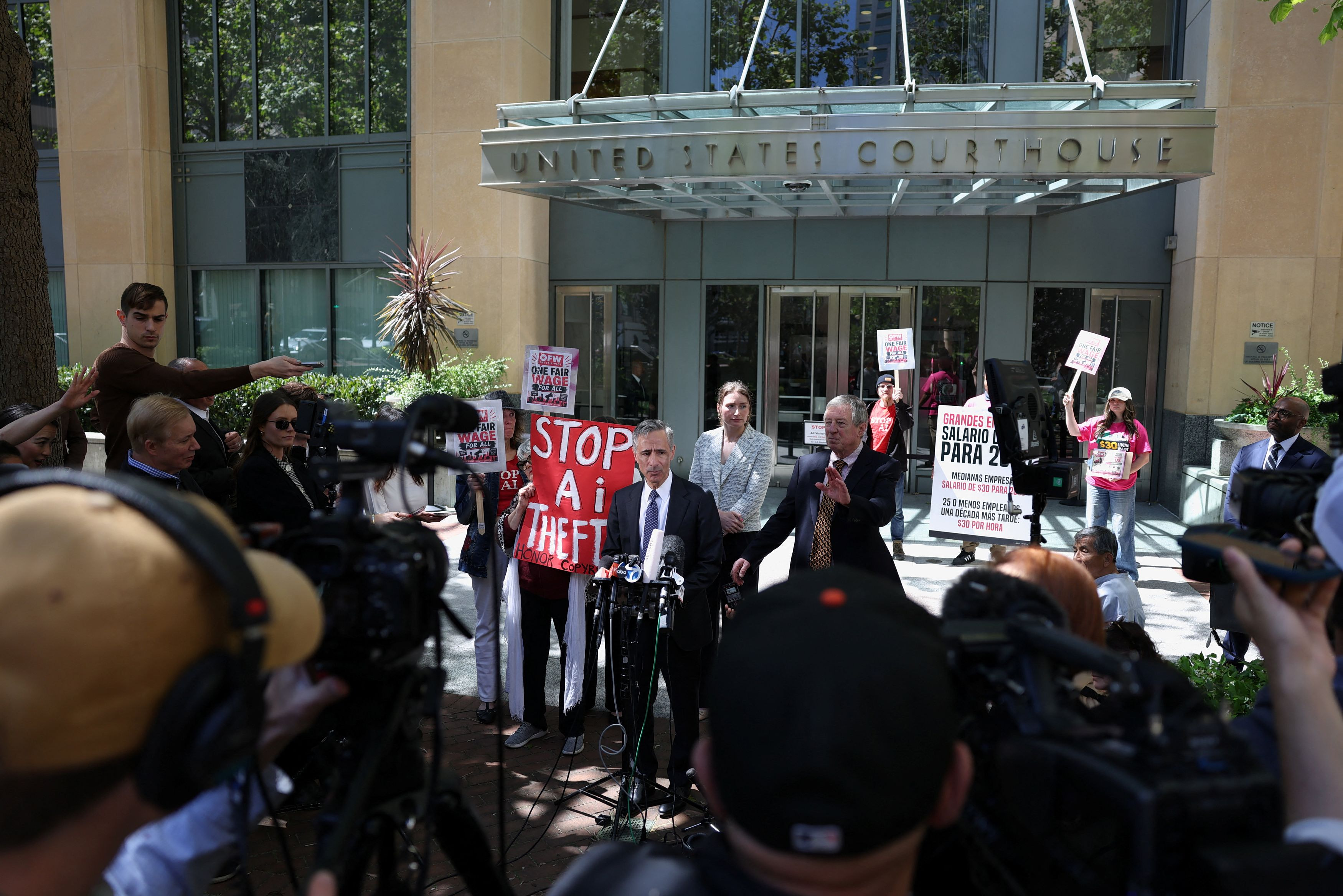
Consumers resent energy-price jumps exacerbated by the spread of data centers. Workers fear widespread job losses. Parents worry about AI undermining education and harming children’s mental health . In recent months, the wave of anger has brought protests, swayed election results and spurred isolated acts of violence.
In April, a 20-year-old Texas man allegedly threw a Molotov cocktail at OpenAI Chief Executive Sam Altman’s home and made threats at the company’s San Francisco headquarters, according to a federal complaint filed against him. A few days earlier, someone fired 13 shots at the front door of an Indianapolis councilman who had recently approved a data center.
“It’s something I never thought would be imaginable,” said Councilman Ron Gibson , who found a note saying “NO DATA CENTERS” under his doormat. Two days later, Gibson found a similar note saying “f— you.”
Pollsters and historians say the souring of public opinion is all but unprecedented in its speed. “I don’t think I’ve ever seen something intensify this quickly,” Gregory Ferenstein , who conducted a recent poll with researchers at Stanford University and the University of California, Berkeley, said of the backlash.
The poll showed about 30% of Democrats think America should accelerate AI innovation as quickly as possible, compared with roughly half of Republicans and 77% of tech founders.
Rising political issue
Also unprecedented is the rapid rise of AI anxiety’s salience as a political issue , one that is shaking up routine re-election races and scrambling partisan battle lines, political analysts say.
After bubbling up in a handful of races last year, it has exploded onto the ballot across the country. Voters in Festus, Mo., ousted four city council members a week after they approved a $6 billion data center. Dozens of communities in states from Maine to Arizona are trying to ban new data centers. Some 360,000 Americans are in Facebook groups opposed to the facilities, roughly quadruple the number from December, figures from organizations fighting the AI build-out show.
“People just feel like they’re under siege,” said Sen. Josh Hawley (R., Mo.), who has proposed bills to impose new requirements on data centers and AI companies.
AI has risen in importance most quickly among 39 political issues studied by polling firm Blue Rose Research in the past year, though it still trails priorities including the economy, immigration and foreign policy.
While AI rejectionism has put wind in the sails of some campaigns, for AI companies and builders of the data centers that serve them, it is creating an acute crisis. Investors have staked tens of billions of dollars in capital on the ability of OpenAI, Anthropic and other companies to get access to ever-larger quantities of computing power, and they in turn have pledged much of that capital to fund data-center construction.
The companies are spending hundreds of millions of dollars in the midterm elections to help fight the backlash.
But all over the country, community-level organizations have been succeeding in blocking data-center projects. Local opposition blocked or delayed at least 48 projects valued at some $156 billion last year, according to Data Center Watch, an organization tracking the trend. A record of 20 were canceled in the first quarter of the year because of local backlash, figures from climate-media outlet and data provider Heatmap show. Dozens more are currently facing similar obstacles on top of obstructions because of permitting snafus and equipment shortages.
On Monday, Texas Agriculture Commissioner Sid Miller called for a moratorium on new hyperscale data-center development in the state, citing concerns about the costs to farmers and strain on the power grid.
Persuading the ‘cave people’
As the poll numbers continue dropping, industry leaders and their allies wonder how much worse they can get and what it will take to turn them around. A string of high-profile layoff announcements in which executives have attributed steep job cuts to AI have furthered Americans’ mistrust of the technology.
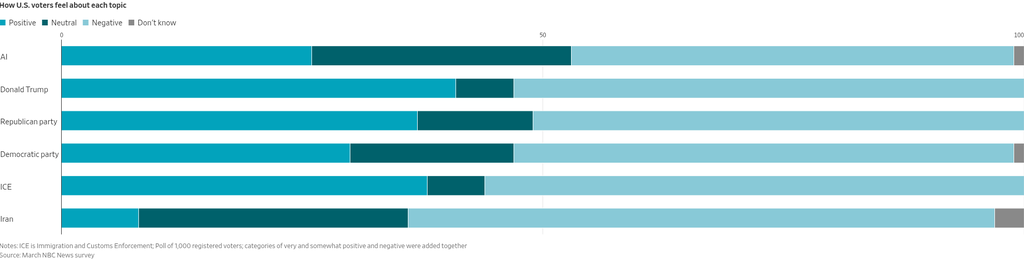
Dylan Patel , CEO of AI-infrastructure consulting firm SemiAnalysis, recently predicted there would be large-scale protests against OpenAI and Anthropic within a few months. “People hate AI. AI is less popular than [Immigration and Customs Enforcement]. AI is less popular than politicians,” he said on a podcast.
A review of documents aggregated by AI startup Halcyon shows that thousands of people have expressed concerns about data-center costs by filing sharply worded public comments in regulatory dockets as utilities across the country seek approval to power them.
Ndubisi Okoye , a Detroit-based advertising creative director and muralist, was one of them. He learned last year that his utility company had sought approval of a contract to power a data center that Oracle plans to build near Ann Arbor, Mich.
“We do not want any data centers, especially in Michigan,” he wrote in a public comment. “Do not bring that here ever!”
Okoye said in an interview that he opposes data centers for their impact on the environment, and he worries about the effect artificial intelligence might have on his opportunities as an artist .
In Memphis, Tenn., 31-year-old Justin Pearson is finding support by centering data-center opposition in his Democratic campaign for Congress. Pearson has helped lead the fight against Elon Musk’s xAI over a local data center.
The NAACP recently sued xAI , which was acquired by Musk’s SpaceX, claiming the company has illegally operated gas turbines without a valid air permit in nearby Southaven, Miss. Pearson said voters in the Republican area shared the same data-center concerns as many of his Democratic constituents. “We are building common ground in a powerful way,” he said.
Big tech companies have promised to pay more for electricity that powers data centers at the urging of President Trump , but executives said they need a coordinated effort to highlight the benefits of the tax revenue data centers provide and the ways AI can improve daily life. Trump recently said data centers “need some PR help.”
Chris Lehane , OpenAI’s chief global affairs officer, said “doomers” peddling worst-case scenarios , lingering anger at social-media companies and negative media coverage have fueled poor sentiment in the U.S. “If you’re going to constantly and consistently talk about AI from a fear perspective, you are going to drive fear,” he said.
The company is focused on finding solutions to problems such as energy costs and children’s safety, Lehane said. “We as an industry need to be a lot more calibrated in making the case as to why this is good for the country and good for the world,” he said.
At a recent data-center conference in Washington, one executive said the industry is facing “cave people” who oppose all development. Another said her daughter hears her friends complaining about data centers.
“There’s a disconnect between what we’re saying and what is happening out there, and I think that’s the issue we have to address,” Ernest Popescu , CEO of the company developing the data center in Indianapolis that Gibson had approved, told the crowd.
Write to Amrith Ramkumar at amrith.ramkumar@wsj.com , Katherine Blunt at katherine.blunt@wsj.com and Lindsay Ellis at lindsay.ellis@wsj.com