 Μake us preferred on Google
 Cultural Feast
One difference we quickly notices were the small daily things. For instance: food, socialization between family, and transportation. Our host families ate two warm meals each day together and were eager to share their culture with us. From homemade pasta to Sicilian sweets from relatives in the south, we tasted the diverse culinary culture of Italy. These meals were moments of connection and taught us the importance of family in Italy.
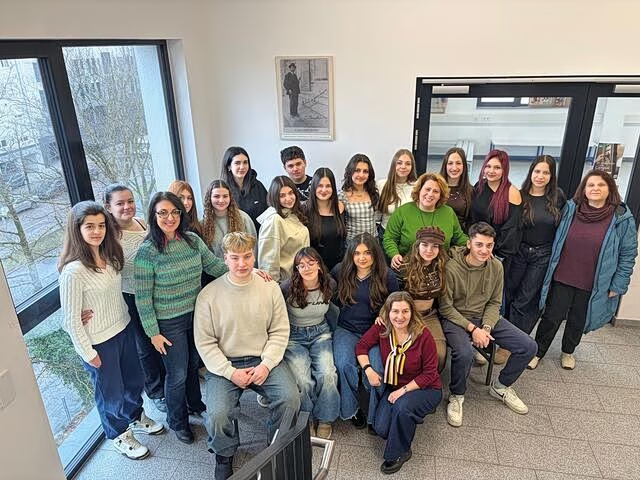
Secondly, we noticed how social the Italians are compared to the Dutch. At school, students openly expressed political opinions and were eager to debate and exchange ideas. This level of engagement in politics was inspiring for us, since it’s less common in the Netherlands for students to exchange these opinions with each other. We realized that being European isn’t about borders or policies, but about sharing various perspectives and actively participating in society. Furthermore, the Italian students were interest in and curious about the Dutch culture. Many asked us questions, both during their classes and during the break.
Exploring History
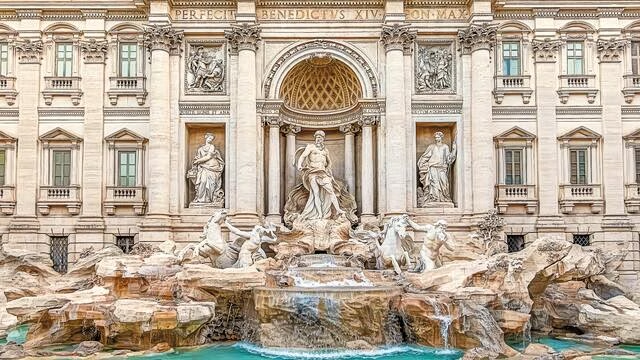
During our exchanges, we visited places that were important in Rome’s and/or Italy’s history. We went to the Colosseum, the Roman Forum, and the Trevi Fountain. Not only that, we also explored different churches, as the Santa Maria della Vittoria, which showed us the influence of Italy on Christianity and how religion plays a big role in Italian history and culture. Every location was a reminder to Europe’s complex yet beautiful past.
Italian Classes
Throughout our time in Italy, we didn’t only visit different locations but also participated in a few classes to get a gist of the Italian schools. We mostly visited English classes, in which the students were taught about grammar or history of the UK. In other classes, we simply chatted with the students and exchanged our cultures with each other.
One important class we followed was about climate change and Europe’s role in fighting it. It gave us insights on how the EU works towards a greener world. In our opinions, it was also the most interesting class. Not only did we hear about different policies, such as the 2019 Green Deal, we also discussed our own opinions on Europe’s goal of climate neutrality and found we think the same: that it’s important for Europe to work on climate neutrality.
What it taught us
This exchange taught us that we are adaptable and thrive in new situations. Working with students from different countries has its challenges but is in the end very benefitting. We came up with conclusions none of us could have reached alone.
Our perspective of Europe has changed due to this exchange. We now see Europe as a continent with deeply connected countries, where nations work together to solve major challenges, from climate to history preservation. Even though our cultures are vastly different, we all strive for the same future: green and better.
Memories from Rome
We have made many beautiful memories in Rome. The cultural exchanges, the insightful conversations with Italian students, and the complex history of Rome will forever stay with us. Beyond this all, we have built new friendships and found a cultural understanding.