 Μake us preferred on Google
 On Oct. 12, 1944, as German occupation forces withdrew from the city of Athens, the capital began to reclaim itself after more than three years of enemy occupation and exploitation. It was a moment of liberation, but also one of rupture — and among the institutions caught in the aftermath was the German Archaeological Institute Athens.
Eighty-two years later, that episode will return to the center of Athens’ cultural landscape with the opening of “A Divided Past: Greek-German Relations in Dark Times,” an exhibition jointly organized by the National Archaeological Museum and the German Archaeological Institute Athens.
The choice of opening date is deliberate, as it coincides with the anniversary of the liberation of Athens from German occupation in 1944 and comes just days before the international conference “Archaeology and Occupation: Greece 1941-1944,” to be held in Athens from Oct. 15-17.
Running through Jan. 31, 2027, the exhibition looks beyond the objects in its cases to examine what happens to archaeology when scholarship, cultural institutions and political power collide.
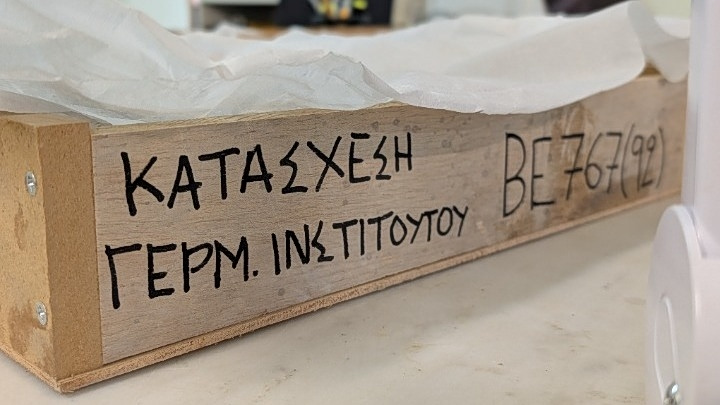
The central episode is the seizure of the German Archaeological Institute Athens in 1944, immediately after the departure of the German occupation forces. But the story begins much earlier, tracing the relationship between the two institutions from the 19th century to the present and focusing particularly on the years immediately preceding World War II and the occupation.
The history of the German Archaeological Institute in Greece is both distinguished and complicated. Established in Athens in the 19th century, it became one of the most influential foreign archaeological institutions in the country, contributing to more than 160 excavations and investigations, including at ancient Olympia and Tiryns. The institute’s scholars helped shape modern archaeological practice, while its archives became an important repository of knowledge about Greece’s ancient past.
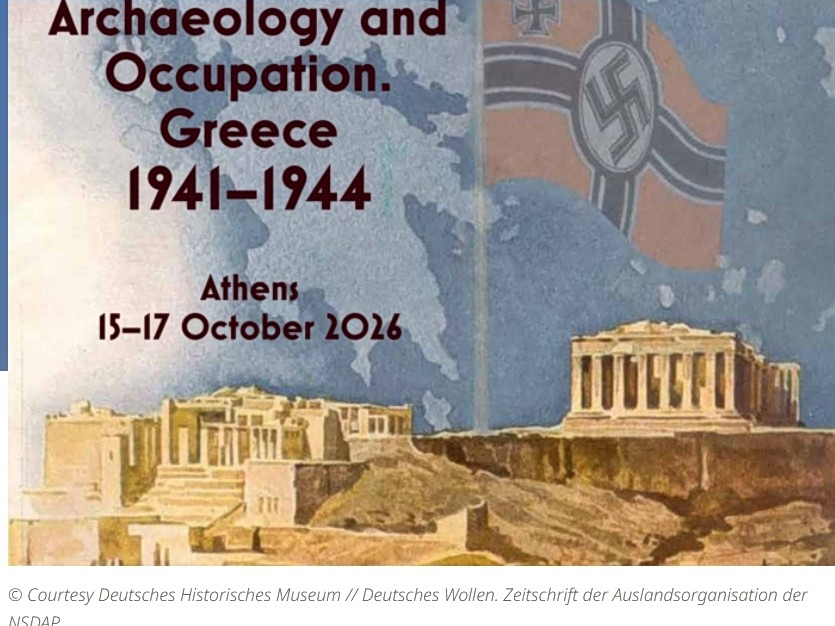
Yet the institute’s history also carries a darker chapter.
During the 1930s and early 1940s, its activities became increasingly entangled with Nazi Germany and the regime’s effort to appropriate the cultural legacy of ancient Greece for its own ideological purposes. Walther Wrede, a prominent figure within the institute, became director in 1937, while the institution itself became a gathering place for Nazi supporters in Greece. German archaeological activity was eventually halted by Greek authorities in 1940 WWII transformed the political circumstances in which the institute operated.
It is this complicated inheritance that the new exhibition seeks to place under examination.
Rather than presenting archaeology as an isolated scholarly pursuit, “A Divided Past” explores how the two institutions navigated one of the darkest periods in modern European history. It also examines how their relationship evolved afterward, ultimately becoming a basis for renewed academic cooperation and joint research.
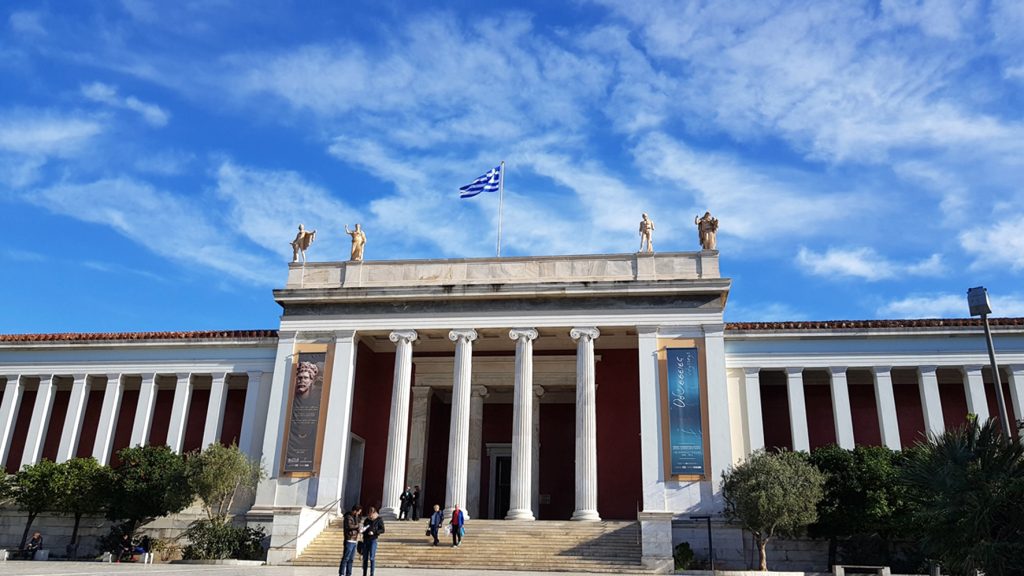
The exhibition unfolds across two locations — the National Archaeological Museum and the German Archaeological Institute Athens — allowing visitors to encounter the story in both institutions that shaped it.
At the National Archaeological Museum, selected antiquities are displayed alongside extensive archival and photographic material. The exhibition is organized around a chronology and a series of thematic sections examining the long history of the two institutions, the museum’s preparations to conceal its antiquities in 1940-41, its operation during the occupation, antiquities seized from the German Archaeological Institute and the 21st-century research project that has brought the history back into focus.
At the German Archaeological Institute, the emphasis shifts toward the institute’s own experience during the occupation and, in particular, the history of its archaeological collection. The displays examine the formation and development of the collection from the late 19th century to the present, including its pottery holdings and case studies focusing on Argolis and Attica.
The physical setting is part of the story.
At the National Archaeological Museum, the exhibition occupies a gallery on an upper floor where the museum’s old wooden display cases provide a deliberately atmospheric setting for archaeological objects, documents and photographs. At the German Archaeological Institute, the exhibition extends into the foyer and library — precisely the spaces in which some of the events being reconstructed took place.
The result is less an exhibition of spectacular antiquities than an archaeological investigation of memory itself.
The objects on display are not intended to overwhelm the visitor. Instead, they function as witnesses around a historical narrative: a story about institutions, occupation, cultural property and the difficult relationship between scholarship and political power.
That approach also places the exhibition within a broader moment of reassessment for the National Archaeological Museum itself. The museum is preparing for the most ambitious transformation in its history, including an expansion, a new museological approach and a rethinking of how its collections are presented to the public.