 Μake us preferred on Google
Families with children, low-income renters and some of Greece’s poorest households are set to receive no additional financial support through four key welfare programs in 2027, despite rising living costs and an overall increase in government spending on social protection.
According to the explanatory report accompanying the 2027 state budget, the government has allocated a combined 1.373 billion euros to family benefits, the Guaranteed Minimum Income program, housing allowances and school meals, exactly the amount it expects to spend in 2026. While the funding freeze does not amount to a direct cut in benefits, it leaves the four programs with fewer resources in real terms as inflation continues to erode purchasing power.
Where Welfare Spending Remains Unchanged
Funding for family benefits will remain at 557 million euros, while the Guaranteed Minimum Income program, which provides financial assistance to households with insufficient income, will receive 450 million euros. Spending on housing allowances will remain at 250 million euros, with a further 116 million euros allocated to school meals.
Other social protection programs, however, are set to receive additional funding. Spending on disability benefits will rise from 1.279 billion euros to 1.321 billion euros, while funding for childbirth allowances will increase from 159 million euros to 164 million euros. The Personal Assistant program, which supports people with disabilities in their daily lives, will receive 50 million euros, up from 34 million euros in 2026.
Fewer Households Receiving Benefits
The funding freeze comes amid a steady decline in the number of households receiving some of Greece’s main welfare benefits. The number of housing allowance recipients fell by 12.3% in the year to October 2026, from 175,148 to 153,594. The decline has been even more pronounced over the longer term. In June 2020, more than 243,000 households received housing assistance. By June 2026, that figure had fallen to around 168,400, a reduction of nearly 75,000 households.
A similar trend is evident in the Guaranteed Minimum Income program, where the number of recipients fell by 9.9% between October 2025 and October 2026, from 159,472 to 143,635.
When Higher Earnings Mean Lower Income
Although income eligibility criteria do not account for every household that has stopped receiving benefits, even a modest increase in earnings can leave some families financially worse off if it pushes them above the qualifying threshold.
A household of three, for example, can receive a housing allowance of 140 euros a month, or 1,680 euros a year, provided it meets the program’s eligibility requirements, including an annual income limit of 14,000 euros. If its qualifying income rises from 13,950 euros to 14,050 euros, the household could lose its housing allowance when its eligibility is next assessed. Under these circumstances, an increase of just 100 euros in annual earnings could result in the loss of 1,680 euros in financial assistance over a full year.
Financial Insecurity Remains Widespread
The 2027 budget forecasts a 3.9% increase in nominal earnings per employee. With inflation projected at 2.6%, however, the real increase in earnings would be approximately 1.3%.
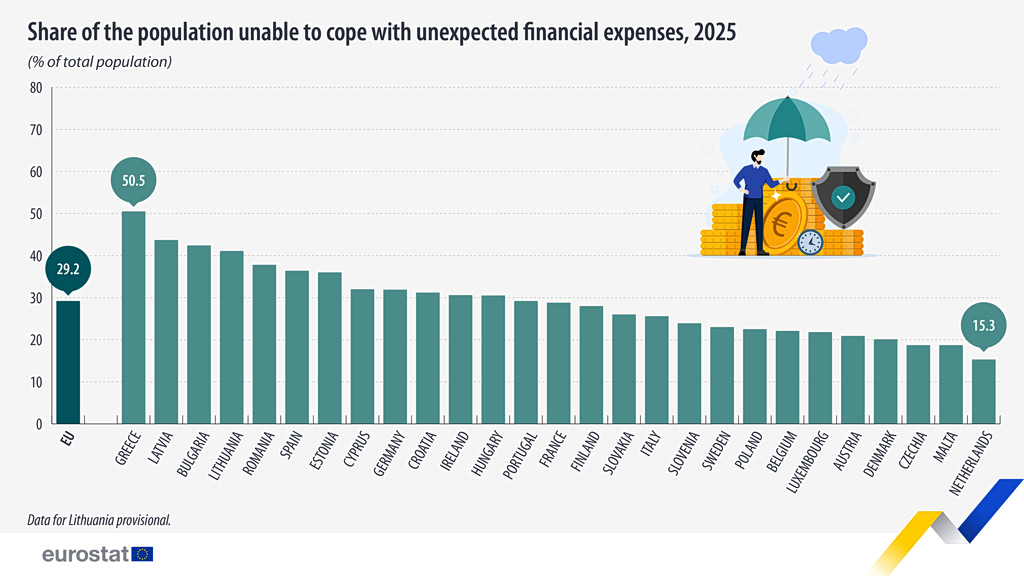
Figures from Eurostat, the EU’s statistics agency, illustrate the extent of financial insecurity in Greece. In 2025, 50.5% of the country’s population could not afford an unexpected financial expense, compared with an EU average of 29.2%.
Source: OT.gr