 Μake us preferred on Google
 There are gardens watered by wind and dew, and there are farmers determined enough to keep them alive—so that some of the most delicious products of the Cyclades can still make their way to our tables.
In the Cyclades, the Greek island group in the Aegean Sea where the sun dominates and water has always been a precious resource, residents developed a distinctive way of farming over centuries, long before irrigation networks and modern watering systems. They created what are known as anydroi baxes—literally “waterless gardens”—an ingenious agricultural system adapted to the islands’ demanding conditions.
These small gardens made use of natural moisture in the soil, winter rains and nighttime dew. Cultivating them required experience, knowledge and constant observation. Today, at a time when water scarcity is becoming an increasingly pressing concern across the Mediterranean, the wisdom of these traditional farmers is taking on new significance.
Farmers sought out fertile valleys and soils capable of holding onto rainwater for months. Using dry-stone walls, terraces and windbreaks, they reduced evaporation and shielded their crops from the powerful northern winds known as meltemia.
A waterless garden was not simply an ordinary vegetable patch. It depended on selecting hardy varieties capable of surviving with very little water—a striking example of sustainable agriculture born out of necessity and adaptation to the environment.
The small local treasures
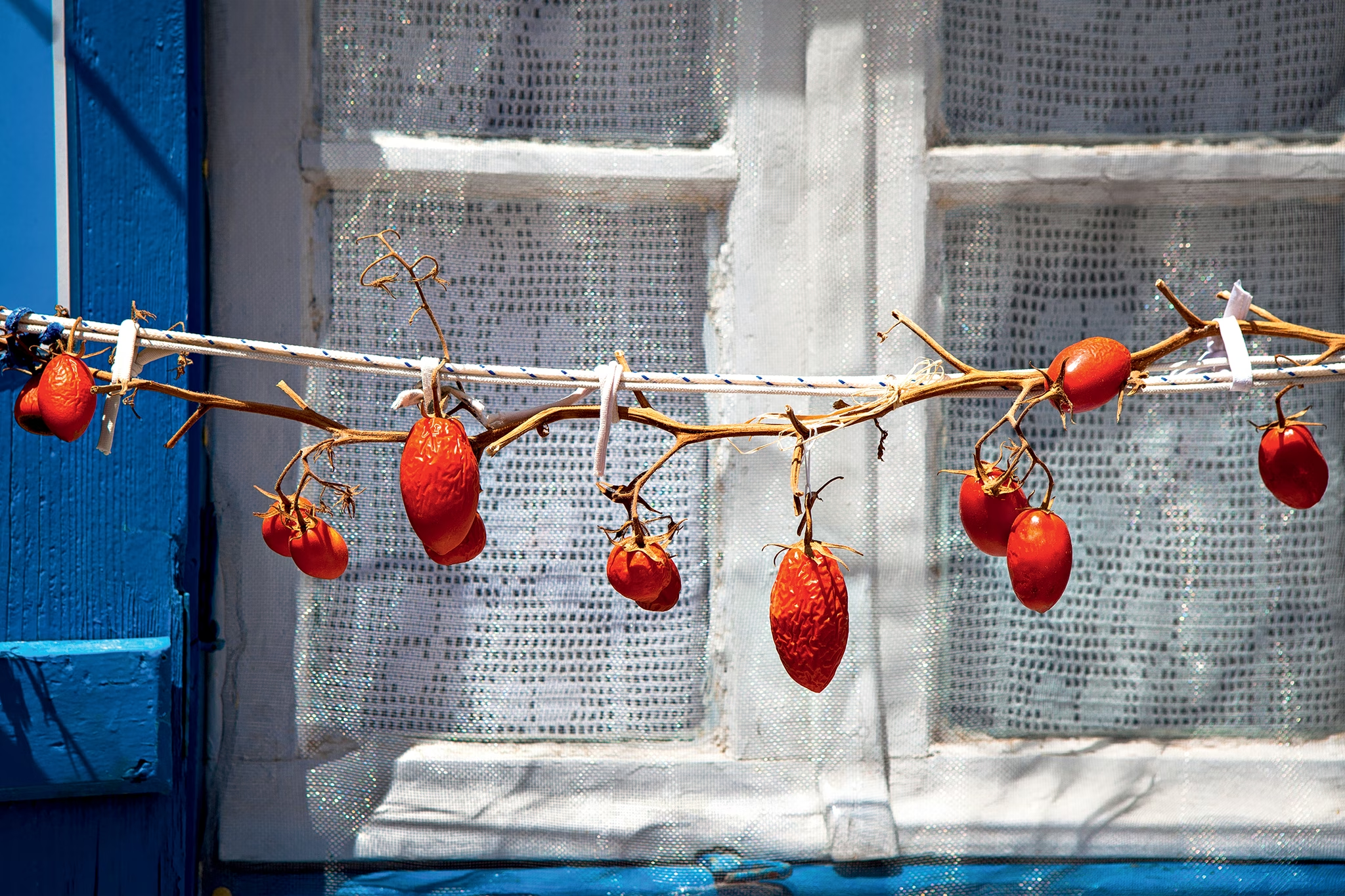
The best-known example is Santorini’s small-fruited tomato. With a deep root system and a remarkable ability to draw on atmospheric moisture, it has traditionally been grown without irrigation. The fruits remain small, but they are packed with concentrated aromas, intensity and a distinctive sweetness.
On the island of Milos, farmers still grow rousiki, a dry-farmed tomato variety that retains its place in the island’s traditional gardens.
Chef and producer Vasilis Papikinos, who grows the variety in his own garden and uses it in the kitchen of his restaurant, Alevolimnos, explains that it is “the most resilient traditional dry-farmed tomato variety grown on the island since 1930 in the areas of Livadia, Provatas and Phylakopi.”
As he explains, its name comes from the Italian word rosso, meaning red.
“It is the same variety as the one in Santorini. It has thick skin, which makes it resilient. It has a sweet-and-sour flavor, but as it ripens, it becomes sweeter. That is when we make the famous Milos tomato paste, which we use in skordolazana, baked goat and braised rooster.”
Skordolazana is a traditional Milos dish combining pasta with garlic and tomato, while the baked goat and rooster dishes reflect the island’s rustic culinary tradition.
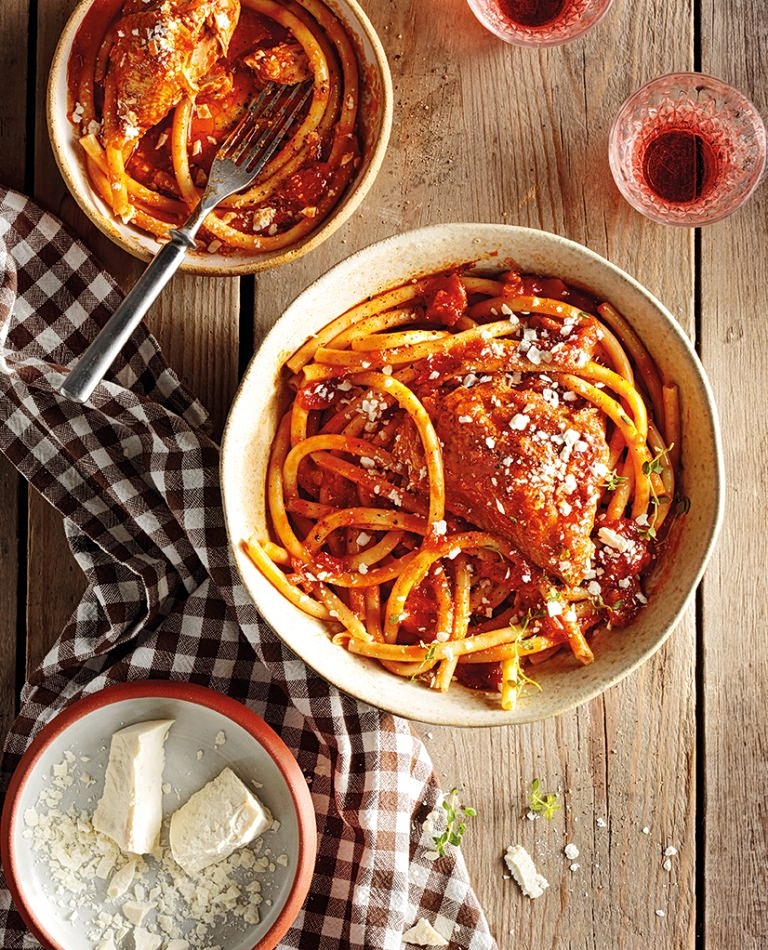
The traditional braised rooster made on Milos with tomato paste from the island’s own tomatoes.
Photo: Giorgos Drakopoulos, Food styling: Olivia Artemis Webb
Similar crops were once found across almost the entire Cycladic island group. On Paros and Naxos, farmers grew dry-farmed watermelons, melons and pumpkins. On Amorgos, Sikinos, Schinoussa and Iraklia, legumes took center stage, while on Andros, Tinos and Mykonos, the gardens produced seasonal vegetables, onions, garlic, vlita—a leafy green commonly eaten in Greece—and aromatic herbs.
On the islands of Schinoussa, Iraklia and Amorgos, a distinctive variety of split pea known as katsouni is still cultivated. It comes from the seeds of the garden pea (Pisum sativum). The variety survived thanks to the persistence of local residents and continues to be grown using traditional methods. Fava made from katsouni cooks quickly and is prized for its sweet flavor.
Producer Manolis Kovaeos, a fifth-generation farmer on Schinoussa, describes how the variety has traveled through time.
“We cultivate it from an old seed that we preserve on the island. The katsouni was brought here in the late 1800s by people from Amorgos who settled on Schinoussa. It is dry-farmed and harvested by hand. It is a delicate plant.”
Production remains limited today.
“Only a few island residents, ranging in age from 20 to 80, grow it, and only two families are involved professionally and sell their production commercially,” he says.
Flavor, concentrated by scarcity
The secret behind all these products lies in their slow growth. Because the plants do not receive large amounts of water, their fruits remain smaller and develop higher concentrations of sugars, acids and aromatic compounds.
The result is unmistakable on the palate. The ingredients acquire greater intensity and complexity, along with a stronger connection to the place where they were grown.
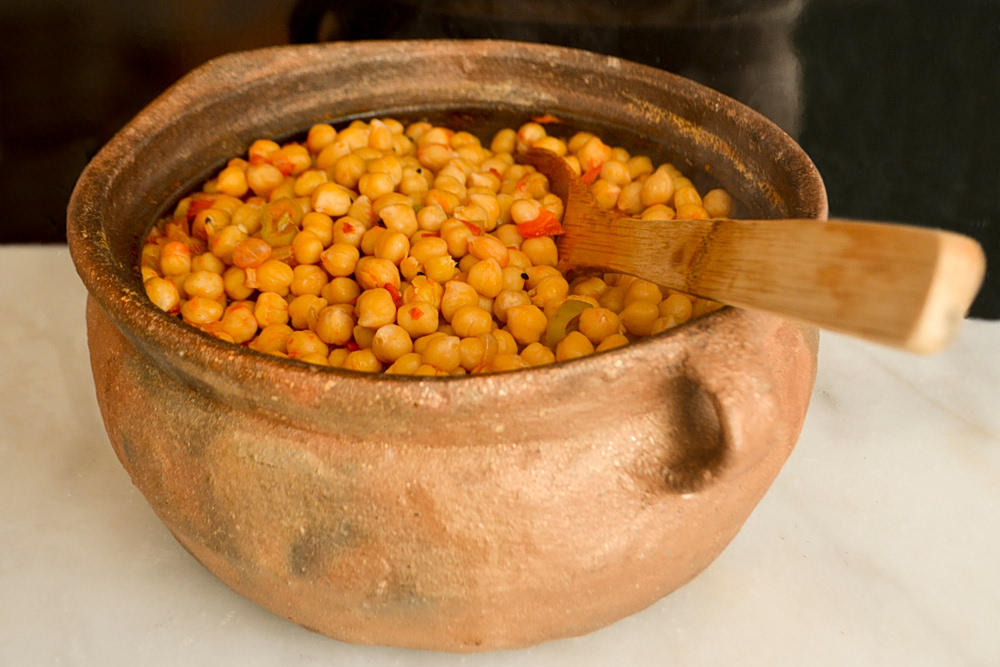
On Paros, dry farming remains an important part of local agricultural life. Argyros Loukis belongs to a younger generation of producers who have chosen to continue a family tradition spanning several decades. He grows small-seeded chickpeas and fava and, in recent years, has devoted even more attention to preserving traditional seeds.
“I started because I wanted to continue something my grandfather did, and before him, my great-grandfather,” he says.
The chickpeas he grows come from family seed that has been preserved over the years.
“They come from my family’s seeds. They are small-seeded, cook well and are very tasty. My great-grandfather’s father was growing chickpeas in 1891, and I know that on the island their cultivation continued until the early 1980s.”
Arsenis Loukis is also committed to tradition, growing xylangouro—the Cycladic cucumber, also known as atzouri—in his garden. It is light green and highly resistant to a lack of water. It makes an ideal meze, or small savory dish, to accompany Souma, Paros’ traditional grape-based spirit.
The culinary value of these waterless gardens can be seen in some of the Cyclades’ best-known products: the sun-dried tomatoes of Santorini and Milos, the fava of Santorini and Schinoussa, Paros’ small-seeded chickpeas and the aromatic herbs of Amorgos. They are all examples of foods shaped by an environment where water has always been in short supply.
Following a centuries-old tradition
A special place belongs to Santorini Fava PDO. Producer Yiannis Nomikos points out that it “has a history spanning more than 3,000 years.”
Despite the modernization of agriculture, much of its cultivation remains manual.
“We are following a dietary tradition that goes back thousands of years,” he says.
The famous Santorini fava is made from lathouri (Lathyrus clymenum L.), a legume uniquely adapted to the island’s conditions.
“It owes its distinctive flavor to the fact that we use ancient seeds, but both the island’s volcanic soil and the particular Cycladic climate also play an important role,” he explains.
Santorini’s white eggplant is another crop grown in the island’s waterless gardens, prized for its sweet flesh.
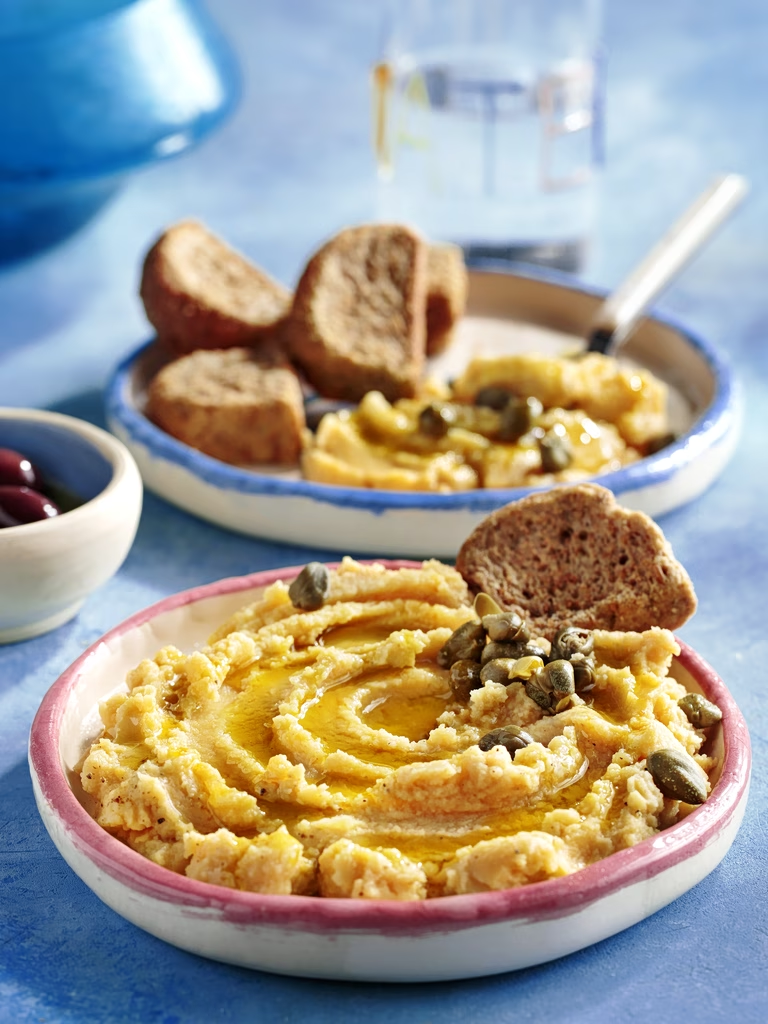
Photo: Giorgos Drakopoulos, Food styling: Olivia Artemis Webb
Behind the waterless gardens lies a deep understanding of how to manage natural resources. Farmers observed the soil, the winds and the moisture left by winter rains, adapting their practices to the particular characteristics of each place.
Today, the abandonment of agriculture, residential development and climate change threaten this tradition. Yet in recent years, interest in dry farming has been renewed.
Young farmers, chefs and local organizations are bringing old varieties back into cultivation and maintaining the dry-stone walls that have long shaped the Cycladic landscape.
Every fruit that grows without irrigation is a reminder that the wisdom of earlier generations may offer a valuable guide to the future of the Cyclades.