 Μake us preferred on Google
When Greece and Israel signed a €3.035 billion agreement for Achilles’ Shield in Tel Aviv, the commentary fixated on the hardware, with three Israeli missile systems of increasing reach, those being Spyder, Barak MX and David’s Sling. The commentary has been asking the wrong question. The question is not what Greece has bought, but rather what Greece can afford to fire.
Nikos Dendias, Greece’s defence minister, stated that new technologies and new forms of warfare had “long rendered the existing defence doctrines completely obsolete”. He is right. But the doctrine that replaces the old ones carries a price tag nobody has published, and it is paid per shot.
The Arithmetic of a Long War
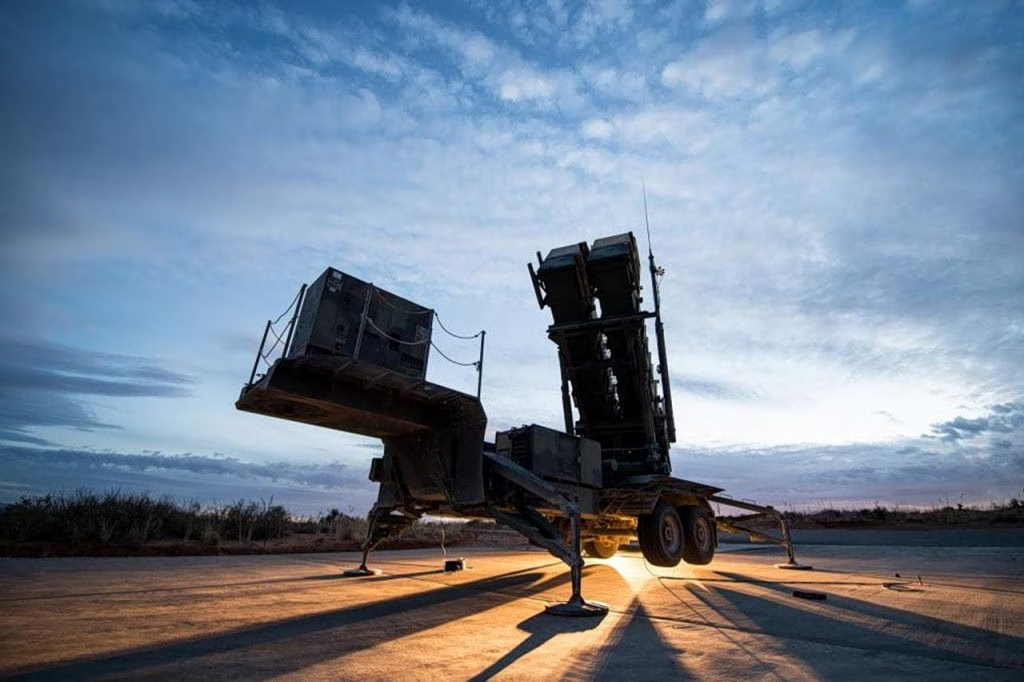
The Iran war of 2026 settled the argument. Four days following the first American and Israeli strikes, the United Arab Emirates alone had detected 941 Iranian drones. Its defences stopped 876. Iran’s workhorse is the Shahed-136, a drone built to crash into its target and worth $20,000 to $100,000 apiece. The best known of the interceptors fired at Iran’s drones and missiles, the American Patriot, costs roughly $4 million, enough to buy 40 to 200 Shaheds.
Stated bluntly, a defender can win every engagement and lose the exchange, because each kill costs more than what it kills. Interception rates indeed were high. However, stockpiles were not. Only about 600 Patriot missiles are expected to be made this year, and one Gulf state faced more drones than that in four days. That is the trap, and Greece owns Patriots too.
The way out is not to meet every drone with a missile. A jammer that scrambles the signal a drone steers by, or a small interceptor drone flown into it, can do the job for a fraction of the price, and together they form the cheap layer. What matters then is depth: how many shots of each kind a country actually holds. In a long campaign, the cheap layer gives way first, because interceptor drones run out and attackers find ways around the jammers. And from then on, every drone is met with a missile. That is the second week.
Greece has not published what it pays per missile, but the missiles it is buying, or their closest equivalents, have sold elsewhere for roughly $550,000 to $1.2 million a shot. Against a drone, each is a sports car sent to run over a bicycle. The only cheap shot came alongside the package: €26 million of Drone Dome, a jammer. That €26 million is under one cent for every euro of the main contract.
Greece need not imagine who could run up that missile bill. Last year, Dendias put Turkey’s inventory at “more than one million drones”, and the newest Turkish designs are closer to the Shahed. Baykar, Turkey’s biggest drone maker, says one is meant to be “mass-produced at low cost” and to fly beyond 2,000 kilometres. Another, it says, finds its target even without GPS. A drone launched from south-eastern Turkey could reach anywhere in Greece. Greece cannot count on reaching the archers first. It has to catch the arrows, one paid shot at a time.
A Design Built for the Problem
Achilles’ Shield was designed by people who understood the arithmetic. Its command-and-control system will, Dendias says, prioritise targets and recommend responses. The ministry’s announcement gives a total price, but not the number of missiles behind the launchers.
The decisive variable is not how many drones arrive. It is how many get past the cheap layer and have to be stopped by a missile. Consider a 100-drone raid. If a quarter get past the cheap layer, Greece fires 25 missiles, which equates to $14 to $30 million. A full cheap layer could stop the whole raid for a few hundred thousand dollars, a few thousand apiece. A million drones can swarm the layer; a first wave can be sized to use it up; and across dozens of inhabited islands, Achilles’ Shield cannot be everywhere. With the shield came €26 million of jammers and no interceptor drones at all.
The Greek Share
Around €750 million will go to 19 Greek companies. The arithmetic points to three priorities.
Firstly, we must build the missiles at home. A Barak MX production line with Hellenic Defence Systems, the state arms and ammunition maker, is reportedly under consideration. A country that can refill its own launchers does not queue behind other customers in a crisis.
Secondly, and more urgently, we must scale what Greece already does cheaply. The state-owned Hellenic Aerospace Industry builds Centauros to jam drones. It costs about €2 million a unit and, as Euronews put it, “consumes only electricity”. In July 2024, it defended the frigate Psara against drones off Yemen. Beyond jamming lies the interceptor drone. Ukrainian firms make such drones for a few thousand dollars or less.
Finally, we must measure depth as a milestone. Delivery dates will tell parliament whether this shield exists. Only the number of shots on hand, layer by layer, will tell it how long this shield can operate. That figure can stay classified. It cannot, however, stay unasked.
The Second Week
Achilles’ Shield is a serious answer to a real problem. Its success will be measured in the second week of a crisis, when every remaining shot costs the equivalent of a sports car. Whether Greece reaches that week with its launchers full will be decided as much in Greece as in Tel Aviv. It will be decided in Tanagra, where the Hellenic Aerospace Industry builds its jammers. And it will be decided in Lavrio, where Hellenic Defence Systems makes artillery shells today and must learn to make missiles. The shield is Israeli, but the depth must be Greek.
Filippo N. Valasakis is a graduate of International Relations and European Affairs from the American College of Greece – DEREE, whose work focuses on defence economics, European strategic autonomy, and the security of critical supply chains.