 Μake us preferred on Google
 At a time when Greek diplomacy appears to be dragging its feet, and no real step toward national consensus has been made domestically—largely due to the Prime Minister’s own responsibility—what will he do if the others do not accept our positions?
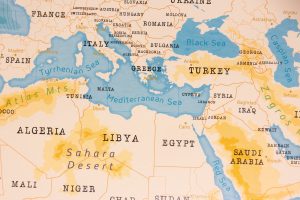
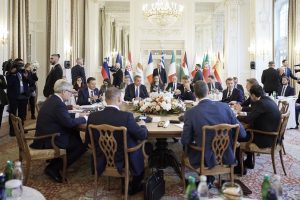
A proposed international conference on the Eastern Mediterranean is, in theory, a welcome development. From Kyriakos Mitsotakis’s statement in Parliament, it is understood that Athens intends to invite all coastal states to a forum where “everything that concerns us” will be discussed.
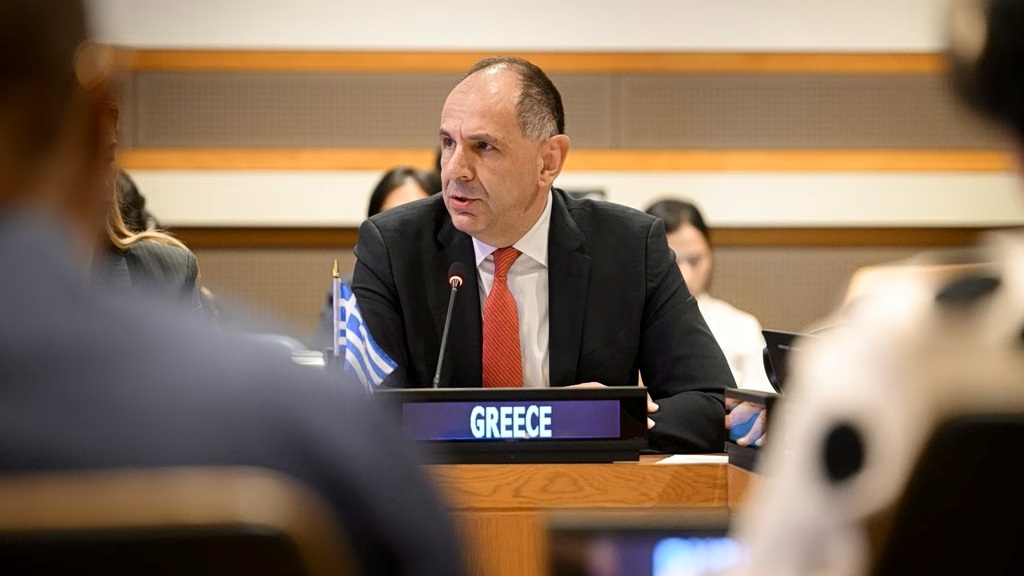
“Greece,” he noted, “has nothing to fear from sitting at the table and defending its positions, always with reference to the Law of the Sea.”
This means that Turkey, Syria, Lebanon, Israel, Cyprus, Egypt, and Libya would all be invited to the table. From what appears, the Prime Minister’s initiative is not a standalone move but part of a broader American plan for the region—reportedly driven by Donald Trump’s son-in-law, Massad Boulos. The U.S. President’s goal, which he has made clear since his inauguration, is his country’s energy dominance. And, as we have seen, he exerts relentless pressure to serve American interests.
In this early phase, Mr. Mitsotakis for the first time included Turkey in the discussions, even though when Erdoğan made a similar proposal in 2020, he had excluded Cyprus. The same proposal, without details, was repeated in Erdoğan’s speech at the United Nations in September.
Meanwhile, interesting developments are underway. Talks with Chevron are intensifying, and ExxonMobil has expressed interest in the same area of the Eastern Mediterranean—meaning the American side has every reason to seek a resolution on maritime boundaries.
On November 5, U.S. Secretary of Energy Chris Wright will arrive in Athens, leading a large delegation of energy company representatives and government officials. The Americans view Greece as an energy hub and Alexandroupolis as the gateway for their natural gas exports to Europe.
Wright will meet not only with Stavros Papastavrou but also with 20 other energy ministers from Central, Eastern, and Southern Europe. Beyond mutual courtesies, commercial agreements are expected to be signed during an intensive two-day event at the Zappeion Hall.
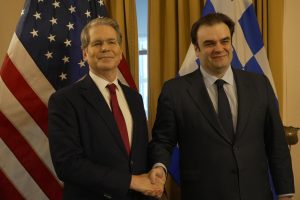
And, of course, one should not overlook the role of the new U.S. Ambassador, Kimberly Guilfoyle, whom those who have met describe as a “bulldozer” — a term also often used for Trump himself — and who has been taking an unusually active interest in Greek affairs. Guilfoyle is expected in Athens later this month, and Wright will be the first U.S. cabinet member she welcomes.
All this sounds very promising—provided that the Greek government stands firmly on its feet, knows exactly what it wants, and understands its limits. Because Trump knows no limits when he wants to achieve something, and he is hardly sensitive to the concerns of his interlocutors. The public humiliations of Zelensky and Erdoğan are not to be taken lightly.
In such a multilateral setting, Mr. Mitsotakis will be able to control very little, even as the host. At a time when Greek diplomacy seems to be faltering, and when no step toward national consensus has been made at home—again, largely due to his own responsibility—what will the Prime Minister do if others reject Greece’s positions?
Turkey’s intentions are well known. Libya and Egypt, however, are far less predictable. If the Israel–Lebanon agreement on maritime boundaries, achieved through U.S. mediation, serves as a model, matters might be simplified, avoiding the need to turn to the International Court of Justice in The Hague.
If not, would it perhaps be wiser to settle our differences with Turkey through bilateral talks—as Evangelos Venizelos has long argued is the “safest method,” and as Erdoğan traditionally prefers? Because a call for an international conference and, at the same time, tough talk over the undersea cable — those two things don’t quite go together.