 Μake us preferred on Google
 Is there life after the death of the Recovery Fund?
Its official expiration date has already been set for August — the month traditionally associated in Greece with the “people’s holidays,” a phrase rooted in Greek political culture, when the only headline used to be the weather forecast. Mild summer winds or suffocating heatwaves? That was once the extent of August anxiety.
But August has long also carried predictions of a “hot autumn” — not meteorologically, but politically. The temperature on Greece’s political thermometer was always destined to rise. The atmosphere changes, and the lethargy of summer never survives into September.
This year, even more so.
And it is not only because the European Recovery Fund — the massive EU financial mechanism that pumped billions into the Greek economy after the pandemic — is coming to an end, forcing the country to confront the uncomfortable question of “what comes next” for an economy that spent years feeding on European money while earning the reputation of an economic “miracle.”
It is also because the question of elections still hangs unresolved over the country.
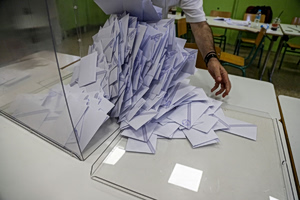
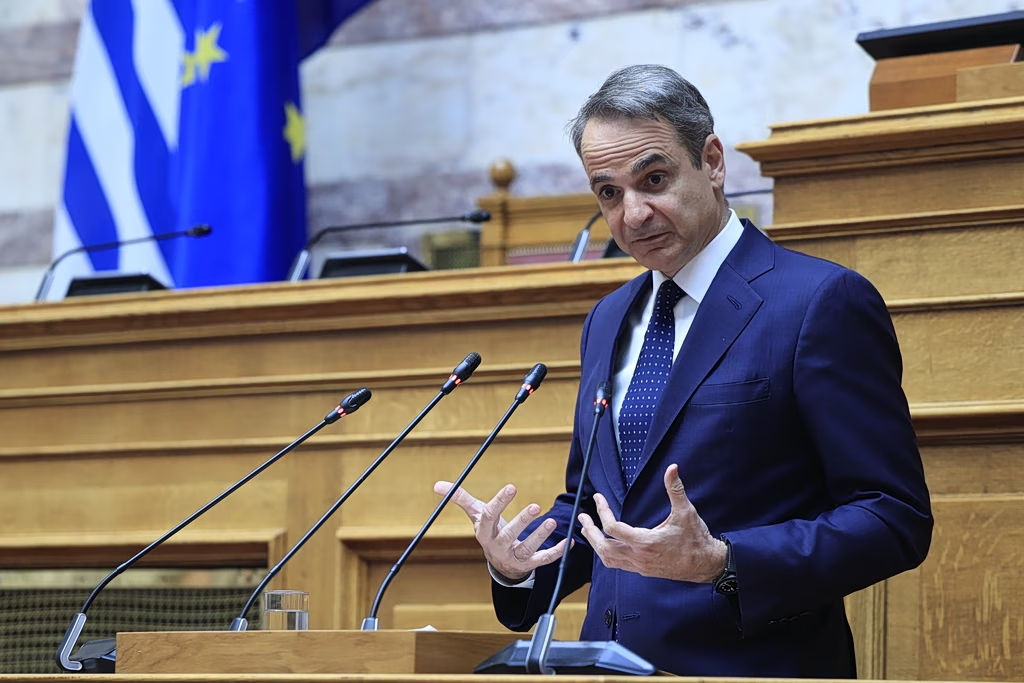
Is this an election year, or merely a pre-election year? Will Greeks head to the polls this autumn, as recent leaks from Prime Minister Kyriakos Mitsotakis’ office suggested? Or will elections instead be held on Palm Sunday next spring, as political insiders who have already circled dates on their calendars believe?
For now, only the noble class of fortune tellers claims certainty — the people who, when they happen to be right, insist they “saw it coming,” and when they are wrong, no one remembers what they said in the first place.
Everyone else, including the Prime Minister’s office, is navigating completely uncharted waters of uncertainty, both domestic and international.
No one knows, for example, whether this summer will become one of those catastrophic fire seasons in which August headlines are dominated by mega-fires and charred tragedies.
Nor does anyone know when Donald Trump might finally decide he has “won” enough to declare an end to war — or whether he will remain trapped in what the article describes as an Iranian “war of attrition,” shifting between the mouse that roars and the lion that licks his wounds.
The roaring mouse drives oil prices higher. The wounded lion drives them lower.
As oil prices rise and fall like an elevator, the Greek government can still rely on one powerful political weapon: the sense of external danger and the familiar instinct of “rallying around the flag.”
Look at the chaos abroad, the message goes. Look how calm things are at home. Vote for stability.
Wildfires and wars are not things the New Democracy government can simply summon by rubbing a genie’s bottle.
What it can ask from the genie, however, is an opponent who reinforces its central political narrative by appearing as a threat to stability.
Above all, former Prime Minister Alexis Tsipras. To some extent Maria Karystianou — the mother who became a symbolic public figure after the Tempi train disaster — and, when convenient, PASOK leader Nikos Androulakis, who government strategists portray as resembling them politically.
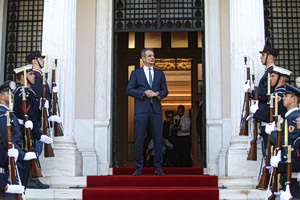
That is the electoral strategy emerging from Maximos Mansion, the Greek Prime Minister’s headquarters.
Whether elections come in autumn 2025 or spring 2026. Whether it rains or snows.
None of the opposition parties — nor any future parties yet to be announced — can force elections.
But neither do they have any reason to rush toward the ballot box by rubbing the genie’s bottle themselves.
Wars, as happened with Ukraine, eventually fade into the background as distant unresolved crises. Polls already show that public fear over the Gulf conflict is beginning to decline.
So what remains?
A harsh, grinding winter without the Recovery Fund, with inflation as the only constant.
Months that feel stagnant while steadily emptying people’s wallets.
That is when Greece may finally discover what life looks like without European money — and realize that the Recovery Fund was an economic elixir the country not only no longer has, but perhaps never fully used even when it did.