Μake us preferred on Google
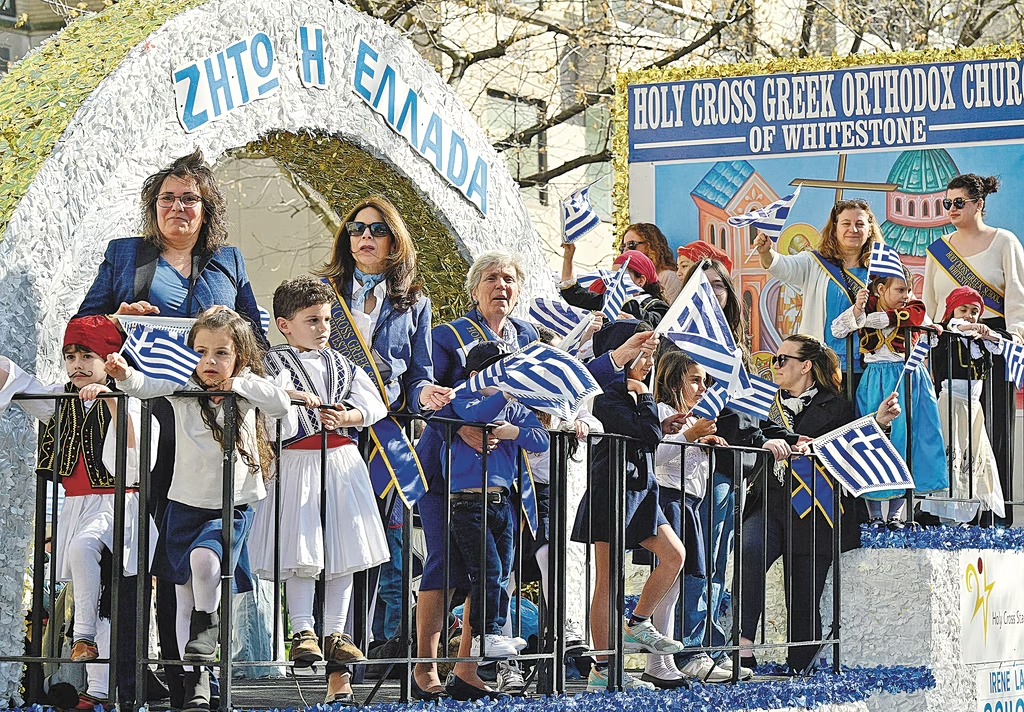
 Greek-American billionaire John Catsimatidis took the floor at a Manhattan gala celebrating the Greek Independence Day Parade and told the room what he thought Greece needed.
Less invasion. Fewer foreigners. He thanked Prime Minister Kyriakos Mitsotakis for what he called described as holding the line. The Germans and the French, he added, were fools for losing their countries. Some in the crowd applauded.
Then a bishop from the Church of Greece walked to the same podium and, without raising his voice, said something else entirely.
I wasn’t in the room this year. But when people who were told me what had happened, I found the video and listened to it twice.
Metropolitan Hieronymos of Kalavryta and Aigialeia did not mention Catsimatidis by name.
Speaking in Greek, which is its own kind of privacy in a bilingual room, he reminded the assembled Greek-Americans of something their own families might have told them: “Greeks have never cast immigrants aside. Greeks have never stood against immigrants.”
He was speaking to a room full of people whose grandparents or great grandparents arrived in this country with nothing but a name no one could pronounce.
Catsimatidis himself is the son of immigrants from the island of Nisyros. His father came here the same way.
There is a strain of diaspora nationalism that hardens with distance. One that mistakes nostalgia for identity and sentiment for politics. It is easy to police the borders of a country you left. The people who would actually be turned away remain abstractions. The nation becomes a museum you visit once a decade and feel entitled to curate.
None of this is to pretend the question is simple. Large-scale unlawful migration does place real strain on communities and institutions. Greece has experienced that strain acutely.
The argument is not that borders are irrelevant. It is about what a tradition actually teaches, and whether the language of invasion and blood is the honest expression of that teaching or its betrayal.

Greek-American billionaire John Catsimatidis on the podium at the Manhattan gala for Greek Independence Day,
That is precisely what the Bishop was addressing. Hieronymos offered something older and more demanding, In Orthodox theology, the encounter with the stranger is not a political question. It is a spiritual one.
The tradition has a word for it: philoxenia, love of the stranger, which is not a social courtesy but a theological imperative, rooted in the belief that Christ himself is encountered in the face of the other.
When Hieronymos said that those who lived the experience of migration became “heralds of love toward all people and toward Christ,” he was not making a liberal argument about inclusion.
He was making a claim that runs through two thousand years of Orthodox thought. How a community treats the vulnerable is the precise measure of its faithfulness.
The diaspora, in this reading, was not merely a sociological fact. It was a spiritual formation.
He invoked the Monastery of Agia Lavra in Kalavryta, where his predecessor Bishop Germanos blessed the Greek Revolution in 1821, and described his diocese as a place of “sacrifice, resurrection, and hope.”
That Easter arc, sacrifice, resurrection, hope, is not accidental. A bishop mapping the national story onto the Orthodox cycle of death and resurrection is saying something specific: the freedom the revolutionaries bled for was never purely political. It was an act of witness.
And witness, in that tradition, is carried forward not by guarding bloodlines but through faith, education, and solidarity with those who arrive as strangers.
There is nothing new about what Catsimatidis said. The rhetoric of blood and borders has found a comfortable home in parts of the diaspora for years, carried along by the same political currents moving through Europe and the United States.
What was striking was the setting. A celebration of a revolution fought by people with almost nothing, against an empire, sustained by a church that preached sacrifice over self-preservation.
The Greek War of Independence was not won by men who worried about who was Greek enough. The Bishop of Kalavryta knows that history from the ground up. His diocese is where it began.
He did not lecture. He stood at the same podium in Manhattan, spoke quietly in Greek, and left the room to reach its own conclusions.