 Μake us preferred on Google
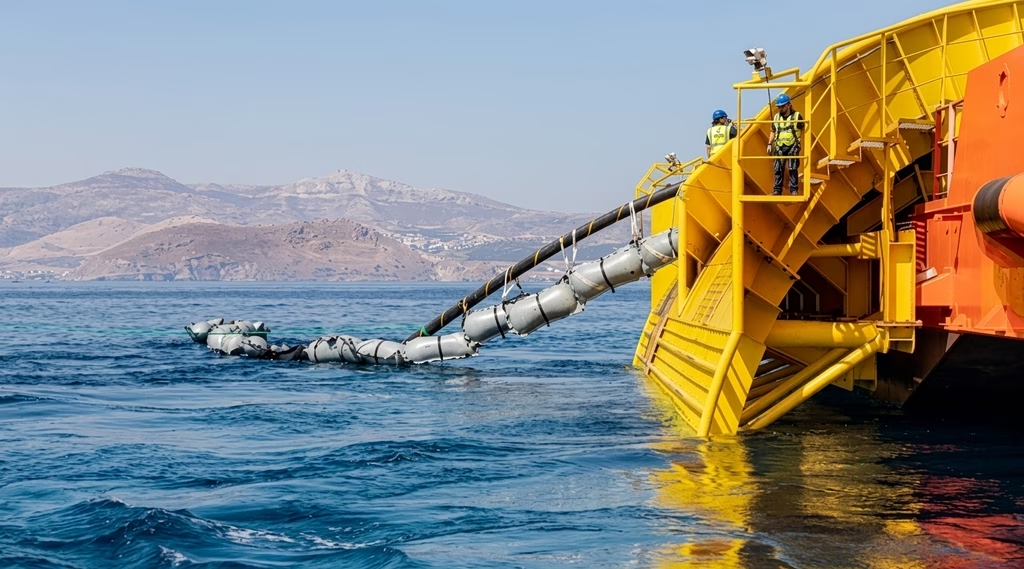
As the French research vessel Abeille Marengo sailed off Chania toward Heraklion on Monday evening, the balancing act between Athens, Paris and Ankara was in full swing. The vessel is due to survey the seabed between Kasos and Cyprus for the laying of the electricity cable.
Diplomatic efforts have been underway for several weeks to find a workable formula: Greece wants to avoid any de facto legitimization of Turkish jurisdiction over the Greek continental shelf, while Turkey seeks to present itself as the dominant power in the Eastern Mediterranean. These efforts have resulted in Athens delaying the NAVTEX navigational notice that would designate the areas where the Abeille Marengo will conduct its surveys.
NAVTEX Issuance “A Matter of Time”
The Greek government has stated that the surveys will be completed as planned, regardless of Turkey’s objections. Issuing the NAVTEX is therefore simply a matter of time, even as successive press reports based on leaks are denied.
Within this complex framework, the parties involved are simultaneously trying to interpret one another’s intentions, wording and, ultimately, breaking points.
A telling example was last week’s informal exchange between Greek Foreign Minister Giorgos Gerapetritis and his Turkish counterpart, Hakan Fidan. It followed Fidan’s comments about sending Ankara written rather than verbal notification, stating: “We intend to undertake specific activities in this particular area; here are the coordinates.”
Ankara’s Warning of Military Involvement
Fidan may not have used the word “permission”—a possibility Athens categorically refuses to consider—but Ankara’s official position has not changed. It maintains that anyone planning surveys or cable-laying operations in areas of the Turkish continental shelf must first secure the necessary cooperation and coordination with Turkey.
Indeed, on Oct. 1, Turkey’s Defense Ministry issued an unequivocal statement:
“Our country, within the framework of its rights and powers arising from its status as a coastal state in the Eastern Mediterranean, will not permit any unauthorized activity on our continental shelf.”
In this instance, the words requiring interpretation are “coordination” and “cooperation.” The statement that no “unauthorized activity” will be permitted leaves little room for misunderstanding Ankara’s intentions: If the procedure does not meet Turkey’s requirements, the project will become a military matter.
Permission or Simple Notification?
This is precisely what Athens wants to avoid, which is why it appears willing to agree to a “notification” procedure.
Following Gerapetritis, government spokesman Pavlos Marinakis clarified that obtaining permission and simply providing notification are two different matters. He recalled that authorization for the project had been sought only from the Greek authorities and would not be requested from any other state. This underscores the central point: Only Greece is competent to issue a NAVTEX for the areas concerned.
“That is authorization. The other thing is simple notification. The procedure for simple notification is being followed, as happens with every project of this kind. Why? Because this has no legal consequences,” Marinakis stressed.
A Precedent and Turkish Claims
As To Vima has repeatedly noted, however, the notification option—if Turkey ultimately accepts it—would establish a particular practice, or a fait accompli, on which Ankara could base demands concerning every similar project.
Among other considerations, international law contains no corresponding requirement; cable laying falls under the provisions governing freedom of the high seas.
Beyond the legal framework, however, the issue has taken on political dimensions, prompting the search for some form of compromise. France, which holds a majority stake in the cable project through Meridiam, is playing the leading role in bridging the gap between the two sides of the Aegean.
A closer reading of Fidan’s remarks also requires attention to his statement that Ankara does not want “the status quo to be disturbed, or a precedent [a fait accompli] to be established in an entirely wrong way.”
In short, Turkey takes it as a given that the survey areas lie on its continental shelf—and that it is therefore competent to issue the NAVTEX. It is warning that ignoring Ankara would threaten to change the region’s status quo, something it clearly will not accept.
The NAVTEX “War”
Athens, however, will not accept a NAVTEX issued by Ankara either. The two sides therefore appear headed, initially, toward another NAVTEX “war,” with competing notices setting out their longstanding and entirely opposing positions on jurisdiction and maritime zones.
This is what happened with the EMC project, although tensions did not spill over into a confrontation at sea. Nor was it clarified whether Ankara had ultimately been notified or had received a request to authorize the surveys.
It remains to be seen whether the diplomatic efforts, French company Meridiam’s majority stake in the project and, ultimately, the procedure chosen for Turkey’s involvement will keep the Greek–Turkish confrontation over the cable within diplomatic bounds.
The NAVTEX and the Turkey–Libya Memorandum
For now, Athens is building on the diplomatic mobilization it was compelled to undertake to secure the broadest possible condemnation of the eastern Libya-based House of Representatives’ ratification of the Turkey–Libya memorandum.
The latest and most forceful intervention was a joint statement by Greece, Egypt, Cyprus, Bahrain, the United Arab Emirates and the European Union at the United Nations Security Council.
According to the statement, the purported memorandum:
“Disregards geographical reality and the rights of all coastal states concerned to maritime zones, including the rights of islands under the United Nations Convention on the Law of the Sea. The subsequent decision by Libya’s House of Representatives does not alter this legal reality. The memorandum remains null and void, contravenes international law and cannot constitute a lawful basis for the delimitation of maritime zones or produce legal effects for third states.”
Turkish Revisionism in the Eastern Mediterranean
Many in Athens believe Greece is holding off on issuing the NAVTEX for the cable surveys while it builds broader international opposition to the Turkey–Libya maritime memorandum, hoping this will discourage Ankara from intervening at sea.
They believe the immediate priority is to build the strongest and most united possible front against Turkish revisionism in the Eastern Mediterranean, backed by broad international support. This, they argue, would give Ankara pause, particularly over intervening at sea in the cable project.
Portraying Turkey as a disruptive state in the Eastern Mediterranean, they believe, would not serve the international image that Recep Tayyip Erdogan is currently seeking to cultivate.