
 Μake us preferred on Google
Greece is expected to issue a maritime navigation warning, known as a Navtex, on Friday, November 6, authorizing the resumption of surveys for the electricity cable connecting Greece and Cyprus, according to information reported by To Vima.
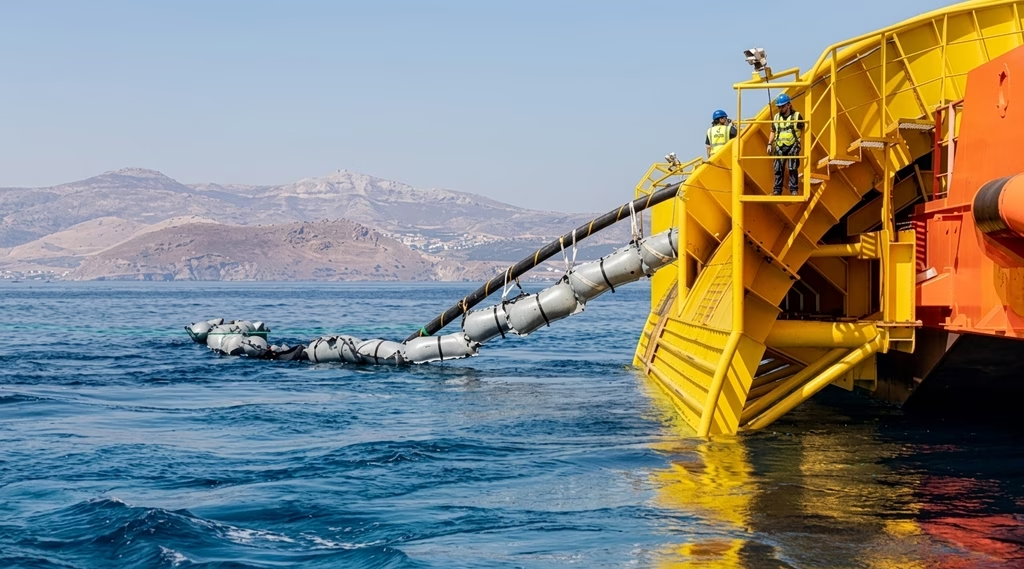
The announcement is expected to follow a meeting of the relevant interministerial committee, which has reviewed the documentation submitted by the French company involved in the project. The coordinates of the designated survey area will then be sent to the Defense Ministry, before the competent maritime station in Heraklion, Crete, issues the navigation warning. The French research vessel Abeille Marengo is currently docked at the port of Heraklion.
The company’s file has been in the hands of Greek authorities for approximately a month.
Under the current plan, surveys will resume where they stopped in July 2024, outside Greek territorial waters off the island of Kasos, in an area that Greece considers part of its potential continental shelf.
Athens says it is prepared for possible obstruction
Foreign Minister George Gerapetritis reiterated that Greece is prepared to respond if Turkey attempts to prevent the research from proceeding. Speaking to ANT1 television, he said Athens had plans for every possible scenario, although he did not consider an obstruction likely.
He pointed to the project’s European significance and the majority participation of French investment company Meridiam, which also brings France into the picture.
“We have all scenarios ready. And I want to tell you that it is very clear that everyone bears the responsibility for their actions. If Turkey attempts to obstruct the project, it will obviously find Greece standing against it,” Gerapetritis said.
He added that plans were in place for any attempt to disrupt the work, and that he expected the French company and the French state to have corresponding preparations.
Turkey would also face the European Union, he said, because the project receives EU co-funding. If Ankara aspires to join the bloc while obstructing European projects, Gerapetritis argued, it is “closing the door on itself.”
Dispute over whether Turkey should be notified
The central diplomatic question concerns whether Turkey should receive advance notice of the research and, if so, in what form.
Gerapetritis has stressed that authorization for the surveys can come only from Greece. Under international law, the company itself is not required to submit an authorization request or notification to Turkey, according to the account.
Turkey’s Foreign Minister Hakan Fidan had recently called for Ankara to receive written notification, arguing that this was necessary to avoid changing the status quo in the area. Athens views such a demand as an attempt by Turkey to establish that waters beyond Greece’s territorial limits fall within the Turkish continental shelf.
Under that position, Ankara would either issue its own Navtex or be formally informed as the coastal state claiming jurisdiction over the seabed where the research would take place.
Gerapetritis, however, has distinguished formal notification from what he described as an informal update. Informing Turkey that a vessel will conduct research, he said, would not be unreasonable, would carry no legal consequences and would not alter the balance of rights concerning authorization.
That distinction remains contested. Some legal experts and opposition figures argue that even an informal notification could indirectly be interpreted as recognition of Turkish rights in the area.
Athens must also take into account Fidan’s subsequent clarification in Brussels that Turkey’s positions have not changed. Official Turkish statements have maintained that the research should proceed only following consultation and that any activities must be authorized.
The broader objective for Ankara, according to the article’s analysis, is to establish that no energy project in the Eastern Mediterranean can be completed without Turkish approval or consent. Fidan has reiterated that Turkey will continue to defend what it considers its legitimate rights in the Aegean and Eastern Mediterranean without concessions.
Greece and Cyprus coordinate their maritime warnings
Ahead of the expected Greek Navtex, Gerapetritis spoke on Wednesday with his Cypriot counterpart to coordinate the next steps. Cyprus must also take the necessary measures to designate the areas falling under its own jurisdiction.
The planned research areas are described by Athens as lying exclusively within the potential continental shelves of Greece and Cyprus. Turkey disputes those claims, relying on the 2019 maritime memorandum it signed with Libya and coordinates it submitted to the United Nations in 2020 outlining the claimed outer limits of its continental shelf.
The issuance of Greek and Cypriot navigation warnings is expected to trigger a series of competing Navtex and counter-Navtex announcements involving Turkey. A similar exchange took place during the dispute over the EMC cable project. Such notices allow the parties to restate their positions on maritime rights and responsibilities in the Eastern Mediterranean.
French research vessel awaits authorization in Crete
The French research vessel Abeille Marengo has been docked in Heraklion for 10 days, as the timetable for completing the cable project becomes increasingly tight for all parties involved, particularly Greece and France.
Intensive discussions between Paris, Athens and Ankara over recent weeks appear to have helped bridge differences between the Greek and Turkish positions, with France seeking to facilitate an agreement. It remains unclear, however, whether Turkey will continue to insist on a formal request for authorization or official notification from France.
The cable project has been a source of sustained political controversy in Greece, with opposition parties accusing the government of inaction and making concessions to Turkey.