
 Μake us preferred on Google
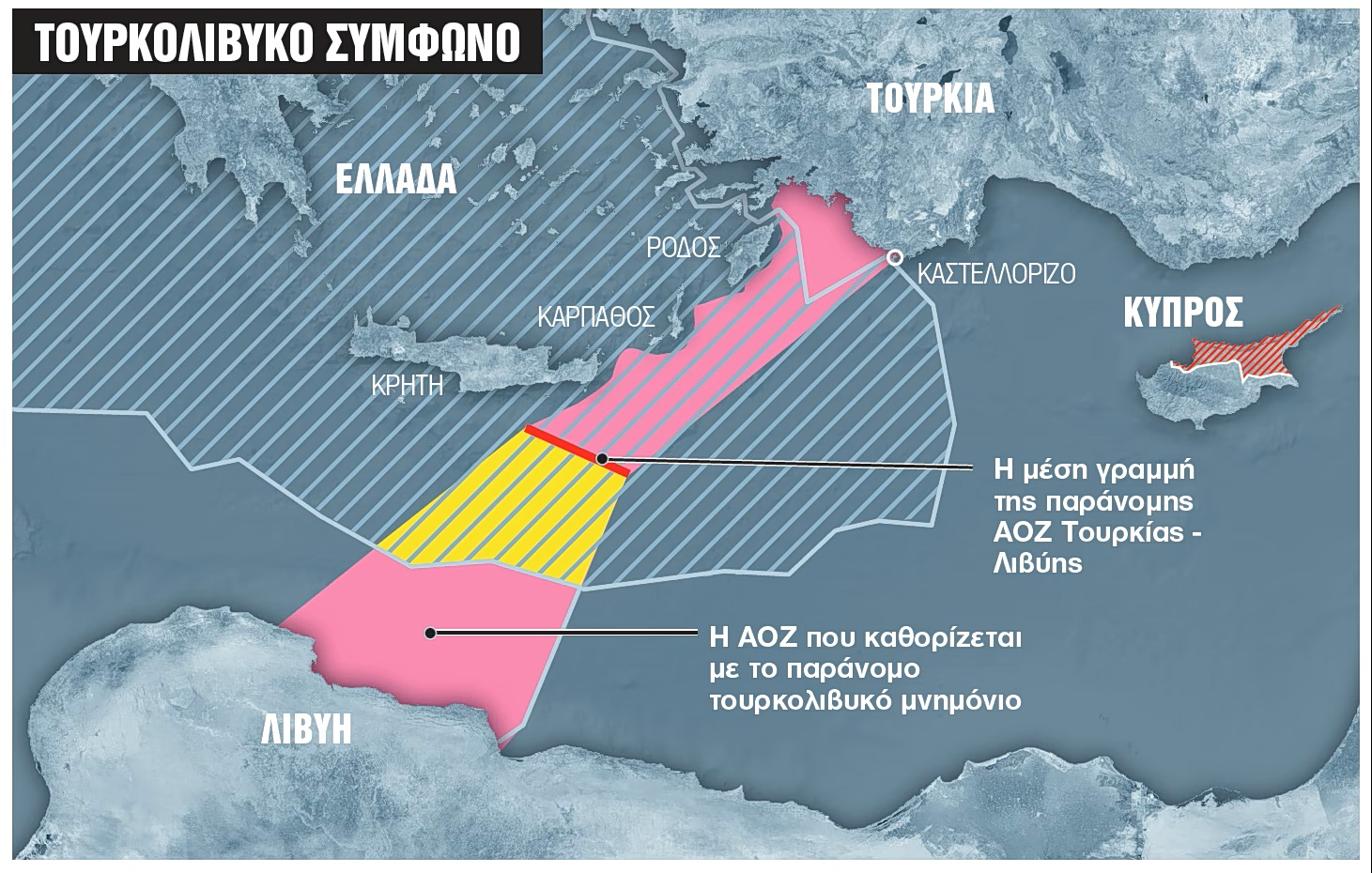
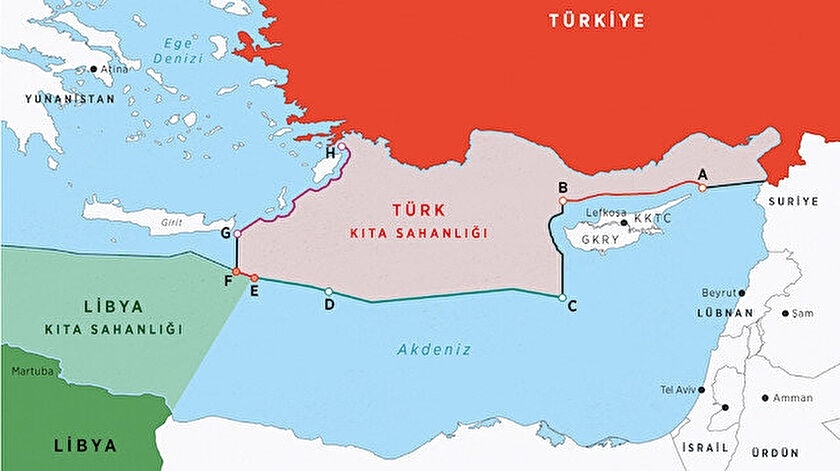
The agreement was published under Law No. 8 of 2026 in Issue 17 of the Libyan parliament’s official gazette, together with a map and geographical coordinates. The publication follows the House of Representatives’ unanimous approval of the memorandum on Oct. 20, reversing its previous rejection of the agreement in 2020.
Signed in November 2019 by Turkey and Libya’s then-Government of National Accord, the memorandum establishes a maritime boundary between the two countries in the central-eastern Mediterranean, defining their respective continental shelf and exclusive economic zone (EEZ) claims through geographical coordinates. It consists of six articles and two annexes.
The maritime agreement requires either party to inform and consult the other if it enters negotiations with a third country on EEZ delimitation that could affect the agreed coordinates. It also provides for joint arrangements to exploit natural resources that may extend across the boundaries of their respective EEZs. Its provisions on maritime delimitation and the accompanying annexes are excluded from the agreement’s review and amendment mechanism.
Greece: Agreement disregards islands and third-state rights
Athens has strenuously argued that the memorandum disregards the maritime entitlements of a handful of Greek islands, most notably Crete and the Dodecanese isles, and attempts to establish a boundary that overlaps areas where Greece claims sovereign rights over the continental shelf and EEZ.
In a letter to the United Nations in December 2019, Greece argued that Turkey and Libya had neither adjacent nor opposite coasts that would provide a legal basis for the maritime delimitation they sought. It also maintained that the agreement disregarded the presence of Greek islands and their entitlement to generate maritime zones under Article 121 of the United Nations Convention on the Law of the Sea (UNCLOS).
Article 121 provides that islands, like other land territory, generally generate a territorial sea, an EEZ and a continental shelf. The exception concerns rocks that cannot sustain human habitation or economic life of their own, which are not entitled to an EEZ or continental shelf.
Greece argues that the islands affected by the Turkey-Libya memorandum cannot simply be disregarded in drawing a maritime boundary. It also points to what it describes as an inconsistency in Ankara’s approach: the memorandum uses Turkish islands and geographical features as base points in constructing its claimed equidistance line while denying comparable significance to Greek islands.
The Greek position is also based on Articles 74 and 83 of UNCLOS, which govern the delimitation of EEZs and continental shelves between states with opposite or adjacent coasts. Both provisions require delimitation by agreement, on the basis of international law, in order to achieve an equitable solution.
Athens maintains that the principle of an equitable solution cannot be invoked to exclude the maritime entitlements of islands or to establish a bilateral boundary at the expense of third states.
Turkish ‘allergy’ to UNCLOS
A central element of the dispute is that Turkey is neither a signatory nor a party to the landmark UNCLOS, which was adopted in 1982 and entered into force in 1994. Greece, by contrast, ratified the Convention in 1995.
Ankara has repeatedly stated at the United Nations that it does not consider UNCLOS the sole or universally applicable legal framework governing maritime activities. In formal explanations of its position, Turkey has said the Convention does not adequately account for particular geographical circumstances and conflicting interests, and that its prohibition on reservations to individual provisions is among the reasons it has not become a party.
Turkey maintains that maritime disputes should be resolved on the basis of equity and applicable international law. It rejects what it describes as Greece’s “maximalist interpretation” of UNCLOS, particularly the argument that islands should automatically receive full effect in maritime delimitation, regardless of their geographical position in relation to the mainland coasts involved.
Official Ankara has argued that islands situated on the opposite side of a median line between mainland coastlines should not necessarily generate maritime jurisdiction beyond their territorial waters if doing so would cut off or disproportionately restrict another state’s coastal projection.
Six parties reaffirmed rejection at UN
The opposition to the memorandum extends beyond Greece. For instance, on Oct. 26, Greece, Cyprus, Egypt, Bahrain, the United Arab Emirates (UAE) and the European Union issued a joint statement at the United Nations, delivered by Greek Foreign Minister George Gerapetritis.
The six parties said the agreement remained null and void, ran counter to international law and could not serve as a lawful basis for maritime delimitation or produce legal consequences for third states.
They argued that the memorandum disregarded geographical realities and the maritime entitlements of all relevant coastal states, including the rights of islands under UNCLOS. They also warned that bilateral agreements cannot be used to prejudice the rights of countries that are not parties to them.
The EU had separately reiterated its opposition following the Oct. 20 vote. European Council President António Costa and European Commission President Ursula von der Leyen said the agreement infringed on the sovereign rights of third states, did not comply with the Law of the Sea and was null and void. They also reaffirmed the bloc’s solidarity with Greece and Cyprus.
Egypt has been particularly vocal in rejecting the memorandum, arguing that it encroaches on areas where Cairo claims maritime rights. It has also challenged the agreement through diplomatic communications to the United Nations and signed a separate maritime delimitation agreement with Greece in August 2020.
The legal principle concerning third states is also central to the objections.
Under Article 34 of the Vienna Convention on the Law of Treaties, an agreement cannot create obligations or rights for a third state without its consent. Greece and its partners argue that the Turkey-Libya memorandum cannot therefore determine or prejudice their maritime rights.
The memorandum was registered with the United Nations in December 2019 and is recorded in the UN Treaty Collection as having entered into force on Dec. 8 of that year. As Athens and other countries have pointed out, however, registration, is not a ruling by the United Nations on the legality of the agreement or the validity of the maritime boundary it establishes.