 Μake us preferred on Google
 Greek Economy and Finance Minister and Eurogroup President Kyriakos Pierrakakis has called for greater European integration, arguing that the European Union can no longer afford to address major challenges 27 times through separate national approaches.
“We cannot continue to do the same thing 27 times, separately,” Pierrakakis said. “In this changing geopolitical landscape, we do not have the luxury of operating as 27. We must operate as one united Europe.”
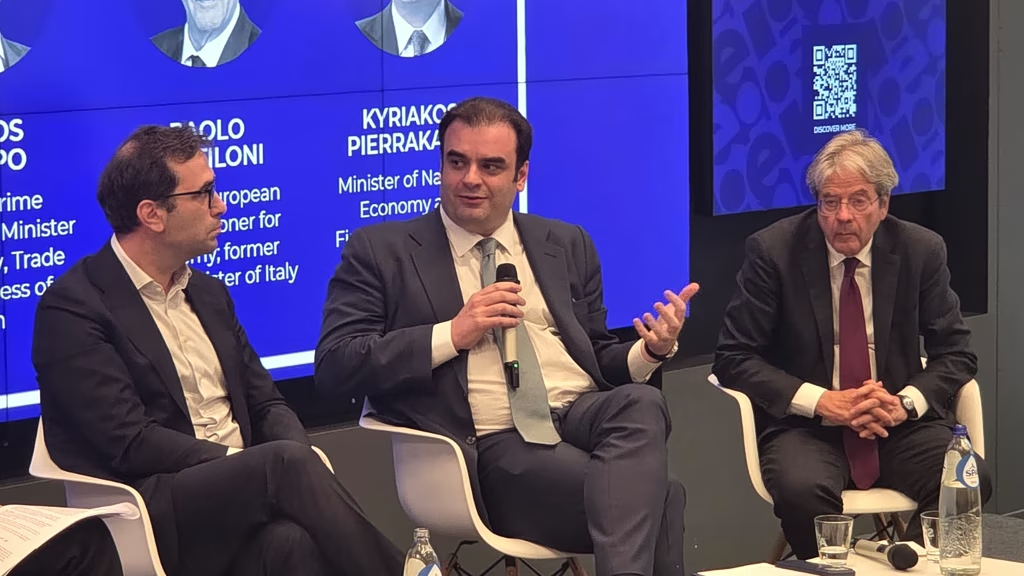
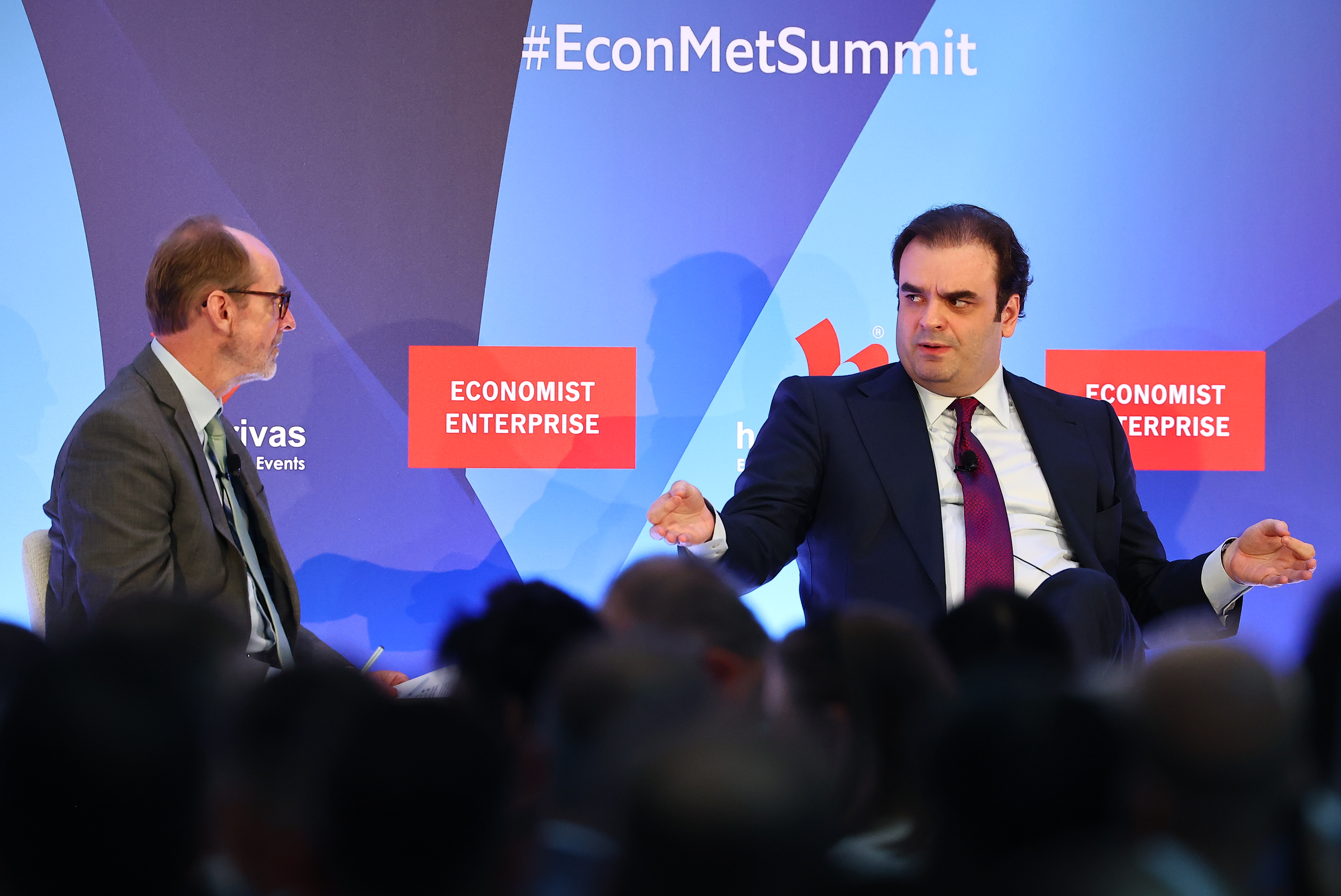
Pierrakakis made the remarks during a discussion with Peter Frankopan, professor of global history at the University of Oxford and honorary research fellow at the Blavatnik School of Government. The conversation was moderated by Alasdair Ross, countries editor of The World Ahead 2027 at The Economist, during the sixth Thessaloniki Metropolitan Summit, organized by The Economist and powergame.gr.
Europe faces a changed geopolitical landscape
Pierrakakis said the return of geopolitics to the forefront, combined with rapid technological innovation, has fundamentally changed the environment in which Europe operates.
He compared the situation with Greece’s experience during the economic crisis of the previous decade. The country had long-standing problems and knew which policies and reforms needed to be implemented, he said, but the rapid implementation of reforms demonstrated that even obvious measures could deliver significant benefits.
Pierrakakis described this as the “dividend of the obvious” — addressing long-standing problems that are already understood — while also emphasizing the need to respond quickly to developments that cannot be predicted.
He said Europe faces a similar challenge, pointing to areas including the Capital Markets Union, Banking Union, the broader Savings and Investments Union, the digitization of the currency and the absence of a unified European energy policy.
Technology is another area where Europe still lacks what Pierrakakis called a clear technological doctrine and strategic understanding of where it wants to go.
At the same time, he said, Europe now understands that its period of “geopolitical innocence” has ended, citing the cost of security and the consequences of Russia’s invasion of Ukraine for European defense.
Political will is key
Pierrakakis said the changing environment has also created what he called a “cost of non-Europe,” making the consequences of fragmented action increasingly visible.
He argued that political will is now the central factor determining whether Europe can close the gap between its ambitions and its achievements.
He pointed to the integration of markets and supervision, the Savings and Investments Union and the digital euro, which has a target timeline of 2029, as examples of reforms that could move forward after years of discussion.
Pierrakakis said it would be difficult to fully implement the ambitions of the report by former European Central Bank President Mario Draghi in the short term, but argued that the question should be how much distance remains to be covered rather than whether the goals can be achieved.
“I believe that this distance will be successfully covered,” he said.
Europe missed opportunities in technology
Pierrakakis said Europe had previously failed to take advantage of opportunities in areas where it already held a technological advantage.
He cited 5G as an example, noting that Ericsson and Nokia were major competitors to Chinese equipment while the European telecommunications spectrum market remained fragmented.
“When you have such an opportunity right in front of you, in an area where you are already at the technological frontier … and you do not leverage the capabilities of the single market, that is a very big mistake,” he said.
He argued that policymakers did not fully recognize this opportunity in 2020, although people in the telecommunications and infrastructure industries had been raising the issue.
Pierrakakis said he now expects a response, but added that the question is whether it will be adequate to the circumstances.
Practical solutions matter
Asked how politicians can address both immediate problems and longer-term global challenges, Pierrakakis said governments need to combine an understanding of history with practical implementation.
He cited U.S. President John F. Kennedy’s reading of Barbara Tuchman’s The Guns of August during the Cuban Missile Crisis as an example of how historical lessons can influence decision-making.
Politicians, he said, need to understand the broader context while remaining closely connected to what is happening in their societies and communities.
“What is missing is the engineer’s mindset,” Pierrakakis said. “Because people need practical solutions to their everyday problems. They do not need grand declarations.”
He pointed to Greece’s gov.gr digital government platform, which he helped create when he was minister of digital governance, as an example. The platform was modeled on the United Kingdom’s gov.uk, launched in 2011, and Pierrakakis said it has become one of the most popular reforms in Greece in decades across political lines.
The lesson, he said, applies to education, health care and major European reforms.
When the Savings and Investments Union is explained to European citizens as a policy concept, he said, most people do not immediately understand its practical significance. But when it translates into better-paying jobs, more employment, higher growth and a stronger Europe, its impact becomes tangible.
Europe must define its approach to China
Asked about Europe’s changing relationship with China, Pierrakakis said Europe must first define its own identity, technological ambitions and strategic priorities.
He described technology as the “21st-century moon race” and argued that Europe needs a clear understanding of the areas where it is already at the technological frontier, those where it wants to reach the frontier and those where it should cooperate with other powers.
That includes managing bilateral relationships with the United States, China and other potential allies and partners, he said.
Pierrakakis identified three possible approaches: leading in a particular field, catching up and developing Europe’s own advantage, or cooperating and jointly shaping developments.
National security, he said, must remain a central consideration when Europe chooses to cooperate.
He cited 5G networks as an example, saying Europe decided that non-European equipment would not be used in the core of its networks, a decision that affects how Europe manages its relationship with China and other players.
“Essentially, the center of the compass is you,” Pierrakakis said. “North is your progress. And you move forward and create the map on that basis, not the other way around.”
Governments face accelerating change
Pierrakakis acknowledged that governments face challenges moving at a pace far faster than traditional political systems.
He said the difference from previous periods is the greater “density” of events and the speed at which change is occurring. While technological disruption has always existed, he said changes in large language models are now occurring within weeks.
“The human brain thinks linearly. Change happens exponentially. Political systems usually react sublinearly,” he said.
As a result, he argued that traditional political vocabulary, rules and divisions are no longer sufficient.
Policymakers need to strengthen their capabilities and reconsider how governments operate, he said. Policy should be viewed horizontally rather than vertically, requiring interaction, interoperability and the ability to attract talented people into government.
Governments also need people capable of understanding highly technical challenges, including artificial intelligence, he said.
The same principle applies at the European level. Rather than having 27 regulators separately address issues such as digital currencies, Pierrakakis argued that Europe should bring together available expertise and talent as quickly as possible.
“The challenge is huge. The challenge is enormous,” he said. “We will be judged on our ability to provide the answers.”