 Μake us preferred on Google
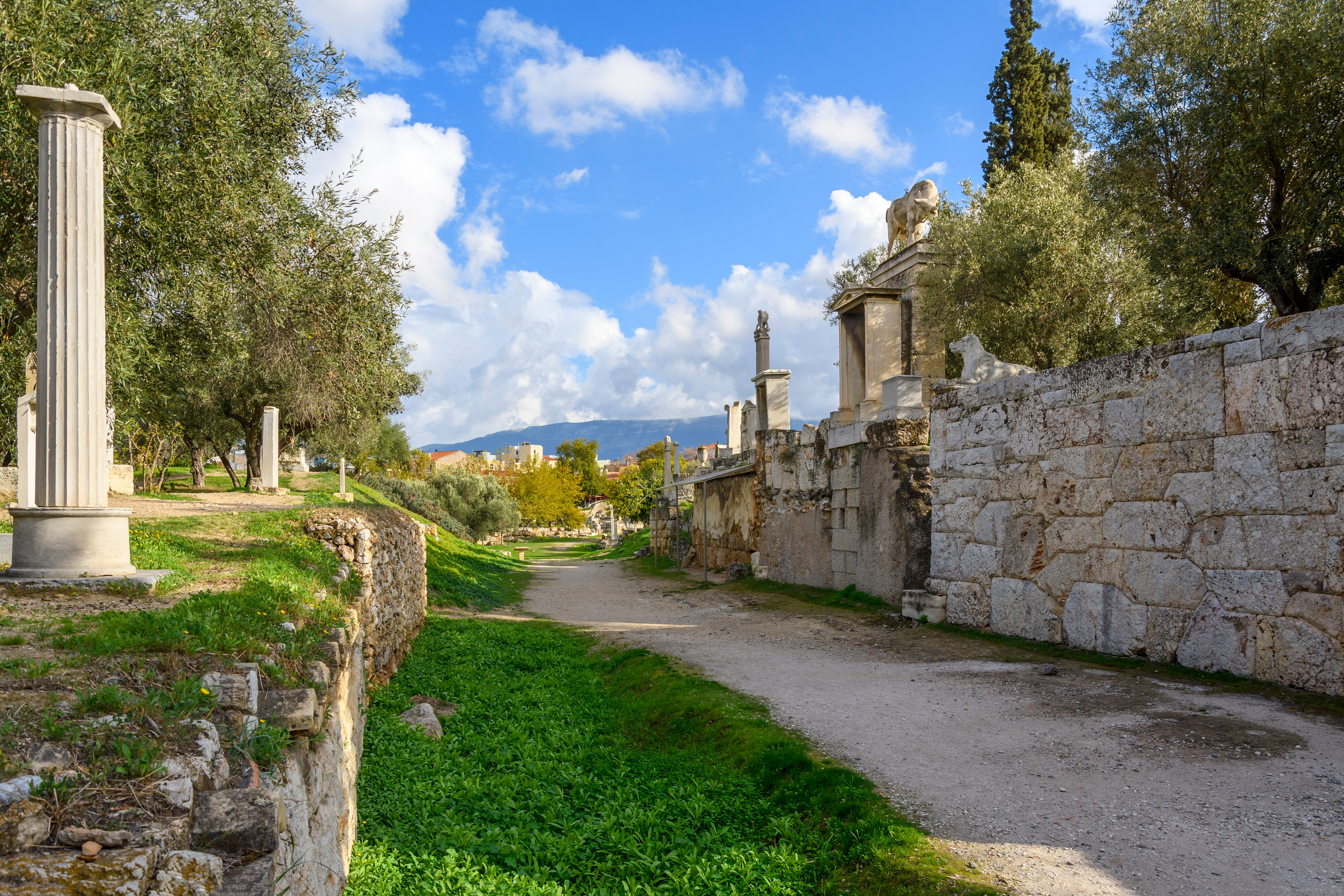
 Anyone leaving ancient Athens on the road toward Eleusis would first pass through the Kerameikos, the cemetery district outside the city walls. From there began the Sacred Way, the route leading to what many historians consider the most important religious pilgrimage of the ancient Greek world.
For centuries, every autumn, thousands followed the same westward path. When the earliest initiates walked toward Eleusis, Athens was still a city of archaic Greece. When the last groups crossed the Sacred Way nearly a millennium later, the Roman Empire had already adopted Christianity.
In the centuries between, Athens experienced its golden age. Socrates wandered the Agora, Plato founded the Academy, and Aristotle taught his students. The Parthenon rose above the city. Alexander the Great pushed the Greek world deep into Asia, and Rome evolved from a regional Italian power into a Mediterranean empire.
Yet through all historical upheavals, one tradition remained unchanged. Every year, the Sacred Way became a gathering point for people from across the Greek—and later Roman—world. It was not reserved for one city or one class.
Men and women, citizens and slaves, farmers, soldiers, poets, merchants, and even emperors who spoke Greek could be initiated—provided they had not committed murder without purification. What united them was a shared belief: that in Eleusis lay knowledge worth seeking.
Nearly sixteen centuries after the Mysteries ended, a Greek research team revisited one of the most controversial questions ever posed about the ritual: could the kykeon, the ceremonial drink of the Mysteries, have produced psychoactive lysergamide compounds?
“For us, the question was not whether the ancient Greeks took LSD,” says Professor of Pharmacognosy Prokopis Magiatis of the National and Kapodistrian University of Athens. “The question was whether the theory that kykeon could produce psychoactive effects had a real chemical basis.”
Meanwhile, interest in the study is no longer limited to academia. Beyond universities and research institutes, the story has begun attracting attention from creators in other fields as well.
The Road to the Telesterion
The procession began in Athens and followed the Sacred Way for roughly 20 kilometers. The initiates carried sacred objects, chanted hymns, and accompanied the xoanon (cult image) of Iacchus, a divine figure associated with the Mysteries.
At the bridge over the Cephissus River, the solemnity briefly broke. There, participants engaged in the famous gephyrismoi—mocking jokes and crude banter that were an integral part of the celebration.
When the initiates reached Eleusis, the most important moment still lay ahead. The initiation did not begin immediately. Days of preparation, purification rites, sacrifices, and ceremonies dedicated to Demeter and Kore (Persephone) had to be completed first.
Only then came the kykeon—a seemingly simple drink made of water, barley, and pennyroyal, a wild mint. The Homeric Hymn to Demeter links it to the moment the goddess broke her fast after the abduction of Persephone.
The initiates were then led into the Telesterion, a vast building designed to hold thousands at once. Inside were tiered seats, and at its center stood the Anaktoron, a small enclosed chamber where sacred objects were kept.
Today we know the initiates saw, heard, and experienced something. The ancient sources refer to “things done,” “things shown,” and “things spoken.” Something was revealed to them, something was said.
Exactly what happened remains one of the greatest mysteries of antiquity—perhaps the greatest. Punishment for revealing the rites was severe, and despite hundreds of thousands of initiations over centuries, no complete description has survived.
Yet those who emerged from the Telesterion appeared profoundly transformed.
Testimonies of the Initiated
Among those initiated were some of the most prominent figures of the ancient world: politicians, poets, philosophers, and emperors.
Isocrates, one of classical Athens’ greatest orators, wrote that Demeter gave humanity two great gifts: grain and the Mysteries, which offered the initiated “sweeter hopes” for life after death.
Pindar, the greatest lyric poet of ancient Greece, described as blessed anyone who had seen the sacred rites before descending to Hades, because only they truly understood “the end of life and the divine beginning given by the gods.”
Centuries later, Cicero, the great Roman orator and statesman, called the Eleusinian Mysteries the greatest gift Athens ever offered humanity. He believed they taught people not only how to live better, but how to face death with greater hope.
Plutarch, the Greek historian and philosopher of the Roman era, compared initiation to a journey through darkness, fear, and uncertainty that suddenly gives way to light—a place of purity and calm.
None of these accounts reveal what actually occurred inside the Telesterion. Yet all converge on one point: initiates believed they had gained a fundamental insight into human existence.
What that insight was, we do not know—and perhaps never will.
The End of a Tradition
As Christianity spread through the Greco-Roman world, Eleusis remained one of the empire’s most important religious centers. For a long time, the two worlds coexisted.
Even as early Christian communities emerged across the Mediterranean, processions still traveled the Sacred Way, and the Telesterion continued to fill with initiates.
Among Christianity’s strongest critics of the Mysteries was Clement of Alexandria, a major 2nd-century theologian, who sought to strip the rites of their authority and present them as human inventions.
Paradoxically, it is through such critics that we know fragments of the ritual today—including one crucial phrase: “I fasted; I drank the kykeon.” Sixteen centuries later, that seemingly simple line would spark a scientific investigation.
A Theory Is Born
One of the scholars drawn to the deeper meaning of the Mysteries was Károly Kerényi, a Hungarian philologist and mythologist. The more he studied the sources, the more he was struck by their intensity.
How could a ritual leave such a powerful imprint across such different people? Why the recurring references to transformation, light, and release from the fear of death? Was something missing from the puzzle?
His thinking led him to an unexpected collaborator: Albert Hofmann, the Swiss chemist who discovered LSD in 1938.
Hofmann, along with classicist Carl Ruck and ethnomycologist Gordon Wasson, published The Road to Eleusis in 1978. Their theory began with a simple observation: ancient texts describe initiates drinking kykeon—a mixture of barley, water, and pennyroyal.
But barley has a natural enemy: ergot (Claviceps purpurea), a fungus that infects grain.
When ergot grows on barley, it produces dark, elongated structures known as sclerotia. These contain compounds chemically related to those from which LSD was later derived.
Could the Mysteries have involved entheogenic substances that altered consciousness?
It was a compelling idea—but with a major flaw: ergot is not only psychoactive, but also toxic.
For decades, the theory stalled on this problem. Then chemist Peter Webster proposed a possibility: if ergot were treated with lye, an alkaline solution made from wood ash known in antiquity, its chemistry might change.
Intriguing—but never experimentally tested.
In the Laboratory
Nearly half a century later, the question unexpectedly resurfaced in a laboratory at the University of Athens.
Researchers Evangelos Dadiotis and Romanos Antonopoulos, working in pharmacognosy and as members of the Hellenic Center for Entheogenic Research study natural psychoactive compounds from plants and fungi.
While reviewing the literature on the Mysteries, they encountered an unresolved question that they could not ignore.
“We were struck that the theory had been discussed for decades without experimental testing,” says Dadiotis.
They focused on Webster’s hypothesis: could ergot’s chemistry change when exposed to lye?
Working in the Laboratory of Pharmacognosy and Natural Products Chemistry under Professor Prokopis Magiatis, they began months of experiments.
They prepared lye, used ergot sclerotia, and systematically varied conditions—temperature, boiling time, concentrations, and alkalinity. Each change was followed by chemical analysis.
“At first we saw nothing unusual,” recalls Antonopoulos. “We kept testing different conditions and returning to the data.”
Weeks turned into months. Most approaches led nowhere.
Then a pattern began to emerge.
“Suddenly, one range of conditions worked,” Antonopoulos explains. “We saw that the chemical transformations described in the theory could indeed occur.”
From Ergot to Ergine
The analysis showed that treating ergot with lye could produce ergine (LSA) and isoergine—lysergamide compounds in the same broader chemical family as LSD.
At the same time, toxic alkaloids in ergot were significantly reduced.
Importantly, the researchers stress this does not mean LSD was created or consumed, as often misrepresented online. Rather, it demonstrates that the process could yield psychoactive compounds while reducing toxicity.
“This is exactly what we set out to test,” says Magiatis. “Whether the proposed chemical pathway was feasible.”
The findings provide the first experimental indication that the theory has a viable chemical foundation. But the gap between a modern laboratory and ancient Eleusis remains vast.
A mechanism is possible—but its historical use remains unproven.
Evidence from Spain
Is there any archaeological evidence that such substances were ever used ritually?
The most intriguing clue does not come from Greece, but from the Iberian Peninsula.
At ancient Emporion, a Greek colony on the coast of modern Catalonia, archaeologists discovered pottery associated with Eleusinian ritual practices containing traces consistent with ergot structures and alkaloids.
The finding suggests that substances derived from ergot were known and possibly used in ritual contexts within the ancient Greek world.
For Magiatis and his team, this supports the idea that ergot-derived compounds were not unknown in antiquity.
“The next step is to gather more archaeological and chemical evidence,” he says. “Only then can such a hypothesis be confirmed or rejected.”
For decades, Hofmann’s theory was considered intriguing but untestable. Now, a framework exists for further scientific investigation.
The Impact of the Discovery
For Antonopoulos, the biggest surprise was not the result itself, but its reception.
The study, published in Scientific Reports, was widely covered by major science media outlets and quickly spread across social networks.
The attention, the researchers say, reflects something larger than the kykeon hypothesis itself: Eleusis still holds more secrets than it reveals.
In moving the discussion from speculation to experimentation, the study may have opened a new chapter.
And perhaps it brings us closer than ever to retracing the steps of those who once left Kerameikos, walked the Sacred Way, and arrived in Eleusis in search of a knowledge that has never been fully explained.