 Μake us preferred on Google
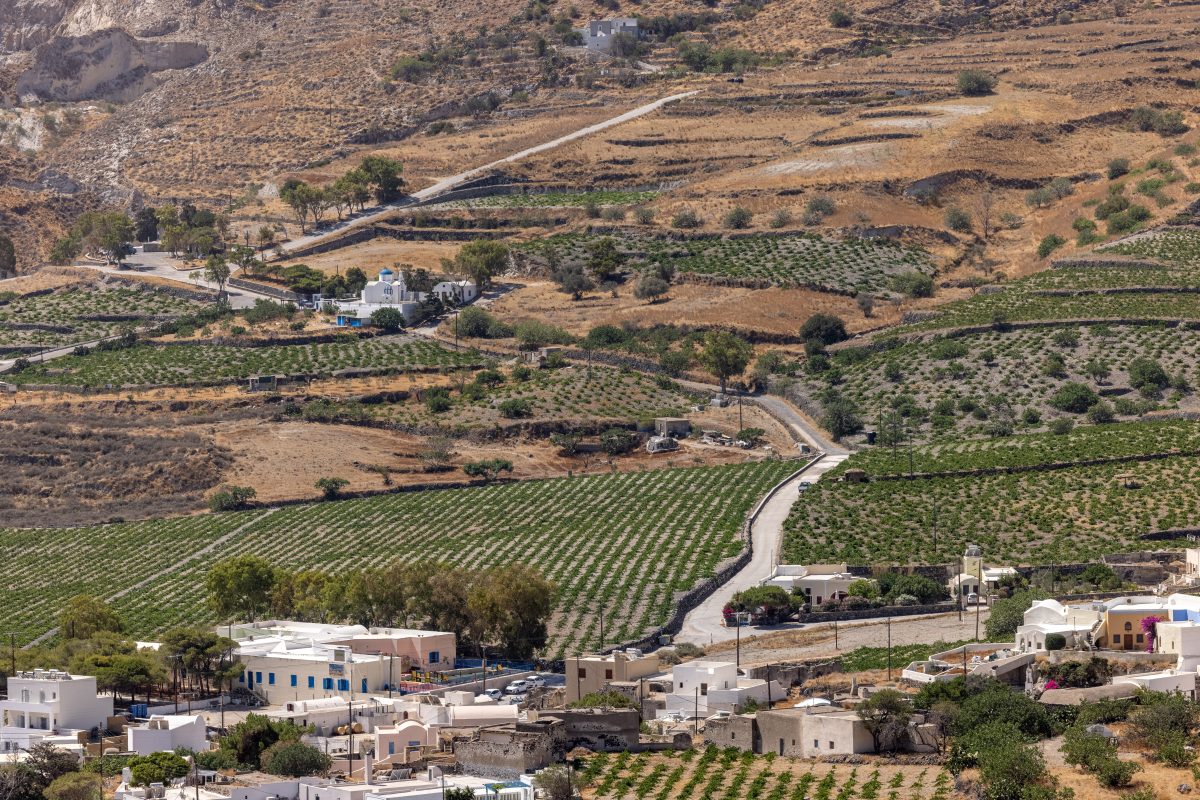
 Santorini’s vineyards are facing one of their toughest challenges in years, with this year’s grape harvest expected to fall to exceptionally low levels. Despite the production crisis, however, the Greek island continues to produce high-quality wines, while demand remains strong, particularly in international markets.
The harvest began with the collection of Mavrotragano grapes and is expected to enter its main phase after the Aug. 15 holiday, when producers will begin harvesting the remaining varieties, primarily Assyrtiko.
Production drops from 2,500 to 400 tons
The scale of the problem is illustrated by the sharp decline in production over the past six years.
Stelios Boutaris, president of the Greek Wine Federation, told OT that production reached approximately 2,500 tons in 2020. This year, estimates put the harvest at just 400 to 450 tons at best.
NEWSLETTER TABLE TALK
Never miss a story.
Subscribe now.
The most important news & topics every week in your inbox.
The difficulties are not limited to the challenging weather conditions this year. The abandonment of vineyards has become one of the main factors threatening the future of Santorini’s wine production.
“People have abandoned their vineyards,” Boutaris told OT, explaining that even the island’s traditional vineyards are facing major difficulties in regeneration.
One traditional method, known as “katavlades,” once allowed old vineyards to be renewed and new plants to be developed from existing vines. According to Boutaris, the practice is no longer being used to the same extent.
Quality remains Santorini’s strength
While production volumes are collapsing, the quality of Santorini wines remains at a very high level.
Boutaris said density and minerality are among the key characteristics that distinguish the island’s wines. The harvest also began somewhat earlier this year in an effort to preserve the wines’ natural acidity.
“Fortunately, Santorini’s wines have maintained a very high level,” Boutaris said.
Demand rises as supplies disappear
Santorini wines have generated significant demand in foreign markets in recent years. Producers and wineries, however, are increasingly unable to meet orders because there simply are not enough grapes and wine available.
Businesses are already effectively “out of stock,” Boutaris said, with insufficient wine to supply the market.
The shortage has also been reflected in prices. According to the president of the Greek Wine Federation, prices have increased by nearly 100% over the past five years.
Despite the steep increase, the higher prices have not led to a corresponding decline in demand, underscoring the continuing strength of the market for Santorini wines.