

 Μake us preferred on Google
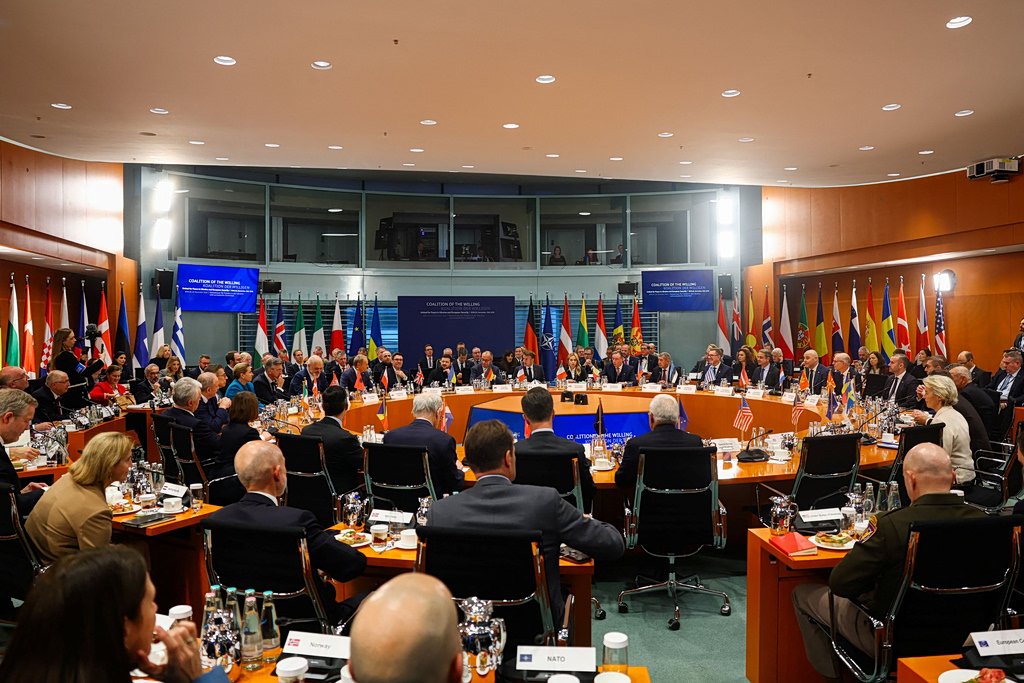
The 72nd annual session of the NATO Parliamentary Assembly continued in Berlin on Monday, overshadowed by Russia’s latest violation of Polish airspace. Speakers included NATO Secretary-General Mark Rutte, German Foreign Minister Johann Wadephul and Ukrainian President Volodymyr Zelenskyy, who joined by video link.
At the same time, representatives of NATO’s 32 member states met in Brussels to discuss the incident.

NATO Secretary General Mark Rutte speaks during the 72nd Annual Session of the NATO Parliamentary Assembly in Berlin, Germany, November 23, 2026. REUTERS/Liesa Johannssen
Missiles In Polish Airspace
According to the Polish government, three Russian missiles entered Polish airspace on Friday and crashed in the southeast of the country. They came down during one of Russia’s largest aerial attacks on Ukraine. After examining debris, Polish prosecutors said all three were Russian Kh-101 cruise missiles. They are believed to have been made in the last quarter of this year at an arms factory in Dubna, about 140 km (87 miles) north of Moscow.
Polish Prime Minister Donald Tusk called the incident an “intentional provocation.” It also coincided with European military drills in Poland, adding to concerns about Moscow’s intentions.
This is not the first such incident this year. In late July, a Russian Kh-101 cruise missile entered Poland’s airspace during a massive overnight Russian attack on Ukraine before crashing in the country’s east. At the time, Tusk said there was no indication that the missile intentionally targeted Poland.
Poland’s Foreign Ministry said on Monday it plans to summon the Russian ambassador, but only after the security services and the military complete their investigations. On Saturday, Foreign Minister Radoslaw Sikorski said Warsaw would convey its “strongest displeasure” to Moscow.
Rutte: “A Dangerous Incident”
Addressing the assembly, Rutte said Poland and its allies were still working to establish whether the missiles crossed into Polish territory on purpose.
“It is clear that this is a dangerous incident,” he said. Whether it was intentional, he added, was for the authorities to determine, and he would comment only once Poland and NATO allies had assessed exactly what happened. “I will never speculate,” he said.
Rutte was later due to be received by German Chancellor Friedrich Merz at the Chancellery.
Wadephul: “We Will Defend Every Centimeter”
Wadephul stressed NATO’s determination to defend itself. “We will defend every centimeter of NATO territory,” he said.
Addressing Russian President Vladimir Putin directly, he added: “Don’t be deceived: we may be a defensive alliance, but we are prepared to defend our countries and our alliance.”
Wadephul said he was in close contact with Sikorski and assured Warsaw of Germany’s full solidarity.
Violations Across The Region
Russian drones and missiles have repeatedly entered Polish airspace during strikes on neighboring Ukraine over the past four years. Violations have also been reported in other NATO and EU countries, including Romania, Lithuania, Latvia and Estonia.
On Saturday, Finland reported a suspected airspace violation by a manned Russian military helicopter near the southeastern town of Loviisa. Moldova, which is not in the EU or NATO, also reported violations, most recently this weekend.
Reports Of A Russian Nuclear Weapon In Space
Meanwhile, German media reported on Monday that Western military intelligence services believe Russia plans to station a nuclear weapon in space by the end of this year.
According to public broadcasters NDR and WDR and the Süddeutsche Zeitung, intelligence chiefs believe Moscow intends to launch a satellite armed with a nuclear warhead into orbit. The intelligence was reportedly shared among NATO members recently, and German Defense Minister Boris Pistorius was briefed by Bundeswehr experts.
A Bundeswehr spokesman reportedly declined to comment on the reports. He acknowledged only that Russia has such capabilities and warned that a nuclear explosion in space would devastate global satellite communications. “It would effectively mean: back to the Stone Age,” he said.
Germany’s Defense Ministry said it continuously monitors developments in space, while the Russian embassy in Berlin said it had no information about such plans.
The US Defense Intelligence Agency warned in October that Russia was developing a satellite capable of carrying a nuclear weapon. According to the new report, a satellite codenamed “Sputnik-S” is believed to have been stored near Moscow for several years.
Western concern has centered on a Russian satellite launched in February 2022, the same month Russia began its full-scale invasion of Ukraine. The US government believes that, in the foreseeable future, Moscow could arm one or more satellites with a nuclear warhead. However, according to the current consensus, Cosmos 2553 is not an active, “live” anti-satellite weapon. Russian officials have claimed that Cosmos 2553 is “intended for scientific research,” which US officials say is unlikely. The Kremlin has earlier denied any intention to put nuclear weapons in space.
Analysts warn of the stakes. Should the Kremlin acquire this capability, it could destroy key parts of the civilian satellite infrastructure by detonating a single nuclear weapon in low Earth orbit, according to the German Institute for International and Security Affairs (SWP).
A nuclear launch into orbit would breach the 1967 Outer Space Treaty, which bans placing weapons of mass destruction in Earth orbit. Russia backed a continuation of the treaty at the UN General Assembly in December 2024.
Space is nonetheless becoming increasingly militarized. In September 2025, the United States acknowledged that it had placed offensive non-nuclear weapons in orbit.