 Μake us preferred on Google
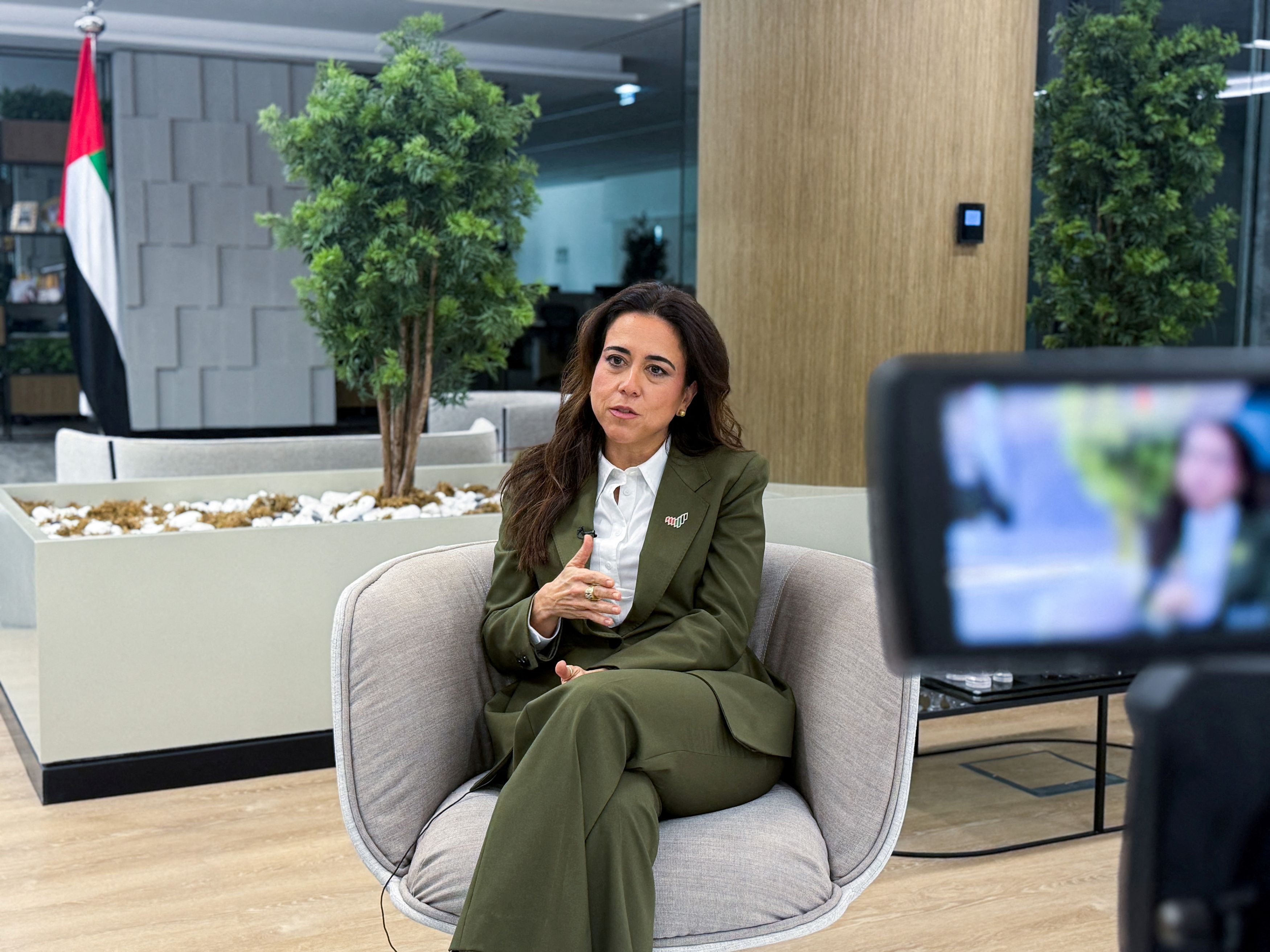
Lana Nusseibeh, a veteran Emirati diplomat who helped secure humanitarian aid deliveries to Gaza during her time as the UAE’s ambassador to the United Nations, has joined the race to replace António Guterres as UN secretary-general as a late entrant. If selected, she would be the first woman to lead the organization since its founding in 1945, as well as the first Emirati and Gulf Arab in the role. She would also be only the second Arab to hold the post, after Egypt’s Boutros Boutros-Ghali, who served from 1992 to 1996.
The UAE formally nominated Nusseibeh on October 21, when President Sheikh Mohamed bin Zayed Al Nahyan sent a letter to the presidents of the UN General Assembly and Security Council, according to the state-run Emirates News Agency. In announcing the nomination, the UAE president pointed to her extensive UN experience, her judgment in dealing with international challenges and her record of constructive work. Teneo, a New York public relations firm working for the UAE Foreign Ministry, also confirmed the candidacy.
Guterres’ second and final term ends on December 31, and his successor is expected to take office on January 1, 2027. Under the UN Charter, the General Assembly appoints the secretary-general based on a recommendation from the Security Council. A candidate needs at least nine votes on the 15-member council and no veto from any of the five permanent members. It is still unclear whether the council will settle on a candidate before Guterres leaves office.
UK Reportedly Leaning Toward Nusseibeh
Britain, one of the council’s five permanent members, is leaning toward supporting Nusseibeh, according to several sources close to the British government, though no final decision has been made. A Foreign Office spokesperson said the UK’s focus is on finding the most qualified candidate based on merit and that it would not comment publicly on individual candidates.
Backing Nusseibeh could be seen as a way for Prime Minister Andy Burnham to ease tensions with Abu Dhabi following a dispute over Manchester City, the football club owned by Emirati Vice President Sheikh Mansour bin Zayed Al Nahyan. Last month, the club was found to have broken 114 Premier League financial rules by concealing more than £830 million ($1.1 billion) in illicit funding, a finding it denies, and Emirati officials have reportedly threatened to pull investments from Britain in response (Middle East Eye). Multiple sources said supporting her could earn the UK some goodwill with the UAE at a difficult moment in relations.
The UAE’s close ties with the United States, another permanent member, also work in her favor, but she will still need to win over Britain, China, France and Russia.
Family Roots and Education
Nusseibeh was born in Abu Dhabi in 1978. Her father, Zaki Nusseibeh, moved there after the 1967 Arab-Israeli war made it hard for him to go back to Jerusalem, where he was born. He went on to become a well-known Emirati cultural figure who worked closely with the UAE’s founding father, Sheikh Zayed bin Sultan Al Nahyan. Her grandfather, Anwar Nusseibeh, was a prominent Palestinian politician who held ministerial positions in the Jordanian government when Jordan controlled the West Bank and East Jerusalem, and later served as Jordan’s ambassador to Britain. Her uncle is Sari Nusseibeh, a respected Palestinian intellectual and author.
She studied history at the University of Cambridge, earning a bachelor’s degree and an MA, and later received a master’s degree with distinction in Israeli and Jewish Diaspora Studies from SOAS, University of London, in 2003. Colin Shindler, an emeritus professor of Israeli studies at SOAS who taught her, wrote in a 2020 Jewish Chronicle column that she had produced sharp essays on Zionism and Israeli history and had played a key role in the Abraham Accords normalization deal.
A Long Diplomatic Career
Early in her career, Nusseibeh worked as a consultant for UNESCO in Paris and as an analyst at the Gulf Research Center. In 2009, she founded the Policy Planning Department at the UAE Foreign Ministry and became its first director, and she later served as the country’s co-special envoy to Afghanistan and Pakistan and as Deputy Sherpa at the 2011 G20 Summit.
In September 2013, she became the first woman to serve as the UAE’s permanent representative to the UN in New York, a post she held until April 2024. During that time, she served as vice president of the General Assembly and president of the executive board of UN Women in 2017, and she co-chaired talks on Security Council reform. While the UAE held a seat on the Security Council in 2022 and 2023, she led the country’s delegation and twice served as council president.
One of her most notable achievements was helping to advance Security Council Resolution 2720, adopted in December 2023 to ease the delivery of humanitarian aid into Gaza. On the council, she argued for Palestinian civilians’ need for aid as Israel restricted food and other essentials from entering the territory. In September 2025, as Israel considered annexing parts of the occupied West Bank, she said the UAE had always viewed the Abraham Accords as a means of supporting Palestinians and called on the Israeli government to halt its plans. She was appointed UAE minister of state that same month.
Her Pitch for the UN
Nusseibeh’s campaign, titled “A United Nations for the Next Eighty Years,” centers on conflict prevention, humanitarian action, institutional reform and stronger international cooperation (Vogue Arabia). Her priorities include stepping up mediation, securing local ceasefires and humanitarian access, and reforming the UN to cut duplication and improve accountability.
In launching her campaign, she said she was running because the moment calls for more urgent action, including acting earlier and bringing people together to produce concrete results. In her vision statement, she argued that countries still need to work together but have lost faith that cooperation pays off, and that restoring that trust through quicker and more realistic results is the UN’s job. She also noted that the secretary-general has neither an army nor a vote, but said the post carries a different kind of power rooted in independence and trust, and described herself as a stubbornly optimistic and relentless diplomat. Citing Article 100 of the UN Charter, which requires the secretary-general to act solely in the UN’s interests, she said she had taken immediate leave from her ministerial post and pledged “no exemptions for friends and no grudges against critics”. In an interview with Reuters, she said the world needs a secretary-general who can turn the UN into a body that solves crises rather than simply observing them.
Endorsements
Nusseibeh, who is known for her advocacy of the Palestinian cause and the two-state solution, has been endorsed by the state of Palestine. Her father’s Palestinian roots could also make her an appealing choice in some circles.
Kazakhstan’s Foreign Ministry voiced support for her nomination, saying a wider field of candidates offered a chance to continue constructive dialogue and reach a decision acceptable to all sides. The ministry noted that consensus in the Security Council has been difficult to achieve and reiterated its call for a transparent, inclusive and merit-based selection process.
Brett McGurk, a former top national security adviser in the Biden administration, credited Nusseibeh with making the UAE the world’s largest provider of humanitarian aid to Gaza, according to UN figures, and called her an inspired choice for the job. Nickolay Mladenov, the Bulgarian diplomat who leads Donald Trump’s Gaza Board of Peace, praised her for quietly building bridges between parties while on the Security Council.
A Crowded and Deadlocked Race
Nusseibeh has defended her late entry by pointing to the near-deadlock on the Security Council, where no candidate has secured the support of all five permanent members after six rounds of informal voting, the most recent on October 16 . That straw poll was the first to use color-coded ballots showing whether permanent members encouraged or discouraged each candidate. Costa Rica’s Rebeca Grynspan came out on top with nine votes in favor and five objections. Grynspan, Guyana’s Carolyn Rodrigues-Birkett and Argentina’s Rafael Grossi, the top three, each received two “discourage” votes from permanent members, which some experts say means they need more negotiation rather than that their bids are over.
Rodrigues-Birkett, in second place, has had to reassure the council, mainly the United States, that her government’s view that Israel has breached international law in Gaza would not shape her decisions as secretary-general. The other contenders are veteran Ugandan diplomat Olara Otunnu, former Ecuadorian Foreign Minister and ex-General Assembly President María Fernanda Espinosa, and Ecuadorian politician Ivonne A-Baki. Two earlier candidates have withdrawn: former Chilean President Michelle Bachelet, who left in late September after U.S. criticism of her women’s rights advocacy, and Senegal’s Macky Sall.
Nusseibeh’s entry adds another woman to the field in a race that a General Assembly resolution had hoped would produce the UN’s first female leader after 81 years. However, the contest was also widely seen as the informal turn of Latin America and the Caribbean to hold the post, and her candidacy, along with Otunnu’s, complicates that. The Community of Latin American and Caribbean States (CELAC) has written to the Security Council objecting to her entry, arguing it came just as support was forming around a candidate from their region. Panama’s deputy UN ambassador, Ricardo Moscoso, has said any new candidate must go through the same color-coded voting and public scrutiny as the others.
A straw poll planned for October 23 was pushed back, possibly to next week, to give the UAE time to file the nomination, and General Assembly President Khalilur Rahman has pledged that any new candidate will be introduced to the full UN membership.
Criticism Over Sudan, Israel and Human Rights
Nusseibeh is facing a strong backlash from human rights activists over the UAE’s domestic record and its alleged backing of the Rapid Support Forces (RSF) in Sudan, a group that two consecutive U.S. administrations have accused of genocide. UN investigators say the RSF’s mass killings bear the hallmarks of genocide, and several authoritative reports by UN experts and rights groups have concluded that the group committed genocide and other international crimes against non-Arab communities in Darfur. Her candidacy has also drawn criticism over the UAE’s close relationship with Israel. Human Rights Watch’s 2026 report on the UAE describes severe limits on freedom of expression, association and assembly in the country.
The RSF has been blamed for thousands of deaths, including during its capture of El Fasher in October last year. On Monday, the UK sanctioned 15 senior commanders from both the RSF and the Sudanese Armed Forces over suspected atrocities, including sexual violence linked to the conflict. British Foreign Secretary Ed Miliband said UK-funded investigations showed rape and starvation were still being used as weapons in Sudan and called for all outside support to the warring parties to stop.
As a senior UAE diplomat, Nusseibeh has repeatedly denied reports that her country supplied weapons to RSF leader Mohamed Hamdan “Hemedti” Dagalo in violation of a UN arms embargo. A UN panel of experts report from January 2024 found credible allegations from sources in Chad and Darfur that arms were being smuggled to the RSF from the UAE. In May 2025, Amnesty International reported that Chinese-made guided bombs and howitzers used by the RSF had been re-exported by the UAE in breach of the Darfur arms embargo. The International Court of Justice threw out Sudan’s case against the UAE for lack of jurisdiction, without ruling on the allegations themselves.
Nathaniel Raymond, executive director of the Humanitarian Research Lab at the Yale School of Public Health, warned that her appointment could be a “catastrophe” for UN work in Sudan, Yemen and the wider Middle East and North Africa, arguing she would face a conflict of interest between the UN and a government accused of enabling the El Fasher massacre. Kenneth Roth, former executive director of Human Rights Watch, has also been among her harshest critics, targeting her denials that the UAE gave any support to any faction in Sudan. The UAE rejects the accusations, denies arming either side and says it supports the creation of a civilian-led government in Sudan.