 Μake us preferred on Google
 President Trump is confronting a challenge with Iran’s nuclear program that is partly of his own making: a mountain of highly enriched uranium that Tehran has refused to hand over despite two months of war.
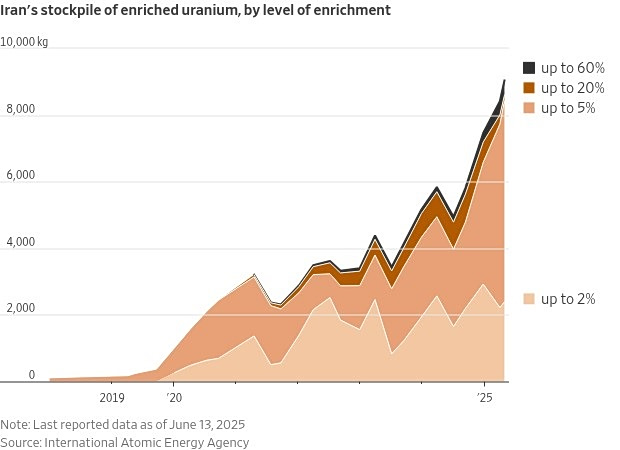
Iran accumulated fissile material after Trump pulled out of a nuclear deal in 2018. It then accelerated its program, producing the near-bomb-grade material, during the Biden and second Trump administrations, according to data from the United Nations’ atomic agency.
Now an important war aim for Trump is ensuring that Tehran doesn’t have the capability to develop a nuclear weapon, but Iran has refused to accept Washington’s terms. Neither the economic pressure campaign from Trump’s first term nor U.S.-Israeli military strikes that were carried out in June and then renewed in February have forced Iran to abandon its uranium stockpile or halt its nuclear efforts.
On Monday, Trump said he was holding off on further military action against Iran because there is “a very good chance” a deal can be reached in the stop-and-start diplomacy the White House has conducted since he returned to the White House. Few experts are so confident.
Seeking a stronger deal than the 2015 agreement, Trump has pushed for Iran to accept tough conditions since returning to office, including at times a permanent end to uranium enrichment and dismantlement of its key sites. His critics argue that the nuclear deal shows that only with concessions from both sides can he reach a deal with Tehran that will bring a durable end to the current standoff.
The failure to contain Iran’s nuclear work isn’t Trump’s alone. The Joint Comprehensive Plan of Action, as President Barack Obama’s 2015 deal was known, delayed but didn’t shut the door on Iran’s potential pathway to a bomb.
The Biden administration’s efforts to revive the 2015 accord and then negotiate a stronger follow-on accord were stymied. Iran rejected an agreement in 2022 that might have led to a peaceful resolution and lifted sanctions on Tehran. Meanwhile, Iran ramped up its nuclear program.
“The first mistake was Trump leaving the JCPOA right when it was working. And the second big mistake was Iran refusing the Biden administration offer to restore the JCPOA,” said Gary Samore , director of the Crown Center for Middle East Studies at Brandeis University and a weapons-of-mass-destruction expert on Obama’s National Security Council.
“In retrospect, Biden could also have a stronger effort earlier in his administration,” added Samore. “But in the end, both sides made mistakes.”
Iran’s leaders have long insisted that they weren’t working on nuclear weapons. Iran isn’t currently enriching uranium and would need to recover fissile material that is buried under tons of rubble if it wanted to sprint to a bomb.
But experts, including the U.N.’s atomic agency, have long assessed that Tehran was developing the technological option to develop a nuclear arsenal. With much of Iran’s pre-war leadership dead, Washington is grappling with the possibility that the country’s new leaders may be even less disposed to compromise.
Iran still has 10 tons of enriched material, including enough near-weapons-grade material to fuel almost 11 nuclear weapons. It has an unknown number of centrifuges, which are the machines for enriching uranium. Despite Israel’s killing of numerous Iranian nuclear scientists, Iran retains the know-how to start enriching again and probably, experts say, to undertake most key steps for building a nuclear weapon.
The U.S.’s biggest concern centers on Iran’s nearly 1,000 pounds of uranium that is enriched to 60% purity. But Iran also has about 440 pounds of 20% enriched uranium. Those materials could be enriched up to 90% weapons-grade material in weeks. Civilian nuclear programs generally rely on low enriched uranium. Iran was the only nonnuclear-weapons country to produce 60% enriched uranium before last June’s attacks.
As the Trump administration has struggled to deal a knockout blow in its military campaign against Iran, supporters and opponents of the 2015 agreement have traded barbs over who was to blame for allowing Iran to expand its program.
The 2015 deal, which took two years of negotiations, capped Iran’s stockpile of enriched uranium at about 660 pounds and the enrichment level at 3.67% for 15 years. Though the accord stipulated that Tehran would never be allowed to develop nuclear weapons, the constraints it established on the amount and enrichment level of Iran uranium lapsed by 2030, spurring concerns even among supporters of what Iran would do then.
The accord permitted Iran to conduct centrifuge research after 8½ years, a concession that meant that when the 15 years expired, Iran could be ready to mass-produce enriched uranium with more advanced machines. Tehran could then swiftly produce enough for a bomb.
Trump assailed the accord during his first presidential campaign, saying it failed to deal with Iran’s missile program or support for terrorism and didn’t eradicate Iran’s nuclear threat. When he exited from the accord in 2018, he switched to a so-called “maximum pressure” sanctions campaign to force Iran into a stricter deal. Iran’s economy was devastated, but it rejected talks with Trump.
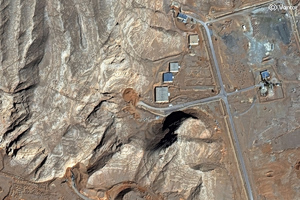
During the remainder of Trump’s term, Iran put in place key building blocks of an accelerated program, peeling back many of the accord’s restrictions or planning to quickly do so. It breached the 660-pound cap and enriched to 4.5% in July 2019. Later that year, Iran fed uranium into advanced centrifuges it was forbidden to use at its Natanz enrichment site and resumed enrichment at the deep underground Fordow facility that was supposed to be a research site.
Over the following months, Tehran expanded its Fordow enrichment and built an underground centrifuge-production facility. Iran’s president said the country was now producing more enriched uranium than before the 2015 accord. By the time Trump left office, Iran had enriched almost 3 metric tons of fissile material.
“Iran’s nuclear program would not have progressed as much as it did had Donald Trump not withdrawn” from the deal, said Richard Nephew , who helped negotiate the 2015 deal and the efforts to revive it under President Joe Biden . “Trump’s plan was basically to relitigate the terms of the nuclear deal.”
“If Iran refused,” Nephew added, “he had no plausible alternative to constrain the program.”
Other experts say that Trump’s decision merely hastened the day of reckoning given that most of the accord’s limits would eventually expire.
Biden acknowledged the limitations of the 2015 deal, vowed to take the U.S. back into the accord and follow up with a “longer and stronger” deal. But it never happened.
Since the 2015 deal was an executive agreement and not a Senate-ratified treaty, Biden couldn’t assure the Iranians that a future American president wouldn’t once again back out. That was a persistent Iranian demand.
Still, some critics say Biden could have applied more economic and perhaps even military pressure.
“Following the U.S. withdrawal in May 2018 and amid Trump’s maximum pressure campaign, Iran’s nuclear advances were initially gradual. They surged, however, around Biden’s election in November 2020 and his pledge to revive the agreement,” said Andrea Stricker , research fellow at the Foundation for Defense of Democracies, which campaigned against the 2015 deal.
Iran started accelerating its nuclear program during the transition between Trump and Biden. The Biden administration pressed ahead with talks to revive the agreement in April 2021. Days after the talks began, Tehran enriched to 60%. U.S. officials discussed whether to continue the talks. They decided to do so, hoping for a swift deal. That didn’t come. By September 2022, negotiations were dead .
In 2024, U.S. intelligence officials said for the first time in years that Iran was carrying out activities that would better enable it to produce a nuclear weapon should it decide to do so.
After Trump returned to the White House, his negotiator Steve Witkoff , a businessman with no previous experience dealing with Iran nuclear issues, fared no better. The Trump team demanded that Iran give up all uranium enrichment and rely entirely on the provision of nuclear fuel from abroad for its civilian program, a proposal that Iran had spurned in past years and which Trump began to relax only in recent weeks by saying that Iran should pause enrichment for 20 years.
By last June, when its enrichment sites were destroyed, Iran had 9.8 tons of enriched uranium. It was producing one ton of enriched uranium every quarter and more than 290 pounds of highly enriched uranium.
Write to Laurence Norman at laurence.norman@wsj.com and Michael R. Gordon at michael.gordon@wsj.com