
 Μake us preferred on Google
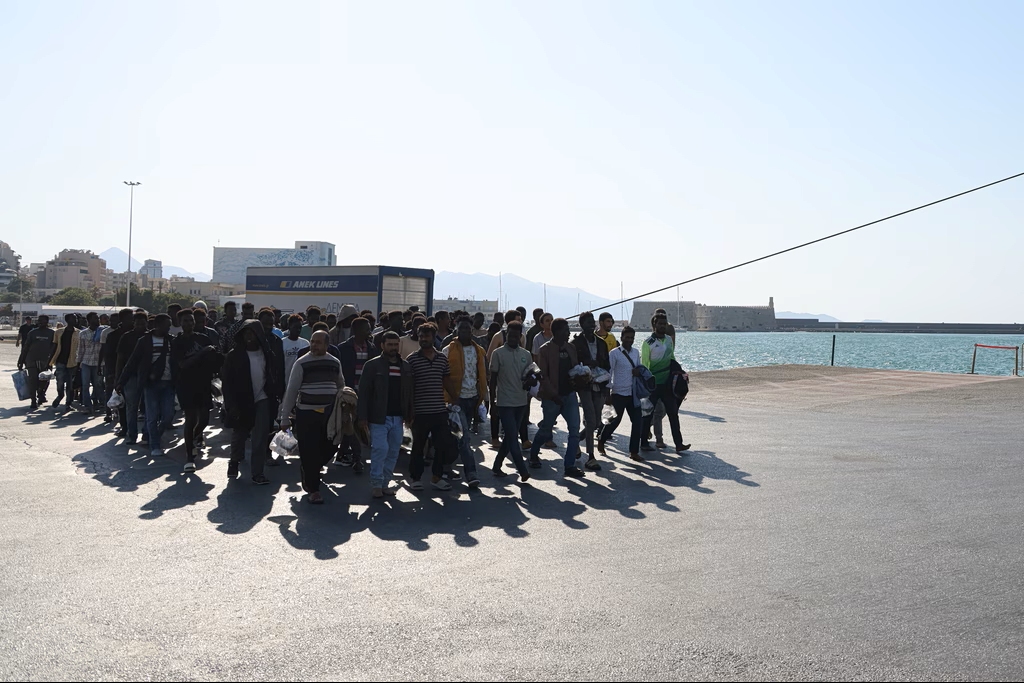
 Prime Minister Kyriakos Mitsotakis used a visit to Leros, an eastern Aegean island close to the Turkish coast and an entry points for migrants crossing from Turkey, to defend his government’s hardening position on immigration and hail it as a success. “Today, Greece is actively protecting its borders, flows have decreased significantly, and the migrants of 2019 have been replaced by visitors, with islanders feeling safe thanks to the strongest armed forces the country has ever had,” Mitsotakis said.
Addressing residents of the island, the Prime Minister underlined that security and stability are nonnegotiable conditions for prosperity. He then turned to the previous SYRIZA government led by Alexis Tsipras, and accused it of operating under the premise that “the sea has no borders” which turned the islands into lawless reception centers.
The remarks came two days after Mitsotakis met with Austrian Chancellor Christian Stocker in Salzburg, a meeting Greek media largely covered as centered on the energy crisis. What he said on migration that day carried substantial political weight of its own. The two leaders called on Brussels to accelerate deportations of migrants whose asylum applications had been rejected and to establish reception centers in third countries outside the European Union, casting the protection of Greece’s borders as, by extension, protection of the European Union’s external border.
New asylum law introduces criminal penalties
The harder line from Leros comes alongside legislation that hardens the same policies into law. The government recently passed new legislation through Parliament that compresses the entire asylum and return process, from application to deportation, into 12 weeks. The law also criminalizes staying in the country after a rejected asylum claim, with a minimum sentence of two years in prison and no possibility of suspension. Entry bans imposed on public order grounds now last up to 10 years, double the previous limit of five. Furthermore, nongovernmental organizations working in the migration space face a considerably stricter regulatory framework as well.
The legislation came after members of New Democracy’s own conservative base accused the government of being too lax on migration.
A strategy aimed at the right flank
The emphasis on security and deterrence reflects a clear political calculation. Part of New Democracy’s traditional voter base has been drifting toward harder line parties further to the right, and the government is trying to win those voters back by presenting migration as a matter of national security and law enforcement.
The approach links migration to a broader security narrative that also includes major defense procurement programs, initiatives the government has calculated will resonate with the conservative voters who make up the core of New Democracy’s support. Polling has reportedly shown Mitsotakis that this combination, migration and defense presented as a single package, resonates with a segment of the electorate. That is one reason he has kept both issues prominent in the news cycle as the country moves toward the next election.
At the same time, the government is positioning itself defensively on two fronts: against an opposition that has resisted its migration initiatives, and against the anticipated launch of a new party by former New Democracy PM Antonis Samaras, who has been sharply critical of the government’s foreign and domestic policy