
 Μake us preferred on Google
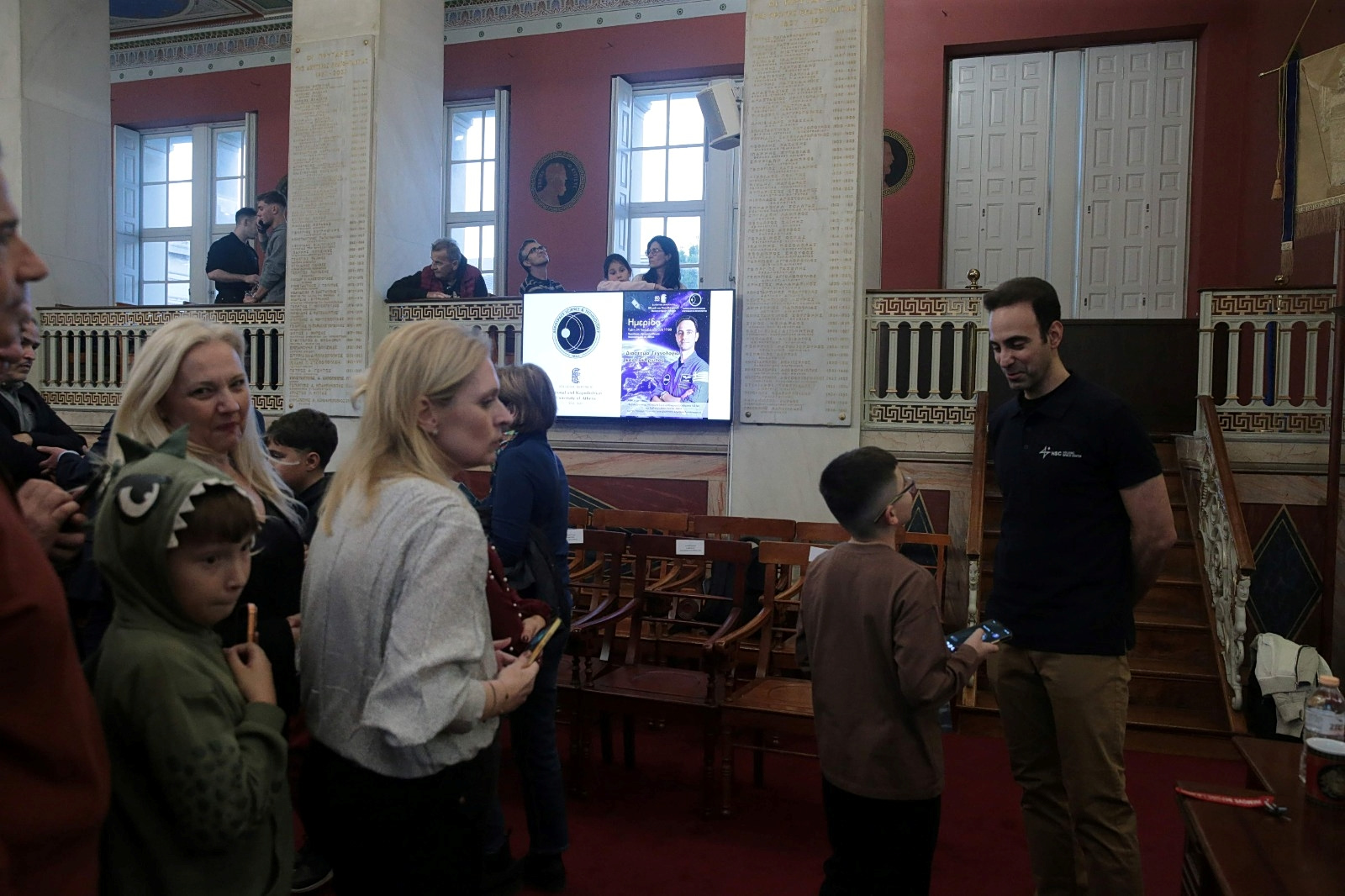
During the event, NKUA Rector Gerasimos Siasos announced that the university had been selected to design one of the 16 experiments scheduled to be conducted by Golemis aboard the ISS. The university will also contribute to the cost of developing the research equipment required for the experiment.
Golemis is expected to join three other astronauts for the VAST-PAM-1 mission in the summer of 2027. The crew is scheduled to spend 14 days aboard the orbiting laboratory, carrying out an intensive program of Greek and European scientific experiments.
He stressed that the mission was the result of the work of numerous scientists, engineers and institutions, singling out the contribution of the Hellenic Space Center to preparations.
“The two most important words are teamwork and effort,” he said, noting that the ISS offers research opportunities unavailable on Earth, with findings that can eventually be translated into applications affecting everyday life.
For the first time, he added, Greek universities and companies would have the opportunity to conduct research aboard what he described as humanity’s most impressive laboratory. Every step Greece takes towards the forefront of space research can bring corresponding scientific and technological benefits.
He also highlighted the educational dimension of the undertaking, saying he wanted the mission to have the greatest possible positive impact on the next generation. Asked what advice he would give young people aspiring to become astronauts, he urged them to persevere while recognizing that everyone follows a different path.
Asked what experiments he would most like to conduct aboard the ISS, Golemis said his medical background naturally drew him towards human physiology and the effects of microgravity on the human body. However, he stressed that astronauts must be prepared to carry out whichever experiments are assigned to them.
He also spoke about the challenges of astronaut training, presenting footage of several exercises, including parabolic flights that simulate weightlessness for approximately 30 seconds, training using the ARGOS system to practise movement in reduced-gravity conditions and helicopter underwater escape training (HUET), designed to prepare astronauts for emergencies during their return to land.
Acknowledging that unfamiliar experiences inevitably involve apprehension, he said preparation, knowledge and trust in instructors were essential to overcoming fear. “Astronauts are often portrayed as fearless people who are never afraid. Preparation and knowledge are the antidotes to the natural fear of the unknown,” he said.
Digital Governance and Artificial Intelligence Minister Dimitris Papastergiou described the mission as part of Greece’s broader effort to strengthen its position in the European space sector, alongside the National Microsatellite Program. Beyond its scientific objectives, he said, Golemis’ journey would send an important message to young people that ambitious goals could be achieved regardless of where they grew up.
NKUA’s Siasos said the university’s participation in one of the 16 experiments reflected its growing contribution to space science and technology. Aerospace Science and Technology Department Chairman Vaios Lappas, meanwhile, presented initial results from the operation of Greece’s ERMIS-1, ERMIS-2 and ERMIS-3 nanosatellites.
He said 47 Greek scientists had contributed to the construction of the country’s first nanosatellites, with all three launched within an 18-month period. Their capabilities are already supporting the development of a national satellite imagery database, with potential applications in precision agriculture, disaster monitoring, national security and urban planning.