
 Μake us preferred on Google
 From the ice of Antarctica to the depths of the Mediterranean, scientists are searching for astrophysical neutrinos, tiny particles that can carry information from some of the most violent events in the universe.
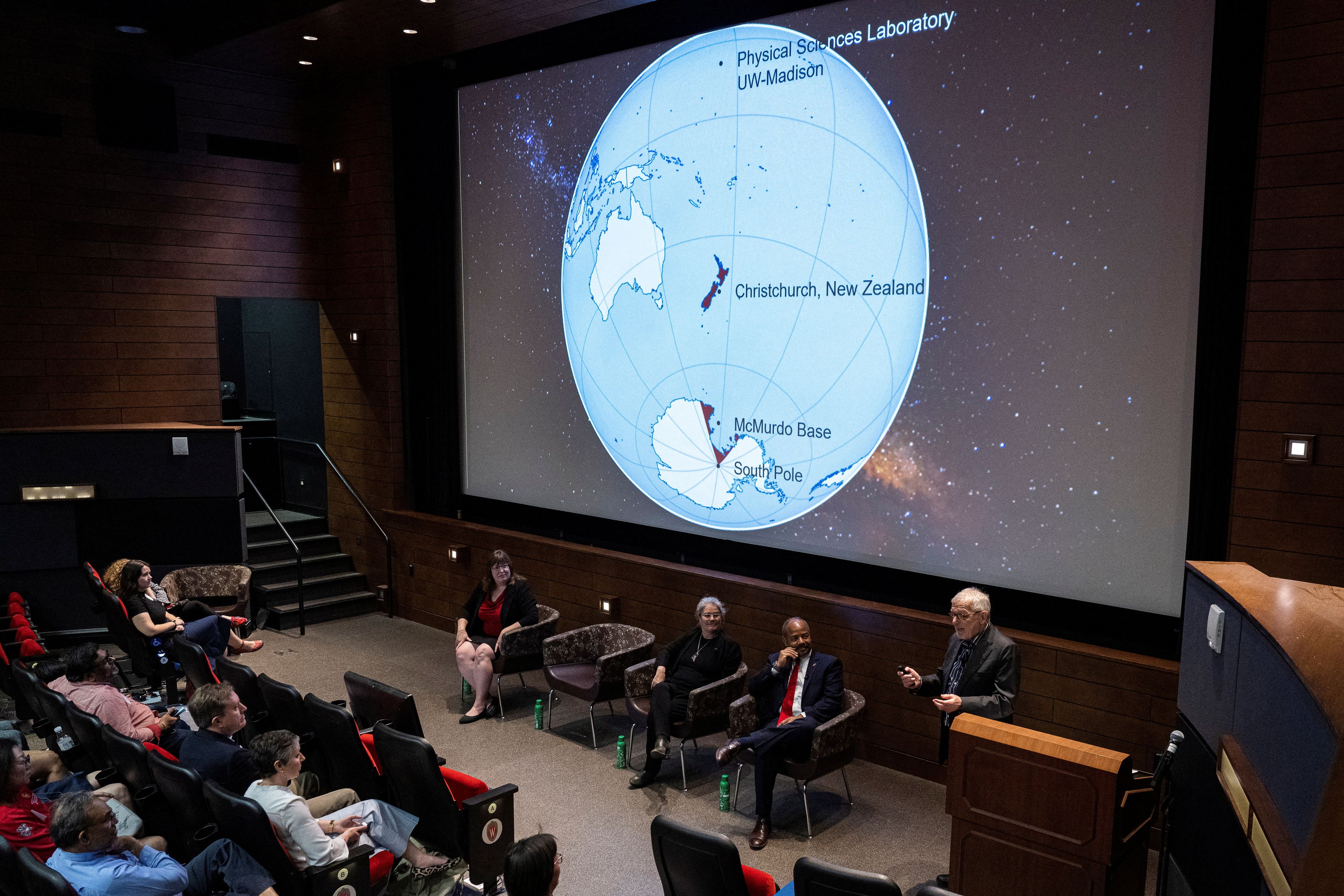
The field has gained fresh attention after the 2026 Nobel Prize in Physics was awarded to Francis Halzen, whose work was instrumental in the development of the IceCube neutrino telescope in Antarctica. But IceCube is not the only major observatory seeking to understand the universe through neutrinos.
A second major neutrino telescope is being built deep beneath the Mediterranean as part of the KM3NeT experiment, with researchers from Greece’s National Centre for Scientific Research “Demokritos” among its participants.
In February 2025, KM3NeT made international headlines when it detected KM3-230213A, the highest-energy cosmic neutrino ever observed at the time. Its energy was 30 times higher than that of any other neutrino previously detected, providing the first evidence that neutrinos at such extreme energies are produced in the universe and offering new information about violent events beyond the Milky Way.
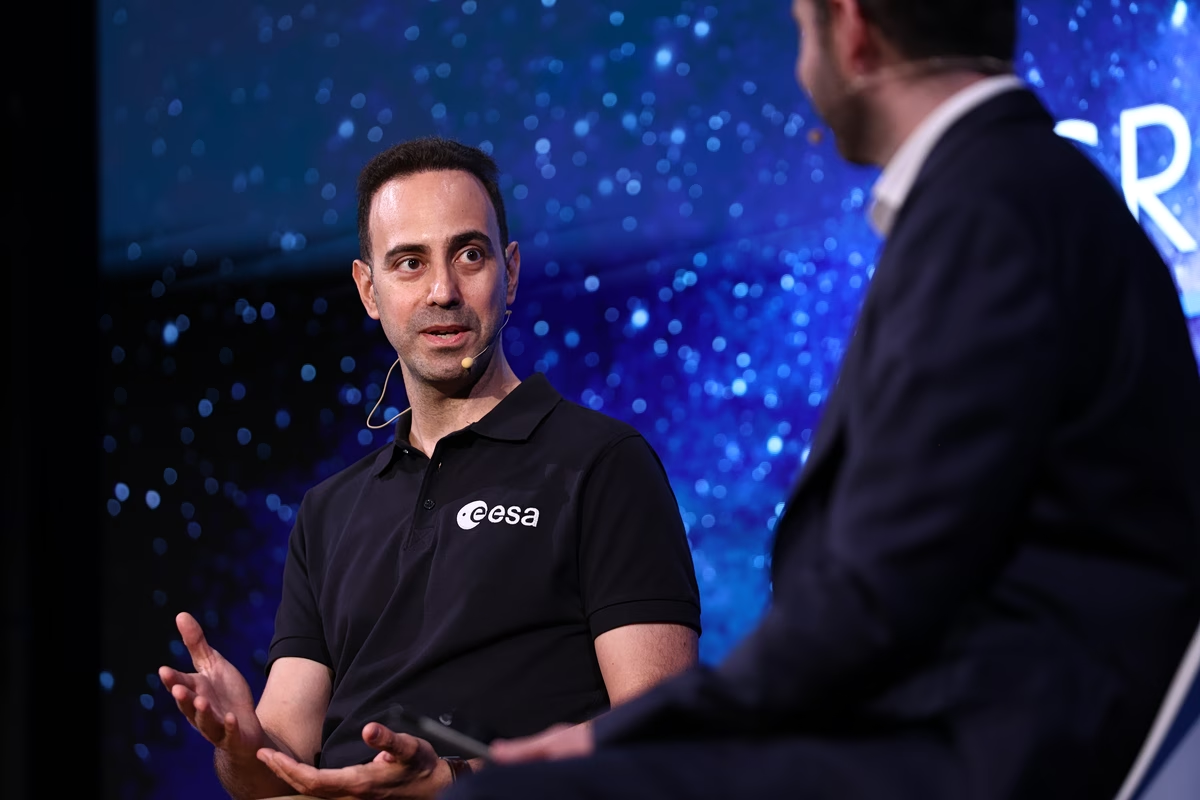
“Neutrino astronomy is only just beginning,” said Ekaterini Tzamariudaki, research director at Demokritos’ Institute of Nuclear and Particle Physics and a member of the KM3NeT collaboration, in an interview with the Athens-Macedonian News Agency.
Neutrinos as cosmic messengers
Until recently, much of what scientists knew about the universe came through two main types of messengers: photons and charged particles known as cosmic rays.
Neutrinos offer a different way of observing the cosmos. They are not deflected by interstellar magnetic fields and are not absorbed as they travel through matter, allowing them to carry information from their astrophysical sources directly to detectors on Earth.
Neutrinos are tiny subatomic particles with extremely small masses and no electric charge. They interact only very weakly with matter. Although they are the second-most abundant particles in the universe after photons, billions of neutrinos pass through the human body every second without leaving a detectable trace.
They are produced across a broad range of energies and through different processes. The Sun produces enormous numbers of low-energy neutrinos through nuclear fusion, while smaller numbers of extremely high-energy neutrinos can be produced in catastrophic cosmic events, including stellar explosions and activity around black holes.
The ability to combine information from different types of cosmic messengers provides scientists with a powerful new tool for studying astrophysical processes and addressing fundamental questions about the origin and nature of cosmic rays.
From Antarctica to the Mediterranean
Detecting cosmic neutrinos requires enormous observatories located deep beneath water or ice. These detectors search for faint flashes of light produced when neutrinos interact with matter.
Halzen was the first to propose using ice as a medium for detecting high-energy astrophysical neutrinos, a contribution that was crucial to the construction of IceCube in Antarctica.
In 2013, IceCube detected 28 high-energy neutrinos originating beyond the solar system, providing the first documented evidence of neutrinos of astrophysical origin. The observatory later reported strong evidence of neutrino emissions from two galaxies as well as from the Milky Way.
Europe’s counterpart to IceCube is being developed beneath the Mediterranean through the KM3NeT project, which is expected to be completed in 2030.
The project includes two detectors: ARCA, located in the deep waters off Sicily, and ORCA, located near the coast of Toulon, France.
ARCA is designed to detect high-energy neutrinos from galactic and extragalactic sources. In its final configuration, it will occupy a volume of one cubic kilometer.
The detection of the highest-energy cosmic neutrino was achieved when ARCA had only one-tenth of its final configuration, highlighting the potential of the detector.
Greece’s role in KM3NeT
Tzamariudaki said KM3NeT/ARCA’s exceptionally precise ability to determine the direction from which neutrinos arrive will be important not only for detecting high-energy neutrinos but also for improving scientists’ ability to identify their astrophysical sources.
That capability could help researchers better understand the violent phenomena taking place across the universe.
KM3NeT follows three earlier pilot experiments aimed at detecting neutrinos, including Nestor in Pylos, Greece, as well as two experiments conducted in southern France and Sicily.
The international KM3NeT scientific collaboration brings together more than 360 scientists from 68 institutions in 22 countries, including Demokritos.
Italy’s National Institute for Nuclear Physics (INFN), a project partner that collects all the data from ARCA, said the 2026 Nobel Prize in Physics represents important recognition for the wider neutrino and astroparticle physics community.
The Demokritos team participating in the research includes Christos Markou, director of the Institute of Nuclear and Particle Physics; Ekaterini Tzamariudaki; researcher Evangelia Drakopoulou; technical staff; and students.
The Greek team’s contribution covers the construction, operation, data analysis and management of the KM3NeT experiment, placing Greek researchers among the international effort to use neutrinos to explore some of the universe’s most extreme phenomena.