 Μake us preferred on Google
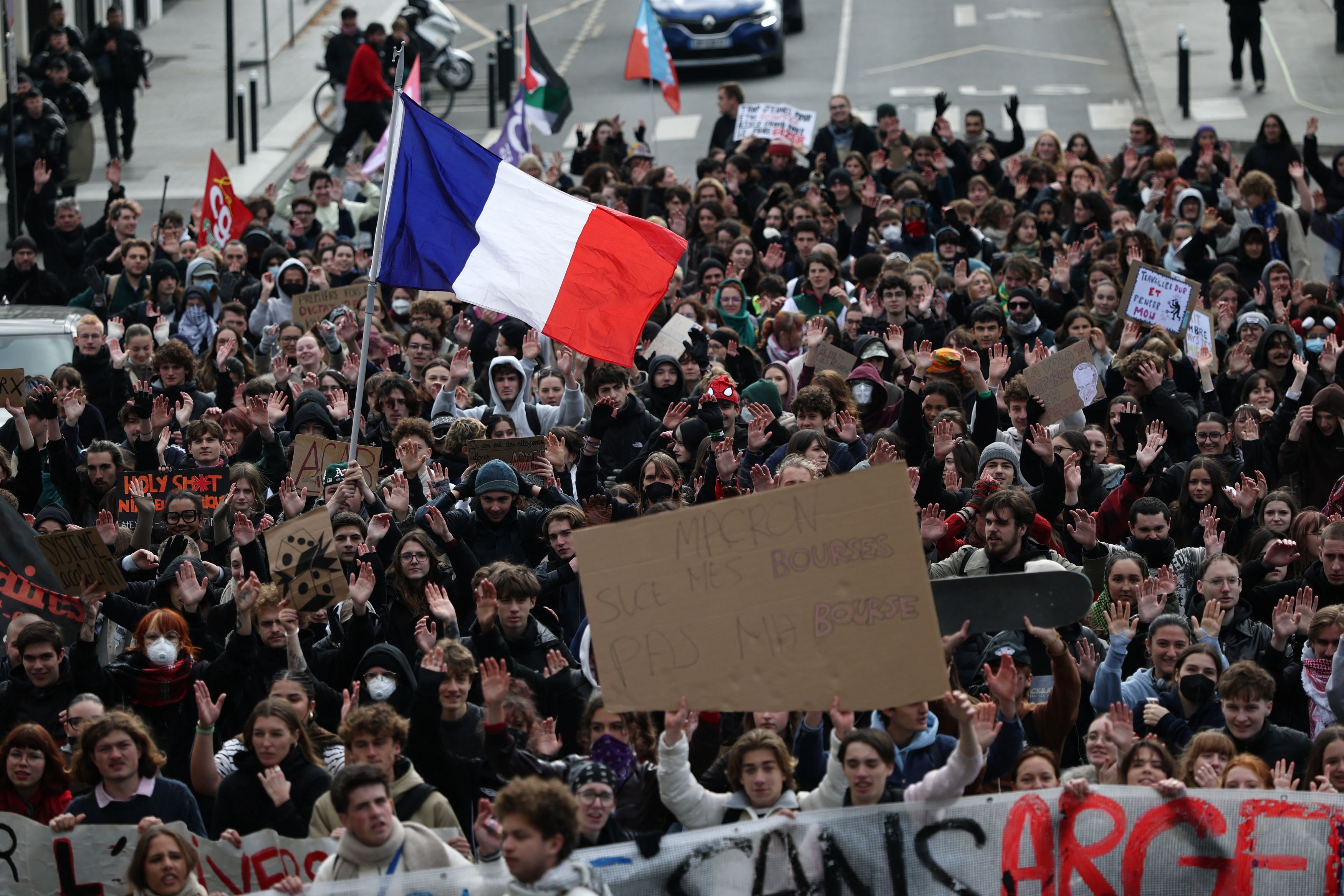
What began in September as a student-led protest in France against deteriorating conditions in public education has developed into a wider expression of social discontent, drawing trade unions, workers and veterans of the Yellow Vest movement into the streets. Hundreds of thousands have demonstrated across the country, protesting rising living costs, declining public services and a political establishment they increasingly regard as unresponsive to their grievances. Yet beneath these immediate demands lie older tensions over inequality, immigration, national identity and the meaning of belonging to the French Republic.
The unrest comes at a particularly precarious moment for President Emmanuel Macron. With public debt reaching 119 per cent of GDP in the second quarter of 2026, a fragmented parliament and limited fiscal room to address mounting social demands, his government faces the competing pressures of restoring public confidence, maintaining order and reassuring financial markets. The approaching 2027 presidential election has only sharpened these divisions. Marine Le Pen, who formally launched her campaign in October, is presenting the far-right National Rally as an alternative to a political establishment she argues has failed to protect France’s security, prosperity and national identity. On the opposite end of the political spectrum, Jean-Luc Mélenchon’s radical left has sought to channel public anger towards economic inequality and institutional reform.
Understanding France’s present divisions requires looking beyond the competing political narratives of the moment to the historical evolution of the Republic itself. To explore these deeper foundations, To Vima International Edition spoke to Mary D. Lewis, the Robert Walton Goelet Professor of French History at Harvard University. A historian of France’s legal, political and social history, Lewis specialises in immigration, citizenship, colonial governance and the limits of republican universalism. Her award-winning book, The Boundaries of the Republic: Migrant Rights and the Limits of Universalism in France, 1918–1940, examines the unequal treatment of immigrants under French republicanism. Her second book, Divided Rule: Sovereignty and Empire in French Tunisia, 1881–1938, explores colonial power and competing systems of authority. Her current research examines the consequences of the Haitian Revolution for the rest of the French overseas empire.

Minda de Gunzburg Center for European Studies, Harvard University
Drawing on this historical perspective, Lewis helps us examine the deeper foundations of France’s contemporary unrest: the relationship between economic insecurity and political polarisation, the enduring influence of empire on questions of citizenship and national identity, and the distance that can separate republican principles from lived experience.
What does it actually mean to be integrated into French society? Recent reporting highlights how young people born and raised in France, educated in French schools and holding French citizenship can still experience discrimination or feel that they are not fully recognised as French. Is the problem that certain communities have failed to integrate, as some political movements argue, or that French society has struggled to recognise them as fully belonging? And how does this contradiction relate to the historical limits of French republican universalism?
If we look at the current student movement, there could hardly be a clearer sign of having fully assimilated the values of the French Republic than to demand the universal access to education that has long been central to its promise. Moreover, in organizing in student unions, and in organizing demonstrations, the students drew on longstanding repertoires of civic engagement in France.
The current movement among high school students in France is widespread and not unique to cities or neighborhoods with recent histories of immigration. Although the movement began in Créteil, an underprivileged suburb of Paris where a quarter of the population is foreign-born, and where material conditions in the school were particularly poor, it quickly spread to other high schools including in the heart of Paris. The movement includes students from many different classes and family backgrounds.
So the 2026 movement is different from the November 2005 unrest, which stemmed from longstanding frustrations over ethnic profiling of youth by police. Those youth, too, were French-born, sometimes even third-generation, but were tired of being treated as if they were second-class citizens.
We see a few echoes of 2005 in the current movement in clashes between police and youth, but there’s hardly a high school in France that hasn’t faced some of the problems the students have called attention to regarding teacher shortages, infrastructural degradation, and so on. So it is a much broader youth movement.
The claim that suburban youth or “youth descendant from immigration” (jeunes issus de l’immigration) engage in violent behavior because of some antipathy for France is a rhetorical strategy deployed for political purposes. In fact, most of the violence in these demonstrations has been perpetrated by so-called “casseurs” (breakers) or the “Black Bloc,” anarchist-leaning opponents to the government. Their origins are varied, and include many whom one would not categorize as “issus de l’immigration.” It is important to distinguish the casseurs and the Black Bloc from the original student movement.
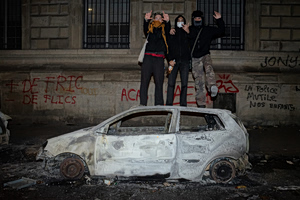
Burned cars at Republique square during a demonstration against the high cost of living in Paris, France, on October 17, 2026.
Your research also explores the history of citizenship and national belonging. Following the recent shooting in Trappes, reports emerged that the gunman had sought to avenge the violence and looting during the protests by targeting people from racial and ethnic minority backgrounds. At the same time, parts of the political and media discourse have portrayed immigrants and Muslims as responsible for France’s wider unrest. To what extent are these attitudes rooted in France’s history?
In many ways, this is not a new struggle. The French Republic has always had many contradictions. The drafters of the Declaration of the Rights of Man and Citizen proclaimed all men free and equal during the French Revolution without even contemplating women, let alone hundreds of thousands of enslaved people in France’s colonies who did not benefit from those rights. Slaves were emancipated in 1794 and reenslaved in 1802, and only freed again in 1848. That same year, Algeria was annexed as three supposedly “integral” departments of France. And yet, those departments sent members to parliament from the settler class, while the vast majority of its Muslim French nationals were not allowed to vote until after World War II, and even then, could only do so through electoral colleges that filtered the impact of their vote. A French Jewish army intelligence officer – Alfred Dreyfus – was falsely accused of espionage in 1894 and exiled, while the upper echelons of the Third Republic military trumped up evidence to conceal the truth. Jews were scapegoated for both the economic depression and the war in 1930s France. Women only gained the vote in 1944. Even after Algerians were granted citizenship in 1946, they still had unequal voting rights, faced housing discrimination, and were subjected to curfews. I could go on, but I think the point is clear: Like any democracy with a history of slavery, colonialism, antisemitism, sexism, or other forms of exclusion, France’s republic has seen its fair share of inequalities, which have of course engendered frustrations on the part of the excluded. In a healthy democracy, these are debated by a free press and addressed – however imperfectly – by an elected legislature. What’s concerning is when societal fissures contribute to the abandonment of democracy, as they did in 1940. At the moment, what worries me is that there are politicians in France trying to deepen such fractures for electoral gain rather than solve their root causes. The scapegoating of others is often the first sign of a fraying commitment to democratic values.
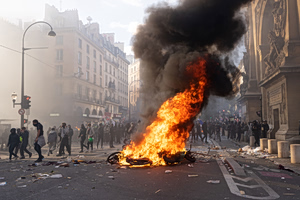
Clashes between protesters and police occur during a demonstration against the high cost of living at Strasbourg–Saint-Denis in Paris, France, on October 17, 2026.
France has experienced successive waves of unrest, from the Yellow Vests protesting fuel prices and economic hardship, to the uprisings in the suburbs over policing and discrimination, and now the student demonstrations over deteriorating educational conditions. These movements have emerged from different communities, with different grievances and demands. Are we looking at separate social crises, or do they reveal a deeper, shared fracture between French society and its institutions? And why has France struggled to translate these recurring expressions of anger into lasting political change?
France has a long, shared history of street politics which sometimes feature similar tactics or explicit references to one another. For instance, the movement this autumn features memes first circulated as posters during the May 1968 movement, replacing the image of Charles De Gaulle with Emmanuel Macron. That said, while the current demonstrators share a deep dissatisfaction with Macron’s leadership, they have different goals and motivations, and visions of what they want from the state. This makes it very difficult for the government to respond to them.
Street politics is effective when it prompts the government to negotiate with what the French call “social partners” (unions and the like). When the antifascist Popular Front coalition won elections in May 1936, the massive demonstrations and factory occupations that ensued led to major labor-law reforms that reinforced the right to strike, shortened the work week to forty hours, and gave workers paid vacations for the first time. In May 1968, student demonstrations were joined by workers and led to advances for workers in the short term, as well as the lowering of the voting age and the diversification of television and radio stations, among other changes, in the longer term.
By contrast, we haven’t seen such major negotiations emerge from more recent street politics. In 2018, when Macron proposed a fuel tax to support green energy initiatives, the Yellow Vest movement emerged, engaging in repeated weekly demonstrations blocking automobile rotaries, demanding lower fuel prices and a reinstatement of a wealth tax that Macron had eliminated. Although Macron made some concessions to the group, he refused to reinstate the wealth tax, and the resurfacing of the Yellow Vests this fall as fuel prices spike suggests that their demands remain unmet. In 2023, when Emmanuel Macron proposed a change in the retirement age in France, demonstrations once again broke out. Instead of conceding or negotiating, the government resorted to a controversial constitutional maneuver that allowed the bill to pass without a vote from the National Assembly. Street politics have been effective means of lobbying when they have forced governments to the negotiating table, as in 1936 and 1968. More recently, they have expressed anger but have not effected lasting change.

French President Emmanuel Macron addresses the media in Marseille, France, October 26, 2026. Aurelien Morissard/Pool via REUTERS
It might have been prudent for the government to have met with the students in September, instead of letting a month pass while police responses exacerbated the conflict and inadvertently created space for instigators to take advantage of the student movement and attack the state more broadly. But with Emmanuel Macron term-limited and the parliament hung since his ill-fated snap elections in 2024, and a revolving door of prime ministers, the current government has shown little willingness to negotiate with the street. Also, while the students had a clear union organization that might have allowed for substantive talks between them and the government, there is no single group that represents all the different actors now involved, and it is exceedingly difficult to satisfy the budget-heavy demands of the students and the cost-of-living concerns of the Yellow Vests simultaneously, to say nothing of the anti-establishmentarianism of the anarchists.
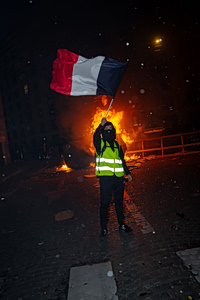
Clashes between protesters and police occur during a demonstration against the high cost of living in Paris, France, on October 17, 2026.
France is facing a difficult economic reality, with mounting public debt, pressure on public services and growing demands for greater economic security. Yet the state is increasingly constrained in what it can afford to deliver. France has historically built much of its republican identity around public education, social protection and the promise of equality. What happens when the state can no longer meet the expectations that underpin that social contract? Is France confronting a temporary fiscal crisis, or a more fundamental questioning of what citizens should be able to expect from the Republic?
I think this is a very important question.
When the republican school was created in the 1880s, the Third Republic mandated a school in every commune. This was a massive infrastructural undertaking, as well a huge investment in salaries for teachers. Third Republic teachers were known as “hussars” of the republic and were charged with inculcating the French language and secular morality among a mostly Catholic population who often spoke regional dialects; so too, they transformed the children of foreigners into French citizens. Education is one of the bedrock values of the republic, so eventually the government will have to figure out a way to address France’s deteriorating educational infrastructure and personnel shortages, despite budget constraints.
Unfortunately, I don’t think this is a temporary fiscal crisis. But it is hard to know where to cut, or how to generate more revenue. Given the rise in life expectancy, Macron’s idea of raising the retirement age was not irrational. Retirement, however, is regarded as a right, and so any further change to the retirement age, or to social rights more generally, will require a nimbler politician.
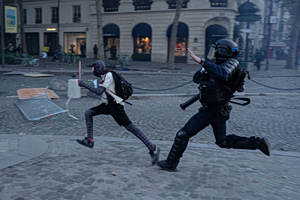
Clashes between protesters and police occur during a demonstration against the high cost of living in Paris, France, on October 17, 2026.
Against this backdrop of economic insecurity, social unrest and growing disillusionment with traditional politics, Marine Le Pen and the National Rally have emerged as an increasingly significant political alternative. We are witnessing similar developments across Europe, from Giorgia Meloni’s rise to power in Italy to the growing appeal of the AfD in Germany, the Freedom Party in Austria and Reform UK in Britain. To what extent are these movements expressions of the same underlying anxieties — declining living standards, immigration, cultural change and distrust of established political elites? Or does France’s particular history, including its republican ideals and colonial legacy, make the rise of the National Rally a fundamentally different phenomenon?
I don’t think it’s an accident that we’re seeing similar developments across Europe right now. That said, there’s a reason Marine Le Pen changed the name of the party from the National Front, founded by her father in the 1970s. Jean-Marie Le Pen was a firebrand known, among other things, for calling the Nazi gas chambers a mere “detail” in the history of the Second World War. French citizens’ antipathy toward the National Front may be partly why the far right has yet to gain a majority in French parliament or win the presidency. Next year’s elections will reveal how much that history continues to haunt her party.

French far-right leader Marine Le Pen, member of parliament for the French far-right Rassemblement National (National Rally – RN) party and candidate for the 2027 French presidential election, attends a press conference to present the party’s alternative budget for 2027 and its fiscal strategy, in Paris, France, October 6, 2026. The slogan reads “For France, a rebirth”. REUTERS/Sarah Meyssonnier
Looking at the country through the longer lens of French history, what do you think is most fundamentally misunderstood about its present crisis? And if France is to begin resolving these tensions, what would genuine renewal have to look like ?
I have been surprised at the extent to which these events have been analyzed through the lens of immigration. The present crisis is about French people from a variety of backgrounds who are worried about their future and want expensive reforms from a state that is broke, while the political system is both polarized and paralyzed. And it is about agents provocateurs who want to exploit that paralysis. Some have said renewal requires a new – sixth – republic. But writing a new constitution amidst such polarization strikes me as a hazardous undertaking, if democratic consensus is the goal.

People run followed by police officers during riots following the death of Nahel, a 17-year-old teenager killed by a French police officer in Nanterre during a traffic stop, at Champs Elysees in Paris, France, July 1, 2023. REUTERS/Nacho Doce TPX IMAGES OF THE DAY