
 Μake us preferred on Google
 A Russian drone struck a train near the Ukraine-Poland border shortly after former UK Prime Minister Boris Johnson and several senior European security officials had traveled through the same area on a separate train.
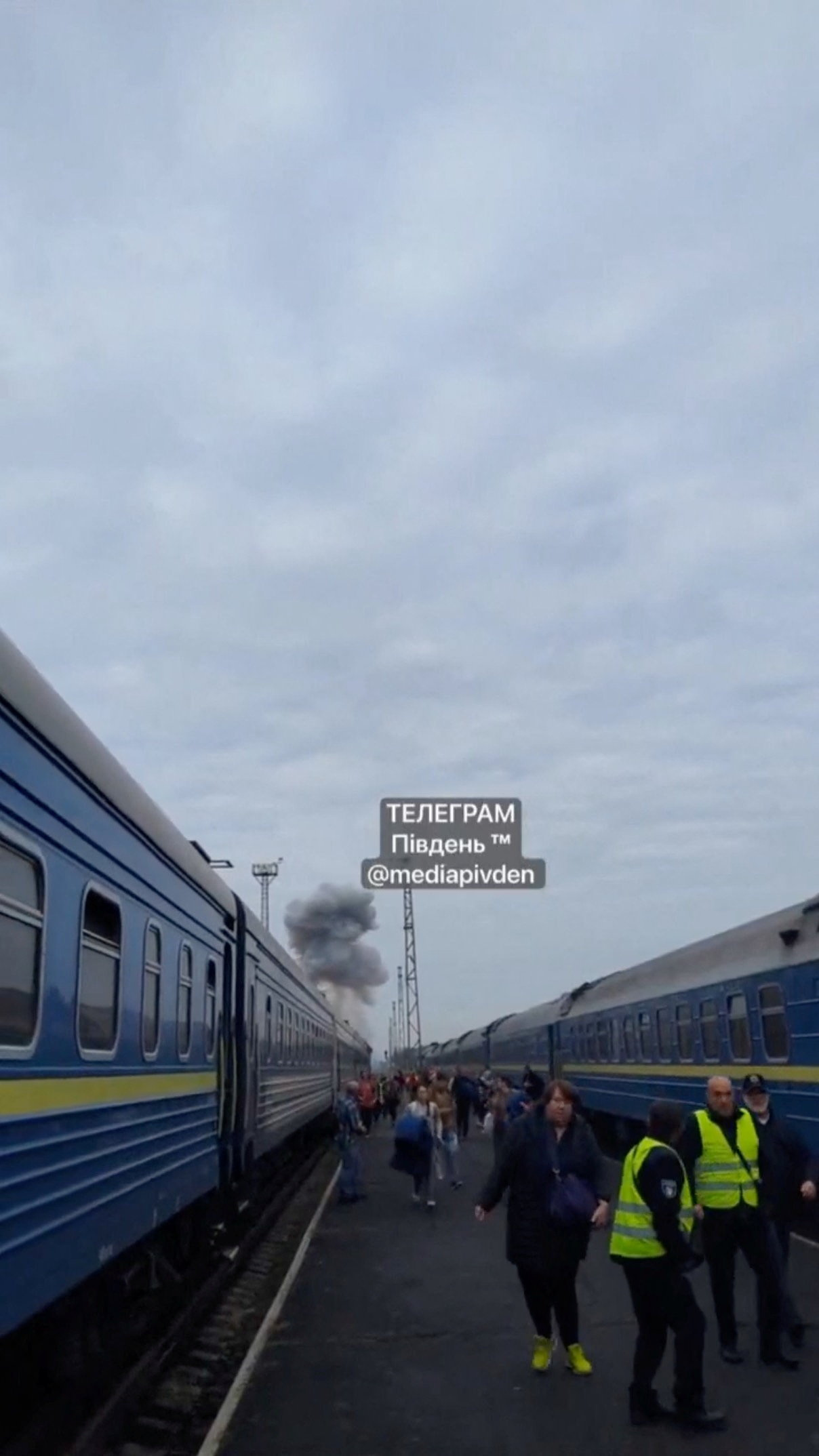
The strike hit the train’s engine at Yahodyn, though no casualties were reported, as all passengers had already been evacuated, according to Ukrainian officials. Johnson had been traveling along the same rail line with other national security advisers, including the UK’s Jonathan Powell, returning from a conference held in Kyiv.
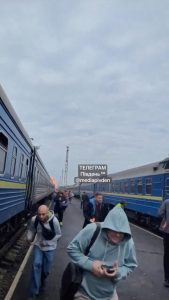
Smoke and flames rise during a Russian drone strike a passenger train, amid Russia’s attack on Ukraine, in Rymachi, Volyn Region, Ukraine, September 13, 2026, in this screengrab obtained from social media. Mediapivden via Telegram/via REUTERS
Russia’s defense ministry described the target as “railway infrastructure” in western Ukraine, but Ukraine’s national railway operator, Ukrzaliznytsia, suggested the diplomatic train itself may have been the intended target.
Katarzyna Pisarska, who chairs the Warsaw Security Forum, told the BBC she had been traveling in the same railcar as Johnson and Powell, noting that the strike occurred roughly 30 minutes after their train had already crossed into Poland.
Ukrzaliznytsia stated that the diplomatic train had departed earlier than scheduled due to a timetable adjustment prompted by ongoing threats of Russian attacks. The company also noted that passengers on the train that was ultimately struck received an evacuation order just 15 minutes before the drone hit.
Former CIA Director David Petraeus, who was aboard a different train at Yahodyn station during the attack, described the experience as terrifying, telling the New York Times it reflected the actions of “a truly barbaric leader trying to terrorise Ukrainian civilians.”
According to both Ukrainian and Polish authorities, the strike occurred approximately 2 kilometers (1.2 miles) from the Polish border.
Former Swedish Prime Minister Carl Bildt, who had also attended the Kyiv conference, told the BBC that passengers on his train were initially instructed to prepare for evacuation before being cleared to continue their journey, eventually arriving safely at the border station in Dorohusk, Poland.
While some reports suggested Bildt may have shared a train with Johnson, the former UK prime minister has not confirmed those details.
In a post on X, Johnson said he couldn’t fathom the reasoning behind Putin’s decision to strike a stationary Ukrainian train near the Polish border, calling it emblematic of the “random and senseless” attacks Ukrainians face daily, even on civilian rail infrastructure. He urged Ukraine’s allies to swiftly provide the air defense systems the country needs.
I don’t know what warped logic drove Putin to blow up a stationary Ukrainian locomotive on the Polish border this morning. What we can say for sure is that this is the kind of random and senseless attack Ukrainians are enduring every day – even on civilian railways. So far Putin…
— Boris Johnson (@BorisJohnson) September 13, 2026
Ukraine has continued pressing its international partners, especially the United States, for additional interceptor systems to counter increasingly frequent Russian attacks involving ballistic missiles and jet-powered drones.
Ukrainian Foreign Minister Andrii Sybiha condemned the strikes near Yahodyn as an act of Russian “terror” knocking directly on the doorstep of the EU and NATO, renewing calls for tougher sanctions against Moscow. He argued that only decisive action raising the cost of war for Putin would ultimately deter further aggression.
In Poland, Prime Minister Donald Tusk convened an emergency meeting to address the incident, warning that Russian escalation was becoming an increasingly tangible threat as attacks moved closer to Polish territory.
EU foreign policy chief Kaja Kallas accused Russia of attempting to intimidate Western nations through the strike, telling reporters at a summit in Finland that the appropriate response was to demonstrate solidarity with Ukraine rather than fear.
Kremlin spokesman Dmitry Peskov, addressing reporters Monday, said Russian military operations were continuing across Ukrainian territory and would persist.
Johnson and the other European security officials had been returning from the Yalta European Strategy (YES) conference in Kyiv, an annual gathering of political, business, security, and media leaders.
Ukraine reported continued Russian strikes overnight, with its air force saying it intercepted 85 of 108 drones launched by Russia. Separately, police in Chernihiv confirmed that three people died after a Russian strike hit a warehouse belonging to an agricultural company in Pryluky. Russia’s defense ministry, in turn, reported destroying nearly 400 Ukrainian drones over Russian territory overnight.
Russia appears to be intensifying its campaign against Ukraine’s transportation infrastructure, increasingly targeting trains, rail depots, fuel stations, and border crossings. Earlier in the week, Ukrainian President Volodymyr Zelensky reported that two people were killed in a drone strike on a border crossing between Ukraine and Moldova. A female train conductor also died in a separate drone attack on a passenger train in southern Ukraine, while six railway employees were killed earlier this month when a depot in Kyiv was struck.
In January, Zelensky condemned a similar strike on a crowded passenger train in the northeastern Kharkiv region, which killed five people, calling it an act of terrorism.
These repeated attacks have significantly damaged Ukraine’s rail network, which remains the primary means of transportation for millions of citizens since all air travel was suspended following Russia’s full-scale invasion in 2022.
Meanwhile, several European countries have accused Russia of orchestrating suspicious incidents beyond Ukraine’s borders. Germany recently attributed an August drone attack at Leipzig Airport to Russia, a claim Moscow dismissed as absurd. Additional unexplained fires at defense-related facilities have also been reported across Europe, from Italy to Estonia, with some governments pointing to Russian involvement.
For its part, Russia has accused Ukraine of targeting trains and buses in recent months. Last year, Ukraine’s Security Service (SBU) claimed responsibility for an operation—carried out over several months—that targeted a railway bridge in Crimea. That bridge, known as the Kerch Bridge, was constructed by Russia following its 2014 annexation of Crimea and was formally opened by President Putin in 2018.
Source: BBC