 Μake us preferred on Google
On 20 November, Prime Minister Andy Burnham will meet European Council President António Costa and European Commission President Ursula von der Leyen in Brussels for the second UK-EU summit, as both sides seek to turn the diplomatic reset initiated in May 2025 into tangible agreements.
The agenda includes reducing trade barriers for agricultural products, closer cooperation on emissions trading, security and defence, and a long-awaited youth experience scheme allowing young Europeans and Britons to live, work and study in each other’s countries for a limited period. An agreement on the latter, which has proved particularly contentious during negotiations, is expected to be announced at the summit.
The political context has also changed. Following the departure of Keir Starmer and Andy Burnham’s arrival at Downing Street in July 2026, the British Government appears increasingly willing to discuss a closer relationship with Europe, although it continues to rule out an immediate return to the single market or customs union.
Burnham has described Brexit as damaging to the British economy, arguing that the country can do better. “I want every family and business to feel the benefits of a closer relationship with Europe,” he has said, promising to cut costs for farmers, food producers and consumers.
But how much can Britain realistically recover without rejoining the EU? And what could the evolving relationship mean for Greece, its businesses, investors and the thousands of young people who have traditionally viewed British universities as a destination for higher education?
‘The prospects of rejoining are so difficult that I cannot see it happening in my lifetime’
For Iain Begg, a Professorial Research Fellow at the European Institute, London School of Economics and Political Science, the changing relationship should be understood against the continuing political divisions surrounding Brexit.
Speaking to TO VIMA, he argues that although the economic consequences of leaving the EU have become increasingly apparent, there is no universal interpretation of what has happened.
“There will be diehard Brexiteers who say, no, no, we haven’t actually tried Brexit yet. We’ve only made very tentative steps. And therefore, the opportunities have not been exploited. But if you listen to Remainers, they’ll tell you Brexit was always going to be an economic cost. That was a cost of regaining some sovereignty.”
He believes that the economic price may have been higher than some anticipated, although the most catastrophic predictions made during the 2016 referendum have not materialised.
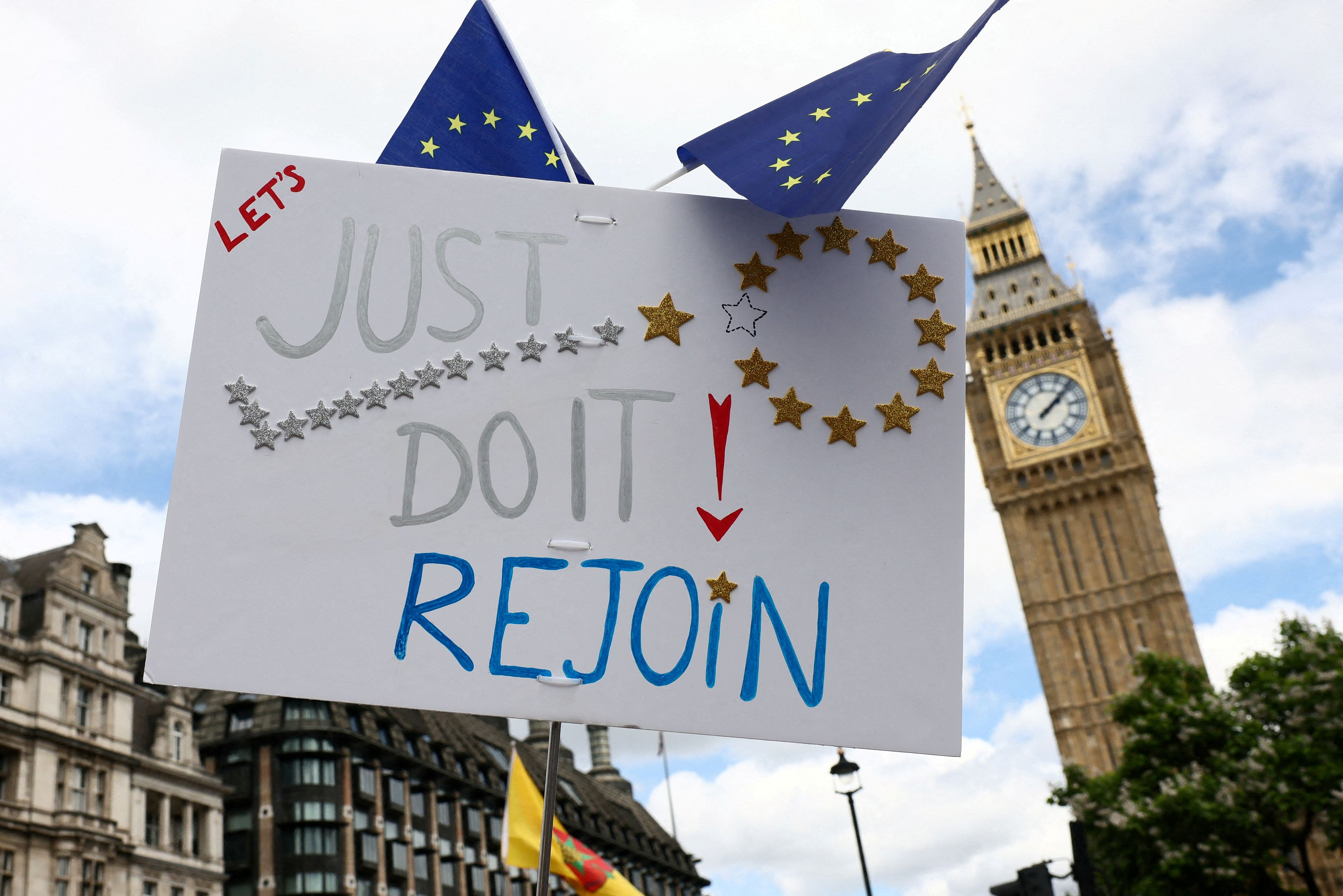
Nevertheless, the possibility of reversing Brexit remains remote. “My view, very briefly, is that the prospects of rejoining are so difficult that I cannot see it happening in my lifetime,” he says.
The immediate challenge, therefore, is to recover some of the economic advantages of European integration without reopening the entire Brexit question.
Begg warns that Britain cannot simply select the benefits it wants while rejecting the obligations attached to them. “Cherry-picking would mean trying to rejoin much of a single market but without offering full mobility of labour. That’s not going to happen because there’s too big a constituency inside the EU that would say if you want the single market, you have to accept all four freedoms: goods, services, capital and labour.”
Yet he identifies considerable opportunities for smaller British businesses, which have struggled with the paperwork, certification requirements and VAT complications introduced after Brexit.
“Many small businesses just give up on exporting because the paperwork around certification, VAT rules, etc, is too complex,” he explains.
He points particularly to agricultural and food exports, where sanitary and veterinary controls have created substantial difficulties. Simplifying these procedures could help British producers regain access to European markets.
Begg also sees potential benefits in youth mobility and the restoration of educational links. For Greece, his assessment is encouraging.
“In a word, yes,” he says when asked whether Greek businesses could benefit from closer UK-EU economic cooperation. He describes the Greek economy as one of the EU’s success stories under Kyriakos Mitsotakis.
For Greek students, lower university fees and renewed opportunities for mobility could be particularly significant. For investors, London remains an important European capital market, although it faces competition from Paris, Frankfurt and Dublin.
‘GDP was hit by something like six to eight per cent’
A considerably more critical assessment of Brexit’s economic consequences comes from Holger Breinlich, Professor of Economics at the University of Surrey.
Speaking to TO VIMA, he argues that public opinion has turned against Brexit, giving the Labour Government greater political room to pursue closer European relations.
“There is a lot of academic evidence that Brexit has had negative economic impacts,” he says.
Citing research by Nicholas Bloom of Stanford University, Breinlich points to estimates suggesting that British GDP had been reduced by approximately 6-8 per cent by 2025.
“Quite a big hit. It’s almost on a par with the financial crisis of 2008-2009,” he says.
He attributes the damage principally to the uncertainty following the 2016 referendum and the trade barriers introduced when the new arrangements came into force in 2021.
Some of that damage, he cautions, cannot simply be reversed. Investment that never took place because businesses were uncertain about Britain’s future relationship with Europe is difficult to recover.
However, reducing trade barriers could generate longer-term benefits through greater competition and innovation.
Small and medium-sized enterprises stand to gain the most. Breinlich refers to research by Tom Sampson of the LSE and Kalina Manova of University College London, which found that smaller companies were particularly affected by the decline in exports.
“The British car industry, for example, will be able to deal with these things, but not the average small companies.”
He is less optimistic about the immediate benefits for European exporters, including Greek businesses. Research into British companies establishing subsidiaries in the EU after Brexit has demonstrated how strongly UK businesses reacted to the loss of single-market access.
European companies, by contrast, often chose to abandon the British market rather than undertake the additional investment required to maintain their presence.
“I think any positive reactions for European firms, they will certainly be there. But I don’t think it will be very large on aggregate. I think it’s going to be much more important for the UK.”
On youth mobility, Breinlich believes an agreement would help, but argues that the central issue remains Britain’s willingness to accept sustained immigration.
He also questions the assumption that reducing tuition fees for European students would necessarily benefit British universities, noting that institutions are already free to offer lower fees but have generally chosen not to do so.
Asked what he would prioritise economically, his answer is unequivocal.
“From an economic point of view, I think there is no real alternative to rejoining the EU.”
Short of membership, however, he identifies two practical priorities: a mutual recognition agreement covering manufactured goods and an agreement on agricultural trade.
Both could reduce border delays and unnecessary checks.
“I think those would be the two most important things,” he says, adding that accepting alignment with European regulations would be a price worth paying.
‘The possibility of membership is now seen as an option to be considered’
Professor David Phinnemore, Professor of European Politics at the School of History, Anthropology, Philosophy and Politics, Queen’s University Belfast, believes the forthcoming summit represents both a practical response to Brexit and a broader change in Britain’s political direction.
Speaking to TO VIMA, he describes the developments as “a combination of both”.
He expects agreements on agricultural trade, emissions trading and youth mobility, alongside declarations strengthening cooperation in other areas.
But the arrival of Andy Burnham has introduced a different dimension.
“The new Prime Minister, Andy Burnham, has indicated that he wants to have a serious dialogue about the future of UK-EU relations. And as part of that, we’ve now got an open door to discuss whether rejoin should be part of that agenda.”
Although the existing red lines concerning the single market and customs union remain in place, Phinnemore believes the Government is increasingly pushing their boundaries.
He suggests that these positions may not necessarily feature in Labour’s next manifesto, potentially allowing a more substantial rapprochement.
The EU, however, has its own priorities. While Britain is particularly interested in trade, Brussels is keen to secure progress on youth mobility and lower tuition fees for European students.
For Greece, the potential benefits extend beyond trade.
“All member states can benefit from a closer relationship because, in many respects, what we’d be doing would be reversing some of the consequences of Brexit,” he says.
Easier movement for students, reduced fees, improved commercial relations and greater investor confidence could all follow.
On the question of eventual British membership, Phinnemore identifies an important political development: “For a long period post-Brexit, Brexit was a taboo subject. You couldn’t broach it.”
That has changed. Nevertheless, rejoining would be a complicated process requiring unanimous agreement among EU member states and ratification by each of them. Britain’s position on the single currency and Schengen would also have to be addressed.
“We’re very early days in this process,” he cautions. But the possibility of membership is now firmly back in the political conversation.
‘The big question is how far Burnham will move’
For Nikos Skoutaris, Professor of European Constitutional Law at UEA Law School, University of East Anglia, expectations surrounding the Brussels summit should remain measured.
Speaking to TO VIMA, he argues that the meeting is primarily about reviewing and strengthening the existing Trade and Cooperation Agreement, rather than negotiating a fundamental transformation of Britain’s relationship with Europe.
“What we expect is probably an agreement concerning agricultural products, the free movement of certain agricultural products, a connection with the emissions trading system, and what they will say about young people. We should not expect anything particularly dramatic in its legal dimension.”
What matters more, he argues, is what Burnham says about the next steps.
“That is whether this is a staging post towards something bigger. But at the moment that does not seem certain, and it will depend very much on domestic political dynamics.”
Skoutaris identifies several reasons for Britain’s changing attitude: the ideological differences of the new Government, geopolitical developments, economic difficulties and the declining popularity of Brexit among sections of the electorate.
Nevertheless, he warns that British politics remains exceptionally unstable.
“The big question is how far Burnham will move. When he starts discussing new models, such as a customs union or the European Economic Area, we will see the real extent of his pro-European position.”
He also challenges the idea that the EU’s rejection of cherry-picking necessarily makes selective agreements impossible.
“The laws are not sacred. We often use them in an instrumental way to achieve another political objective,” he argues, pointing to the arrangements governing Northern Ireland as an example of how differentiated relationships can work.
For Skoutaris, the longer-term question is not simply whether Britain wants closer ties, but whether European governments can trust its political direction to remain consistent.
Britain has repeatedly moved between closer integration and distance from Europe. “The Europeans cannot live with a partner who says one day, ‘I want to be inside’, and the next day, ‘I want to be outside’.”
He believes an intermediate arrangement is more likely than a second referendum in the immediate future.
For Greece, the practical implications could be substantial, particularly in agriculture, emissions trading and energy. Businesses in these sectors could find their lives easier, although he does not expect the agreements to transform trade flows or dramatically alter the commercial balance.
The question of university fees is more consequential for Greek families. If European students eventually secure a significant reduction in tuition fees, Britain could once again become an attractive destination for undergraduate and postgraduate studies.
“That would certainly be a huge change,” he says. “Britain would once again become an affordable destination for many Greek families to send their children, either for undergraduate or postgraduate studies.”
But he cautions that the details may not be settled at the summit itself.
Youth mobility, meanwhile, could prove one of the most important outcomes, particularly for young Britons who lost opportunities after the UK’s departure from Erasmus+ and the wider European educational framework.
Skoutaris stresses that the proposed scheme must not be confused with the restoration of free movement.
“We are talking about a limited period, limited numbers and limited sectors,” he explains. Greek applicants would participate within a wider European quota, with restrictions on the duration and type of employment permitted.
Nevertheless, he believes the agreement could restore valuable connections between younger generations.
As Britain approaches its second summit with the EU, the emerging picture is one of cautious rapprochement rather than a return to the pre-Brexit relationship.
The immediate agreements may be technical, and their economic benefits uneven. But the political significance could be greater: after years of defining itself through its departure from Europe,
Britain is once again having a serious conversation about how close it wants to be to its European neighbours.