
 Μake us preferred on Google
 At an estate nestled in New York’s Hudson Valley, a group of high achievers gathered to talk about the sacrifices and disappointments that can come with success.
“You get the title, the money, and it’s kind of hollow,” a bank vice president shared.
“I’m done waiting every day for the day to be over,” said a marketing director.
A hospital executive whose position was scrapped last year shared that he sometimes finds himself imagining a different life: opening a hardware store or becoming a science teacher. “When I think about that, my nervous system relaxes,” he said.
The $4,000 retreat—sponsored by a networking organization called Punks & Pinstripes and described as “an exclusive gathering for leaders seeking change”—wasn’t your ordinary corporate off-site. The seven attendees, who ranged from their mid 30s to their late 50s, had excelled in lucrative fields like finance, consulting, healthcare and tech. They were consummate problem solvers who had applied that skill to their work lives, often to great effect.
But they had all hit unexpected walls—burnout, breakdowns, disillusionment—that were forcing them to try a different approach.
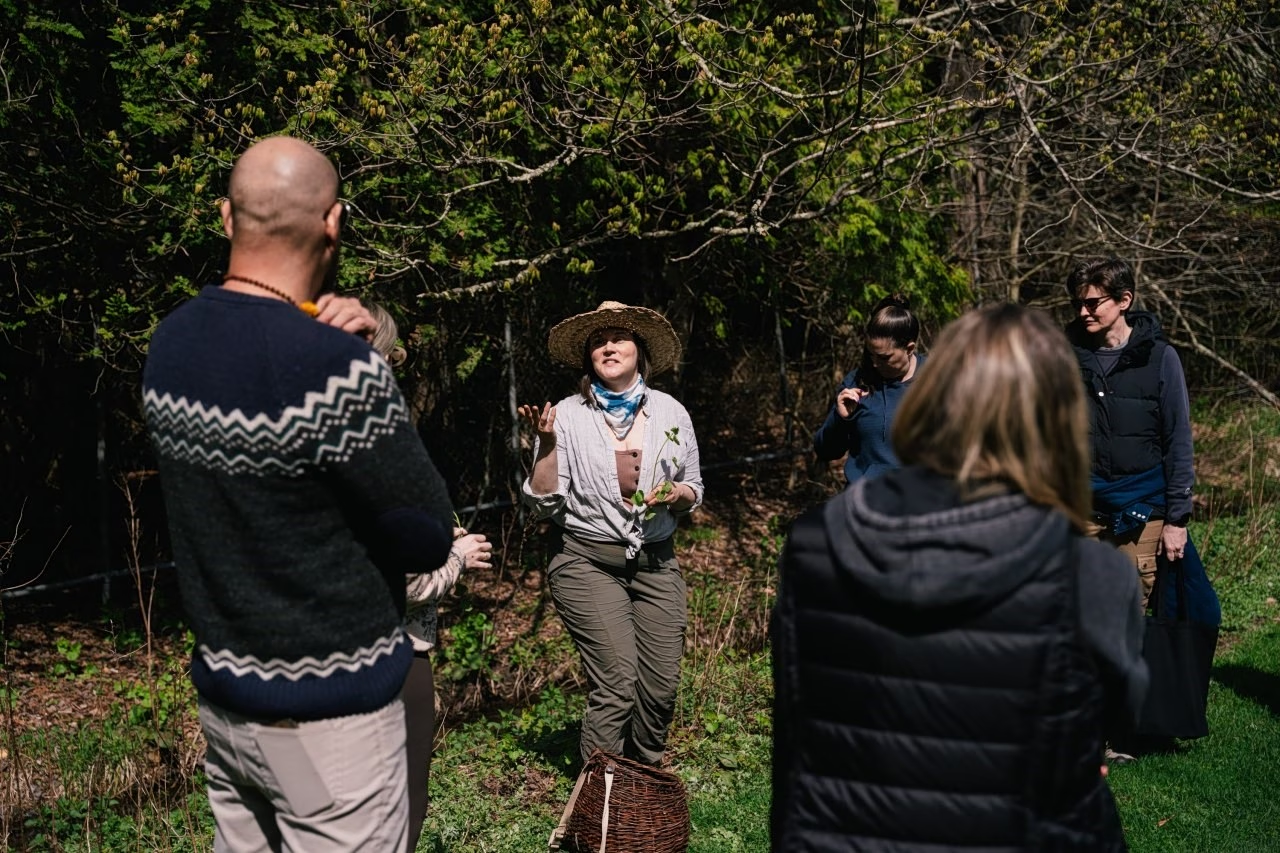
Renee Baumann, a chef and educator, guides a foraging walk for retreat participants. Paola Chapdelaine for WSJ
Middle age has never been a simple stage of life, as the seemingly endless possibilities of youth give way to obligations and the humbling (sometimes brutal) realities of aging. It’s gotten even weirder lately.
Longevity influencers are promoting peptide stacks and cold plunges to help people live much longer. The cost of living is pushing retirement later, especially for those supporting adult children and elderly parents.
And AI is forcing us all to ponder: What are we supposed to do with our elongated lives if technology wipes out the jobs that once gave us purpose?
Perhaps fittingly, midlife retreats have become something of a cottage industry within the broader umbrella of wellness tourism, described as a nearly $1 trillion market by the Global Wellness Institute, a nonprofit that tracks wellness trends.
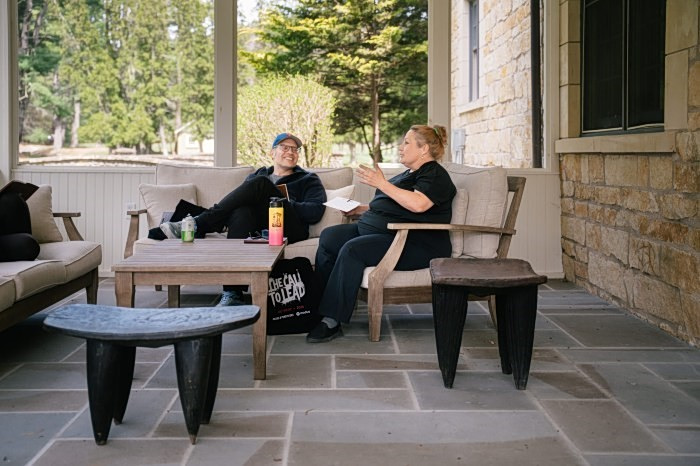
Greg Larkin, left, founder of Punks & Pinstripes and retreat organizer, and Karen Root, a retreat participant and director of experience strategy at Boehringer Ingelheim. Paola Chapdelaine for WSJ
The gatherings can revolve around topics such as spirituality, career transitions or even menopause. Some programs run online and cost a few hundred dollars. Others feature high-end hotels, organic meals and access to celebrity teachers, with price tags in the thousands.
Greg Larkin, one of the organizers of the Hudson Valley retreat for corporate professionals, said his clients were the type of people who were seeking “a sanctuary from the ‘crush-it summit.’” (“That’s where you ask a senior leader how they’re doing, and they say, ‘I’m f—ing crushing it, man,’” Larkin clarified.)
A former Wall Street analyst and entrepreneur, Larkin started Punks & Pinstripes in New York City in 2022 as a community for people who had scaled the mountain of white-collar success, found the view uninspiring and wanted to redefine achievement on their own terms. He began with a series of intimate dinners and group-coaching sessions, and has since expanded to executive retreats.
I’d planned to attend the gathering as an observer, a journalist who covers careers and management, comfortable that my notebook and pen separated me from the others. But I found that I was not immune to being introspective about middle age.
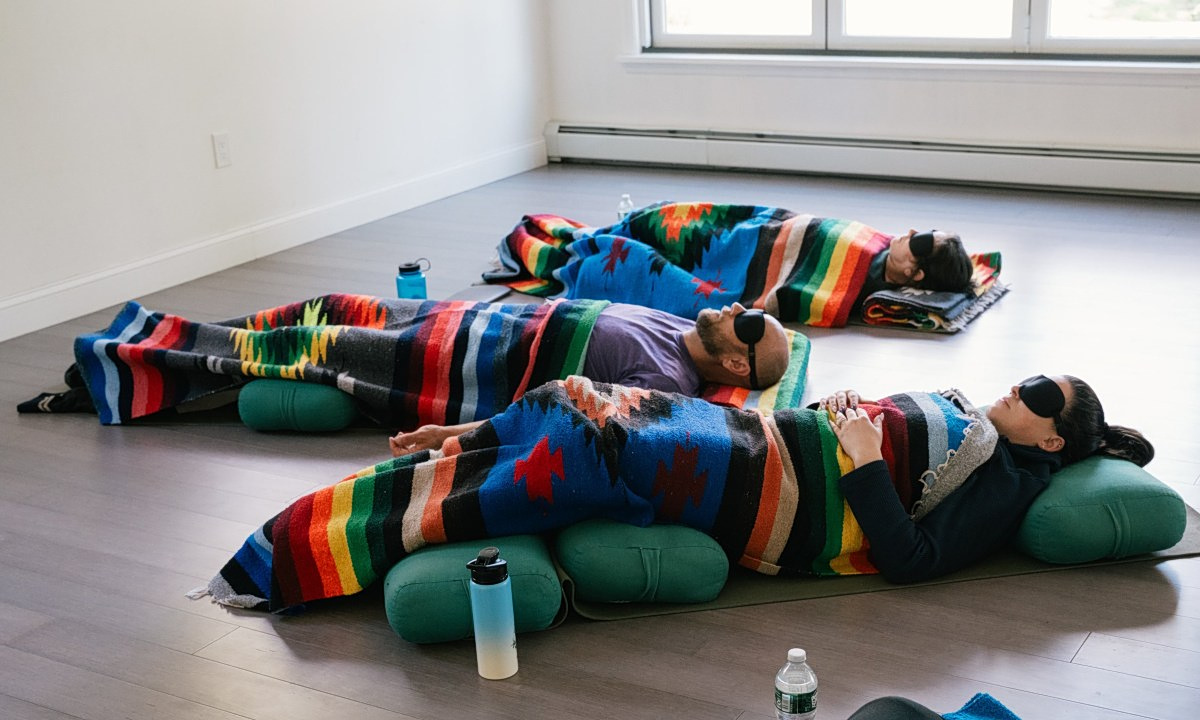
Over two days at Lundy Farm, a quiet-luxury manor seemingly lifted from a Restoration Hardware catalog, the other attendees and I meditated each morning, made pinch pots out of clay, foraged for wild nettles and garlic mustard in the woods and drew analogies between our own lives and the natural world around us during the retreat’s activities. Soil was a metaphor for the growth we were incubating in our lives. Moss creates its own microclimates, just like we could build happy, functional teams, even in the midst of corporate dysfunction.

Paola Chapdelaine for WSJ
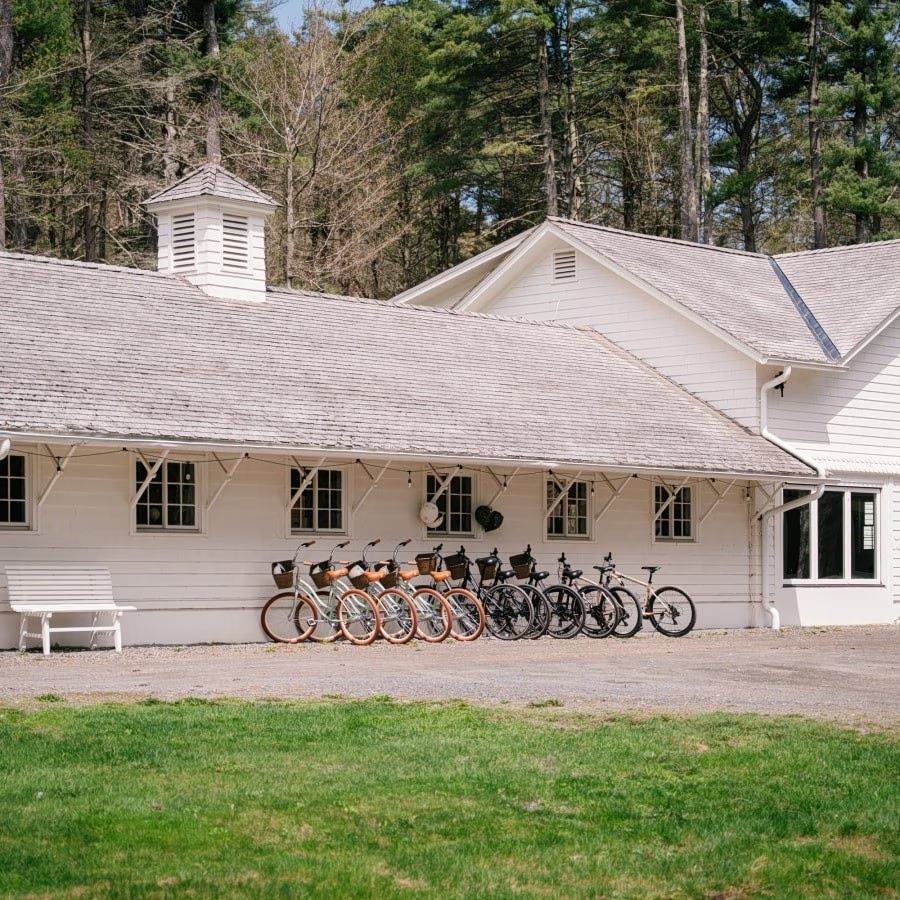
A sauna and bicycles at Lundy Farm. Paola Chapdelaine for WSJ
During group activities, cocktail hours and meetings in small cohorts of two or three attendees and facilitators, participants sought insight and support from each other about starting new businesses and career shifts. But often the big issues they seemed to be grappling with reflected deeper, much more existential questions.
Julie Holland, a psychiatrist who joined us for a first dinner of roasted salmon, millet pilaf and asparagus, told the group that it was common for high achievers to experience confusion and emptiness alongside personal success. She said she once had a patient who won a Pulitzer Prize, then immediately sank into a deep depression.
“It’s like the song, ‘Is That All There Is?’” she said.
Danielle Larish, a 41-year-old consultant who has worked across a dozen sectors, told me on the first night: “I’m good at what I do, and it’s f—ing draining.” She said she usually comes into situations where things are going disastrously wrong and helps turn them around, but she’s tired of walking into companies, talking to executives and employees, prescribing fixes “and having them not act on any of it.” Corporate America, she said in a small group session of three people, is full of toxic behavior—scapegoating, backdoor machinations and leaders clinging to whatever power they have at the expense of good ideas.
A week before the retreat, she realized she wanted to take her management philosophy and turn it into a book or other project. But she was unsure how to begin, naming some obstacles, including self-doubt and frustration over ideas that never got put into practice at the companies she worked with.
The other two members of her breakout group asked Larish questions and offered suggestions. “How hard would it be to prototype two or three approaches to the project?” asked Kellye Rogers, a technology executive who started her own AI consulting firm last year.

A card from a workshop session. Paola Chapdelaine for WSJ
In another small group, the hospital executive was talking about a different kind of crossroads. He had an Ivy League degree, earned his MD and Ph.D. at world-class institutions and ascended to the C-suite of a prestigious organization. Then, last year, organizational restructuring led to the elimination of several teams, including his. (He spoke to the Journal anonymously because he was not authorized to speak about the circumstances of his departure.)
“Nobody looks better than me on paper,” he said. “I went to fancy schools, worked at the best places. And somehow I just got cast aside.”
He said he’d led a charmed life until his 40s, when a divorce unsettled his sense of having cruised along on luck, intelligence and hard work. And then his job disappeared. “I was woefully underprepared in a blissful and terrible way,” he said.
He had also just started on cholesterol drugs and undergone his first colonoscopy. “If it was all over now, do I feel like I did what I wanted to do? And if not, what would that be?” he mused.
He was talking to an AI startup about coming aboard. “If it was five years ago, I would’ve done it in a second,” he said. “Now it feels like a young person’s game.”
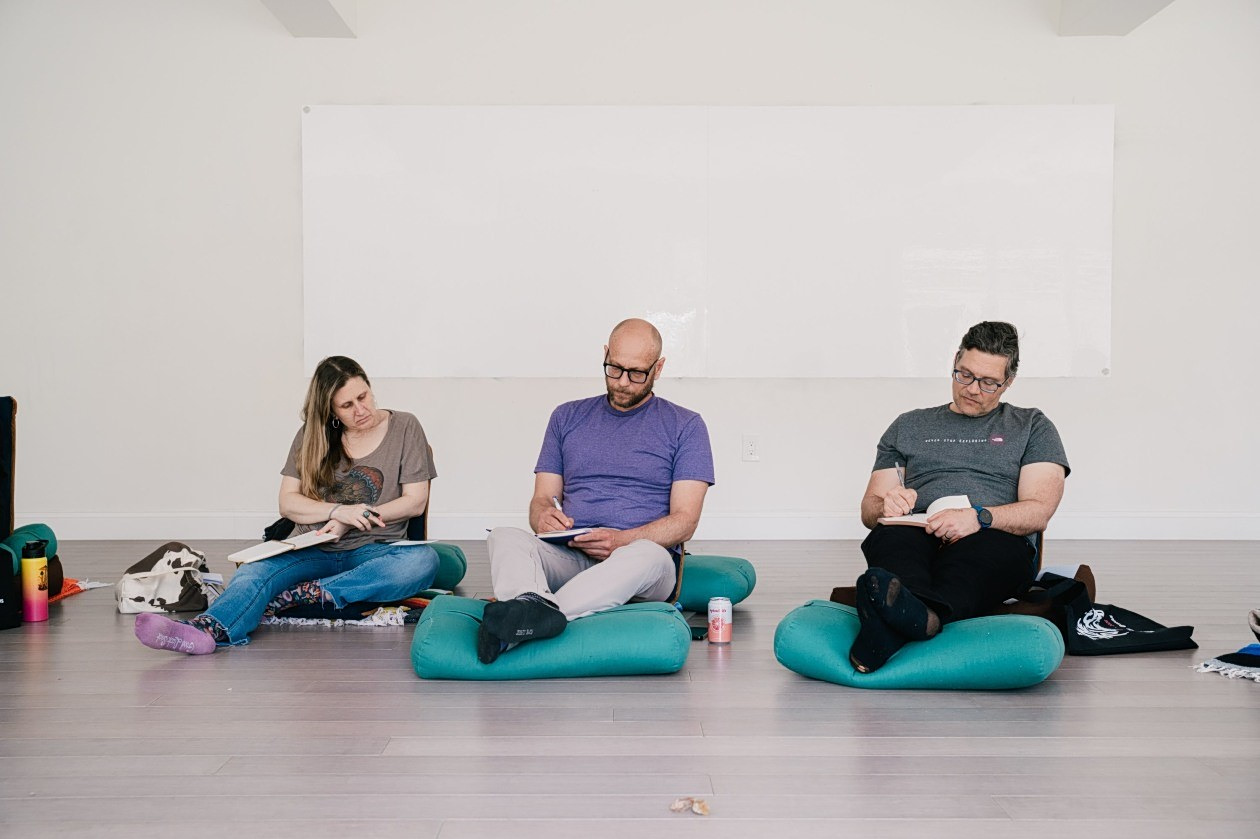
From left: Facilitators Emily Kagan, Jay Erickson and Larkin take notes during the retreat’s writing session. Paola Chapdelaine for WSJ
The Canadian psychoanalyst and management consultant Elliott Jaques is often credited with coining the term “midlife crisis” in 1965.
But the cliché of a middle-aged man who throws away his wife and family car for newer, sexier models flattens and simplifies the concept.
In Jaques’s formulation, articulated in the International Journal of Psychoanalysis, a midlife crisis referred to the harrowing recognition of one’s own mortality, a recognition that could lead to a decisive change in the quality and maturity of one’s work.
“The paradox is that of entering the prime of life, the stage of fulfillment, but at the same time the prime and fulfillment are dated,” he wrote. “Death lies beyond.”
Jaques posited that middle age compels people to lean in to “the tragic, reflective and philosophical.” Such “contemplative pessimism,” he suggested, could lead to a better life—and a deepening of genius, as seen in the later works of artists like Bach and Shakespeare.
At the retreat, no one was writing timeless concertos or the world’s greatest tragedies.
But there was vulnerability and honesty.
I found myself surprisingly moved by the meditative activities and programming, even if it felt silly at first to be constructing a mandala with leaves and twigs in the middle of a workweek.
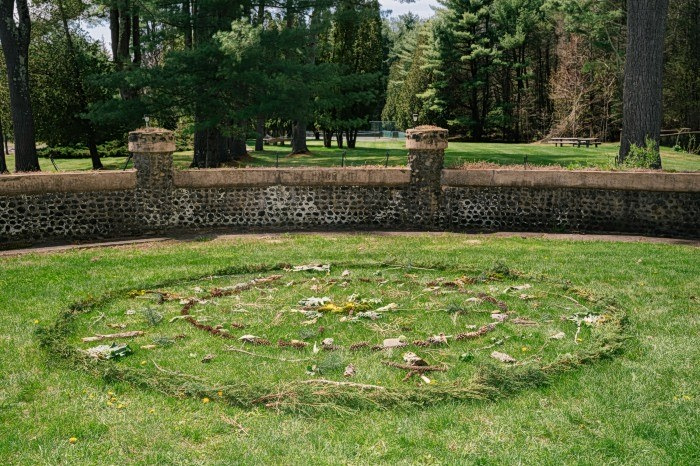
Workshop participants made a mandala with leaves and twigs. Paola Chapdelaine for WSJ

Pinch pots dry in the sun. Paola Chapdelaine for WSJ
One evening, Emily Kagan, a poet and healthcare executive who was one of the facilitators, passed around markers and colored sheets of origami paper. She instructed us to write down things we were “done with”—objects and emotions we were ready to jettison from our lives.
We went around the long dinner table, illuminated by a fireplace, and read what we’d scribbled. Among the baggage we carried: Impostor syndrome. An ex-wife’s shoes. Old identities. Sunday scaries. Shame. Never having a sense of enoughness.
Later, Kagan asked us to write a letter, five years in the hypothetical future, telling someone we love about our lives. I chose my teenage son.
Suddenly, articulating what I saw—the creative writing projects I hoped to tackle, my pride at seeing my child launch into adulthood—I found myself stifling a sob. At the age of 55, my beginning is long over, and hopefully my end is decades away. But for perhaps the first time, I could feel a distinct, emotional embrace of the middle.
On the last day of the retreat, we put the finishing touches on our pinch pots.
My creation resembled a bulky hamantaschen more than a talisman for a life-changing epiphany. But the clay was dry and there was a colorful palette of pigments in front of me. I began to paint.