
 Μake us preferred on Google
In search of a vacation spot for surfing with his family, Clint Tasset put down a $600,000 deposit last year on a $1.8 million lot in Los Cabos, Mexico, a place renowned for its coastline.
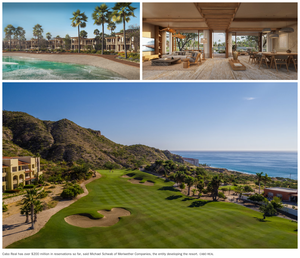
But Tasset doesn’t plan on surfing in the ocean there. Instead, the $3 million house he builds will be across the street from the beach at the Cabo Real Surf Club, a private residential club next to an artificial lagoon with a wave machine.
In the lagoon, he won’t have to wait for waves and battle other surfers. There will be no sharks, jellyfish, rocks or bad currents. He’s promised multiple good waves a session, as big or small as he wants. “It’s approachable,” said Tasset, 46, who lives just north of Denver and founded a digital marketing company. “If you can lie on a board and move your arms, you can get in.” He plans on surfing there with his wife and two kids, aged 13 and 15.
Thanks to advances in wave-pool technology, man-made surf lagoons are becoming the latest amenity high-end housing developers are using to lure buyers. Instead of golf courses, ski mountains or lakes, these developments—often with custom-built homes and members-only clubhouses—offer surfing as the main activity. Whether these capital-intensive projects can be financially successful, however, remains to be seen; at least one planned project has already faltered.
Catch a wave
Wave machines have been around since the late 1960s and were popularized in the 1987 film “North Shore.” There are already more than 30 surf wave pools operating around the world, and about a dozen under construction, some with hotels and vacation rentals, according to Bryan Dickerson, founder and publisher of WavePoolMag, an online platform. And while there is an upscale residential surfing-centered community in Brazil called Praia da Grama, there aren’t yet completed residential surf-lagoon communities in the U.S. where owners can buy lots and build homes. That’s set to change next year, as developers open new communities in Texas, Utah, Arizona and elsewhere.
The timing of these new developments is largely due to artificial waves becoming more efficient and producing more waves per hour, industry analysts said. They not only mimic ocean waves but also allow more surfers per day, making building resorts around them more financially feasible.
“This kind of surfing is much more efficient,” said Asa Cascavilla, 50, a real-estate developer based in Dallas. “I don’t like to waste time.”
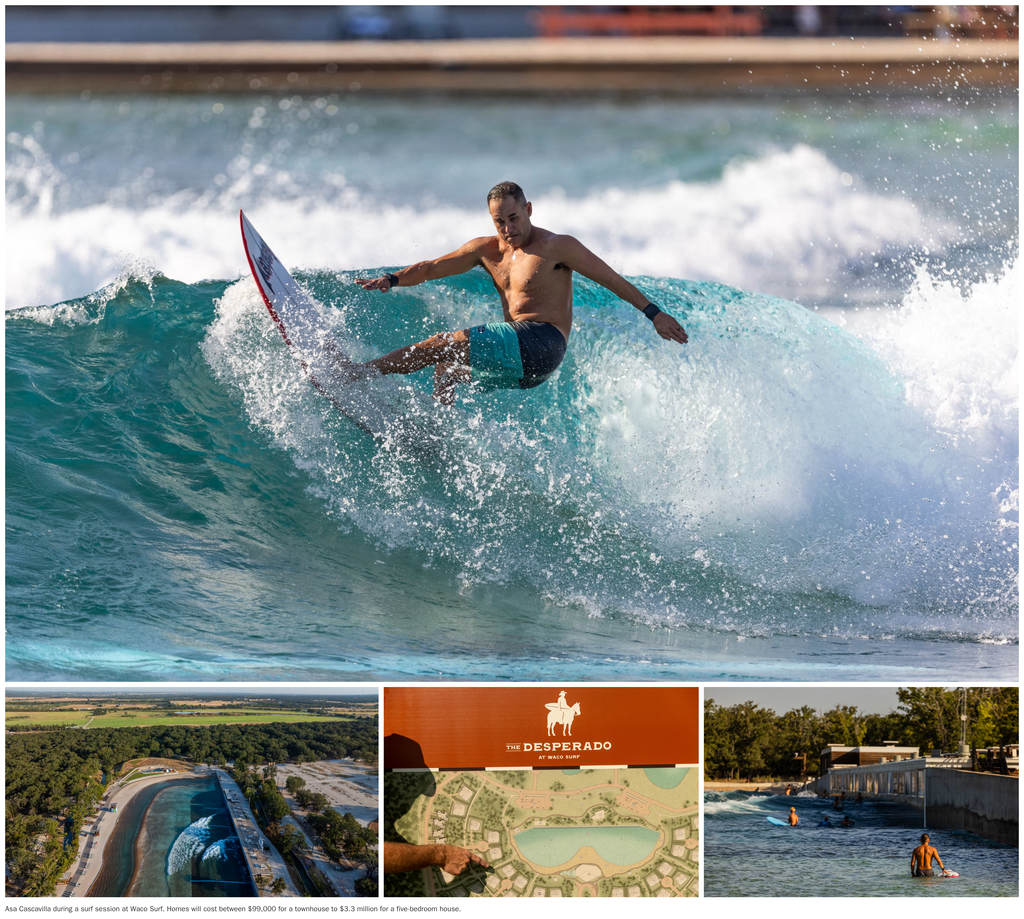
Cascavilla grew up surfing. When his skills started to suffer because he couldn’t get away for extended periods, he started making regular trips to the Waco artificial-wave lagoon Waco Surf. He would visit on weekends and after work, sometimes flying his private plane there for a few hours. Now Waco Surf is adding an 88-unit residential community called the Desperado, and Cascavilla plans to spend $2.2 million building a five-bedroom, 3,500-square-foot house there.
Cascavilla is one of eight people to put down deposits so far at Desperado, where homeowners will have priority access to booking the wave machines.
Artificial waves don’t replicate the same soul-refreshing experience as the ocean, said Brett Parkinson, 51, an attorney who lives in Park City, Utah. “You don’t paddle out and see dolphins,” he said. In a wave pool, “someone on a microphone is telling you your wave is coming.” You also have to get your mind around paying for waves, he added.
Nevertheless, Parkinson bought a $1.5 million lot at the upcoming wave-pool development Zion Shores in Washington, Utah. He plans to build a 2,700-square-foot home there. For Parkinson, that means a few hours’ drive to surf instead of flying to the coast. His wife and seven children, aged 10 to 24, surf at different levels, and controlled waves mean they can all do the sport together.
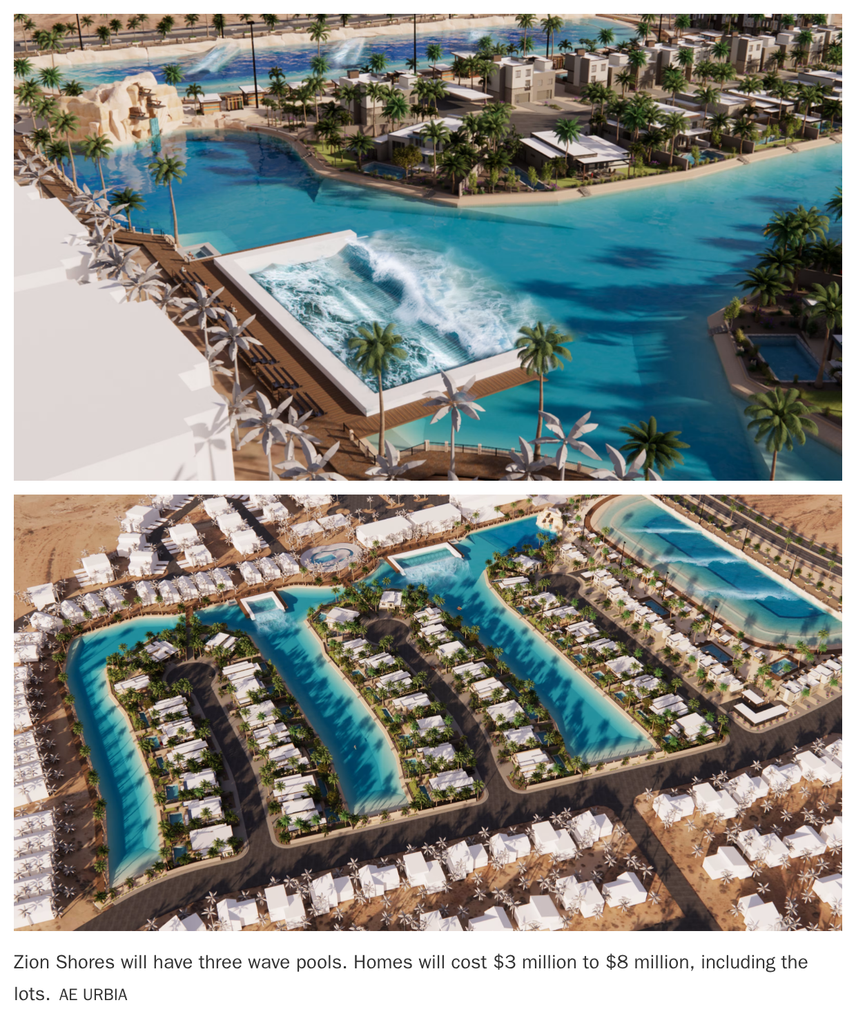
The $130 million Zion Shores project came together after developer Cody Larkin installed a continuous-wave surf machine in a lake in 2021 at one of his residential communities in Utah; he was shocked to see that the surf wave was far more popular than water skiing or wakeboarding. “Everyone would spend almost all their time there,” said Larkin.
Half of the 56 residential lots at Zion Shores have sold since development started a year ago, Larkin said. There is a $500 monthly HOA fee per house, but that doesn’t include surf fees, which range between $30 and $200 an hour.
“Just walk out and surf.”
Tyler Mezin, 51, lives on the North Shore of Oahu, Hawaii, one of the premier surf spots in the world. But as Mezin gets older, the idea of controllable waves—without fighting other surfers or the weather—has become more attractive. “It changes the dynamic of the whole experience,” he said. He expects to spend a total of about $2 million on the lot and a three-bedroom house he is planning to build at Waco’s Desperado, where he will live full time after he retires from his job as a hotel manager. “I want it to be easy,” he said. “I want to just walk out and surf.”
Brett Dedeaux is a 53-year-old commercial real-estate developer who lives in Pacific Palisades, Calif., regularly surfs in Malibu, owns a house in Kauai, Hawaii, and travels around the world to find less crowded surf spots. For him, buying in a surf development was partly a social decision. Twelve of his friends—who meet at 7 a.m. many weekdays to work out—are building homes at Cabo Real Surf Club in Los Cabos.
“It’s a like-minded community of fun-loving guys,” he said. The friends will play on the Cabo Real golf course, but surfing is more their speed, Dedeaux said, adding: “You don’t have to be in great shape to drive around in a golf cart.
It’s unclear, however, whether artificial-wave residential communities will thrive financially. The capital costs range from $38 million to $350 million for one lagoon with a surf deck, parking and food and beverage, analysts said. Wave-pool members often have to pay high monthly fees, ranging from $1,000 to $10,000, for priority and sometimes exclusive access to the waves. Developers have to find a balance between privacy for members and revenue from members of the public coming to surf, who typically pay $60 to $250 an hour.
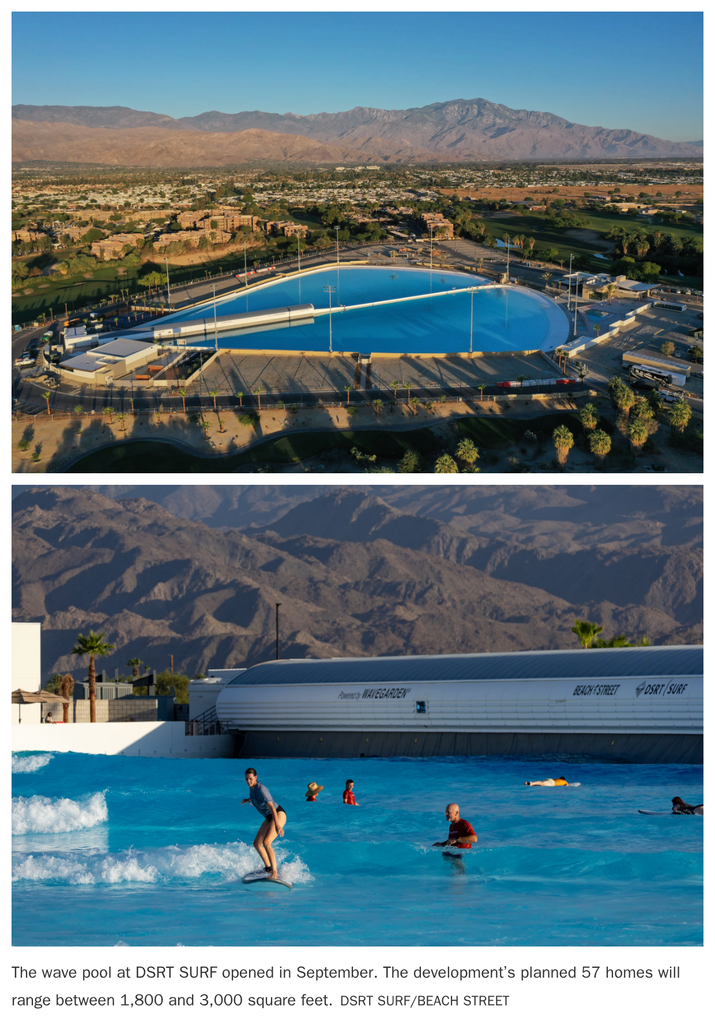
“Getting these things funded has been difficult,” said Doug Sheres, co-founder of Beach Street Development, which is opening a residential surf resort called DSRT SURF in Palm Desert, Calif. The project was supposed to open in 2021 but was delayed by Covid, he said. The company is waiting until later this year, once its lagoon is up and running, to set prices and start sales, according to Sheres.
Construction is currently halted at Austin Surf Club, a Del Valle, Texas, development managed by Discovery Land Company that was slated to open in 2027. The development is installing a wave machine designed by Kelly Slater Wave, and actor Matthew McConaughey, skateboarder Tony Hawk and ex-NFL quarterback Drew Brees are all members there. But the project has faced liens due to unpaid construction bills, according to records filed with Travis County, Texas. Discovery Land Company declined to comment.