 Μake us preferred on Google
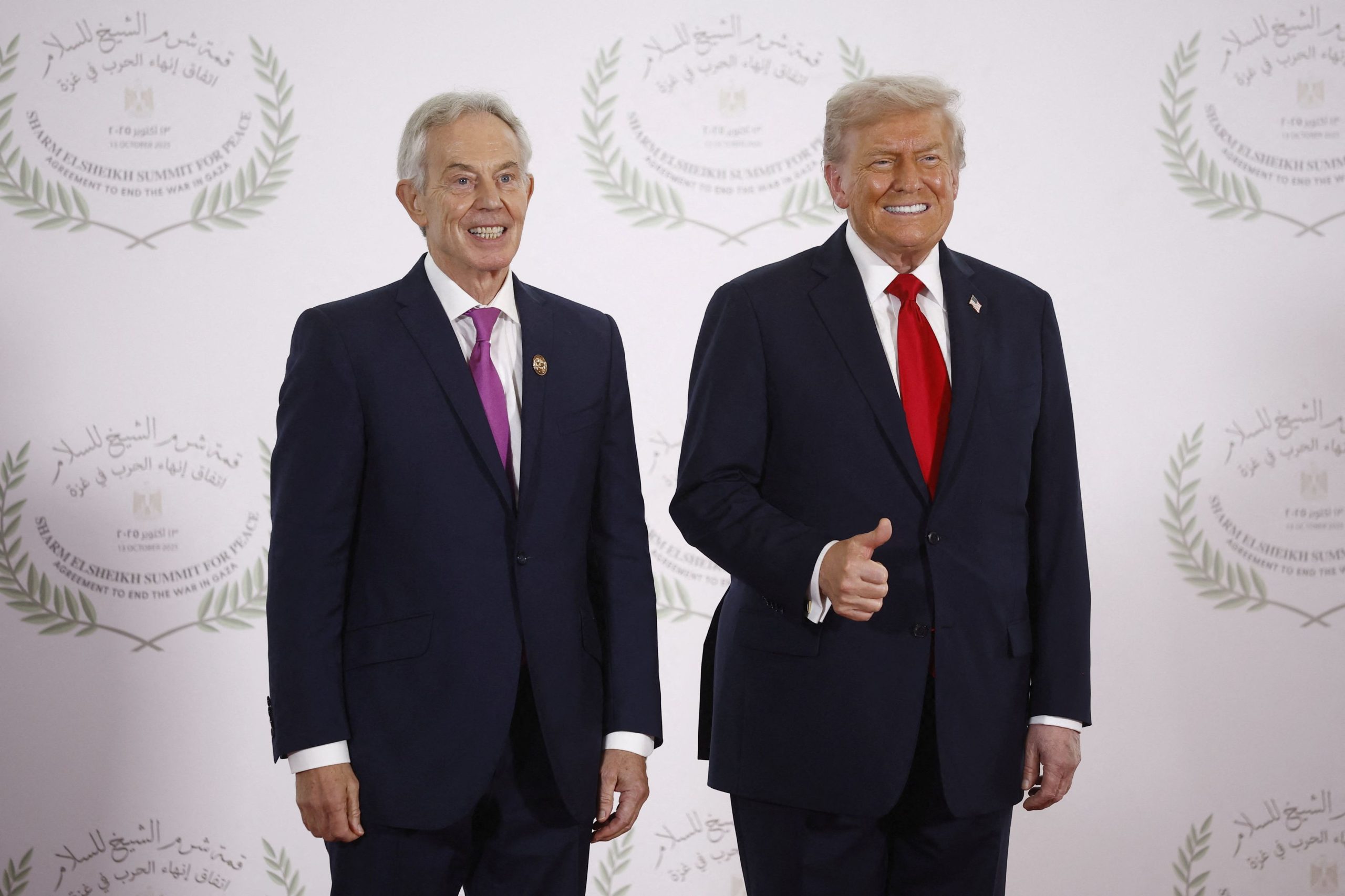
 The former Prime Minister of the United Kingdom, Tony Blair, was among the first names to emerge in connection with a leading role in the post-war governance of the Gaza Strip, under President Trump’s peace plan.
Responding to President Trump’s announcement, Mr Blair described the proposal as:
“President Trump has put down a bold and intelligent plan which, if agreed, can end the war, bring immediate relief to Gaza, the chance of a brighter and better future for its people, whilst ensuring Israel’s absolute and enduring security and the release of all hostages.
“It offers us the best chance of ending two years of war, misery and suffering and I thank President Trump for his leadership, determination and commitment.
“In particular, his willingness to chair the Board of Peace to oversee the new Gaza is a huge signal of support and confidence in the future of Gaza, of the possibility of Israelis and Palestinians finding a path to peace and of the potential for a broader regional and global alliance to counter the forces of extremism and promote peace and prosperity between nations.”
Since that statement, the decision to associate Mr Blair with the initiative has generated significant controversy and criticism.
Sources close to the former prime minister have clarified that, while Mr Blair has been closely involved in shaping the plan and is expected to continue supporting it, claims that he or any other international figure would act as a “governor” of Gaza are inaccurate.
According to these sources, President Trump’s 20-point framework specifies that day-to-day governance of Gaza would be undertaken by Palestinians, under the oversight of an international transitional body – the Board of Peace – chaired by the US president.
With debate continuing over his potential role, TO VIMA spoke to leading British experts to assess their views on Tony Blair’s involvement in Gaza’s prospective governance.
Adam Shockat, Independent MP for Leicester South, spoke exclusively to TO VIMA about the fragile ceasefire in Gaza and the controversial role of Tony Blair in the region.
When asked whether Tony Blair plays a significant role in ensuring stability in Gaza, Shockat was unequivocal. “I personally think he should be nowhere near the peace process and the peace deal and the negotiations for a long-term peace in the region.
“Who is Tony Blair? Tony Blair was responsible, if we look at the Chilcot Enquiry, which wasn’t many years ago, who described that Tony Blair exaggerated the threat of Saddam Hussein and led this country into war. Tony Blair then didn’t take seriously and ignored warnings that there was no long-term plan post invasion, which has consequentially resulted in death and destruction in the region.
“There is no trust of Tony Blair, not just in Gaza, but in the whole region. You know, if we look at a study conducted by Brown University in America, that showed that the death caused by the so-called war on terror was not hundreds or thousands or hundreds of thousands, it actually equates to 4.5 million people due to offshoots of instability in that region, ISIS, famine, disease, etc., etc. So an individual who stood by the United States, who didn’t take warnings seriously, exaggerated claims, and who said to America, I will be with you whatever, is renowned in that region for death and destruction. And therefore, as I have said previously, he should be in the Hague, nowhere near any future settlements between the Israelis and Palestinians.”
“Let’s look at his history as a peace envoy in the region, as the head of the Quartet. You know, he has constantly prioritised economic stability in the region, economic improvement in the region, which is very important. I agree, economy can maintain sustained peace.
“However, prioritising that, overriding any identity, culture, and historic responsibility in that region is absolutely putting the cart before the horse. And you know, in his time, his track record speaks for itself, where he rejected so many opportunities to recognise the state of Palestine when he was the envoy. And when the Palestinians came to him, when they were saying their homes were being destroyed, he rejected their claim, saying that I have a political mandate.
“And then when he had to exercise his political mandate in the United Nations, he wouldn’t recognise the state of Palestine. So his track record speaks really, really sharply why he shouldn’t be. His CV tells us why he shouldn’t be in this position.
“And his simplistic worldview, you know, during the war on terror, he painted everything black and white, good and bad. And he emphasised that the war was done on the politics of fear, that Islamist extremism is the overriding enemy of the world. Yet he was then happy to host Gaddafi. And, you know, he fraternises with oil-rich Gulf nations quite happily. So let me just repeat what the Palestinians’ officials said of him, not myself, what Palestinian officials said of him back in 2012. They used one word three times about his progress in that region to bring peace in 2012: Useless, useless, useless.”
Glen O’Hara, Professor of Modern and Contemporary History, Oxford Brookes University and author of the new book on Tony Blair “New Labour, New Britain?” told TO VIMA: “Blair would bring a huge amount of experience and a huge number of contacts to the job. There’s no doubt he’d be more than useful on the practical and diplomatic side.
“The problem will be with gaining political acceptance for such a role across many parts of the Middle East.”
While O’Hara emphasised Blair’s experience and diplomatic network, other analysts warned that his past record in the region could undermine confidence in the initiative.
Richard Caplan, Professor of International Relations at Oxford University told TO VIMA: “Tony Blair has the respect of Donald Trump, which can be an asset. However, his support while UK prime minister for the US-led invasion of Iraq in 2003, and his ineffectual role subsequently as Middle East envoy of the Quartet (US, EU, Russia and the UN), will be a liability.
“The Trump plan has many virtues. The chief problem is that the plan is underspecified. For instance, which forces will populate the proposed ‘International Stabilization Force’ and how will they impose order in Gaza? Will they be expected to use force to confront spoilers? What role will there be for the Palestinian Authority (PA) in these arrangements? How will any violations of the ceasefire be dealt with? Is Palestinian statehood a genuine goal or an elusive aspiration? The devil is in the details.”
Others took a more nuanced view, suggesting that despite his controversial legacy, Blair’s experience in conflict resolution could still prove valuable.
John Strawson, Professor at the Department of Law, Policing and Justice at the University of East London said: “Tony Blair has been a controversial figure in Britain following the Iraq war 2003, but unfortunately the Middle East has seen more wars since them and some even worse outcomes since then. It needs to be remembered that he does have a track recording heling to end conflicts – Northern Ireland, the Sierra Leone civil war and Kosovo. He also knows the Middle East well from his time as the Quartet envoy.
“Tony Blair and his Institute undoubtedly did a lot of background work on Trump’s 20-point plan. He was clearly working very closely with Steve Witkoff and Jerad Kushner on the final details. He also has the advantage of knowing some the key Middle East leaders, especially Benjamin Netanyahu and Mahmoud Abbas, both of whom are central if the plan is to work.
“His particular role will be in setting up the governing authority in Gaza and his ten years a Prime Minister means that he does have some governmental know how to offer. This peace process which is at an early and fragile stage has had unconventional origins but perhaps that is what we needed to break the logjam that has held up earlier efforts. Donald Trump and Tony Blair may be an odd couple but these are unprecedented times and maybe just maybe they will help craft a better future for the Middle East.”
However, not all experts share that cautious optimism. Some have raised serious concerns about the structure of the plan itself and the potential concentration of power among international elites.
Speaking to TO VIMA, Neve Gordon, Professor of Humanitarian Law at Queen Mary University of London, said: “I think what Tony Blair has introduced here and what also Trump found attractive is to change the model that exists in many countries where there’s a kind of a public governance with private capital investment and the public governance regulates and is actually responsible for development.
“That’s the existing model and what Tony Blair has offered is actually a model where private capital has the authority and it uses the public realm.
“To develop, so what we have here is a group of people that come from the business world and they will be in charge of the so-called Palestinian technocrats who will do the day-to-day running of the show, but the private realm is what will be at the centre and calling the shots, making the decisions, the overall decisions.
“And I think that is a very frightening model and a way of kind of privatising and commodifying the Gaza Strip for the benefits of I don’t know who, but not the Palestinian people.
“It’s a kind of imperial colonial model where the people who are the stakeholders are not involved in any way in the decision making of the game, of the rules of the game, of what will happen to Gaza.
“So Tony Blair came to Trump, Tony and Jared Kushner came to Trump with a kind of imperial model where we will not include the Palestinians in shaping what the model will be and actually it will be a group of billionaires or millionaires and billionaires that will appoint some Palestinian technocrats and tell them what to do.
“This is imperialism. That’s how the British Empire controlled its colonies for millennia or for centuries. So yes, I think it’s an extremely problematic model and I think that from history we know when the stakeholders are not participants in the decision-making process then it usually fails and Tony Blair has a very bad history in the Middle East.
“He lied about the Iraq war in order to to involve the UK military in it. He was a prime minister that on his watch the UK got involved in five different military campaigns, the most of any prime minister and
“I don’t think he’s a welcome figure among the masses in the Middle East but only among the political elites and financial elites and this was the kind of tone that is coming out of Gaza Strip right now. You’re not welcome here, you’re not wanted, who are you to plan our future for us?”
Gordon appeared unconvinced that the proposed peace deal could deliver genuine stability in the region.
“Well, first, my objective is not only stability but also justice, and it’s clear to me that there’s nothing just about this peace deal,” she said. “I think the likelihood of it ensuring stability is also very small, given that the 20-point programme is highly ambiguous. It fails to set out clear targets or define specific obligations and duties on the Israeli side. According to the maps I’ve seen, it appears to leave between 30 and 50 per cent of the Gaza Strip under Israeli control. So, no – I’m not optimistic about it.”
His scepticism was echoed by Chris Doyle, Director of the Council for Arab-British Understanding, who argued that without a detailed and credible framework, the plan was unlikely to succeed.
Chris Doyle, Director of the Council for Arab-British Understanding, told TO VIMA: “If the plan is ineffective and doesn’t add up, then it doesn’t matter who’s in charge of it.
“So, at the moment, we need to see a process where these 20 points are fleshed out and revised massively if they are really going to bring about a meaningful change in Gaza.
“The initial stages were the easy part, the ceasefire, the release of hostages and detainees, and the entry of aid. But we see massive gap between all the parties to this on what comes next, including reconstruction, including governance, including the disarmament of Hamas.
“So, without a much more detailed and viable plan, it doesn’t matter if it’s Tony Blair or Jesus Christ running this. It’s not going to work.”
Doyle then elaborated on whether he had anticipated Tony Blair being put forward for such a prominent role, and whether he considered the criticism surrounding this proposal to be justified, explaining why he believed that criticism was warranted.
“I think the criticism about the proposals are fully justified in that there is, firstly, a lack of Palestinian agency in this. It should be Palestinians who are determining who should be running Gaza. It should be Palestinians who should be determining how reconstruction takes place. What are the priorities? Who carries it out? Who gets the contracts? Who doesn’t get the contracts? They should be the ones shaping what should be a key part of a Palestinian state. None of that are in these 20 points. And the idea that you have a Board of Peace overseeing this, full of international figures, is very neo-colonial, as if Palestinians are children who are unfit to rule themselves. So, that approach will fail.
“Now, in terms of Tony Blair, it was a surprise, in some ways, to see Tony Blair reincarnated in any role dealing with the Middle East, let alone Gaza. This is a man who is much reviled in the region because of his failure over Iraq in 2003, both in prosecuting that war, but also the disaster of the Anglo-American occupation afterwards. Iraq and Iraqis still hold him responsible for what has happened to their country. But also, his role as the Middle East Quartet Envoy in eight years was one that yielded hardly any positive results, any meaningful change to the situation. He touts things like mobile phone networks, but that is simply not good enough in eight years. And over the last two years, it has been noticeable he has offered no criticism of Israeli conduct, hardly at all.
“And for Palestinians to accept somebody who is essentially going to be the viceroy for Gaza, the overlord of Gaza, I mean, they would have to believe that that person is pushing for their interests, is fighting for their rights, their freedom. But there is absolutely no way they will have any confidence that that would be the case with Tony Blair. His history indicates entirely the opposite. And with all these reconstruction contracts being up for grabs, with the reconstruction costing an estimated $60 million, Palestinians will fear that it will be the mates of Tony Blair and Jared Kushner and Steve Witkoff who will be hoovering up all these extremely valuable contracts and delivering on projects that Palestinians may not particularly wish to see, that they may not consider to be the priorities. So there are massive issues with Tony Blair having this role, as indeed there are with Donald Trump.
“I think that, in fairness to Trump, he has demonstrated he’s quite flexible and willing to redraft elements of this plan. Now, that may not apply to the Israeli Prime Minister Netanyahu, but Trump certainly has shown a degree of flexibility. And he’s going to need to do that because, as I said, you have to revise it. Really, in terms of an international role, it should be through the United Nations, with a UN Security Council giving a mandate, for example, to a stabilisation force. And it would be those experts within the UN system who have done similar transitions before in other post-conflict environments.
“They’re the ones who have the expertise, who can advise, assist and ensure that a proper reconstruction and rehabilitation of Gaza happens. This is not something for world leaders or former world leaders to sit around some cigar-filled room and pontificate on.
“This is going to be hard work, 24 hours, 7 days a week, for those who have had a lot of this experience, who know what the challenges are and what the options are. And I’m afraid that does not include Donald Trump or Tony Blair. Their role is to try to chivvy up and cajole other powers to contribute. But how Gaza should be run and how you rebuild it should be left to the experts and, above all, to Palestinians.”